


- LAS served 54.99 million passengers in 2025 (third-highest year on record, down 5.9% from 2024). For most B2B advertisers the value concentrates into 15–20 event weeks — CES, SEMA, Black Hat, Money20/20, AWS re:Invent, and F1 among them.
- LAS is an origin-and-destination airport. Unlike Atlanta or Dallas, almost everyone walking past the ad is actually going to Las Vegas. During your event week they are not a broad travel audience — they are your conference, arriving.
- The minimum campaign is one week. Two-week and four-week flights are also available. A single placement typically runs $10,000–$50,000 for the week. Digital domination takeovers (100% share of voice on a network) run north of $100,000. Most two- or three-network arrival-path campaigns land between $40,000 and $250,000. Those are planning ranges, not a posted rate card.
- Marquee weeks carry a material premium over standard-period rates. The most visible arrival-path units are typically committed 4–6 months out.
- For conference campaigns, arrival-path placements outperform departure-side inventory. Attendees are plan-forming on the way in and heads-down on the way out.
- Digital creative is typically due 14–18 business days before the flight. Contracts are non-cancellable once signed. One creative runs per contracted spot.
- Why is advertising at LAS different from any other airport?
- Who actually flies through LAS?
- Which Las Vegas events matter for airport advertising?
- What does Las Vegas airport advertising cost?
- What airport advertising formats are available at LAS — and what do they look like?
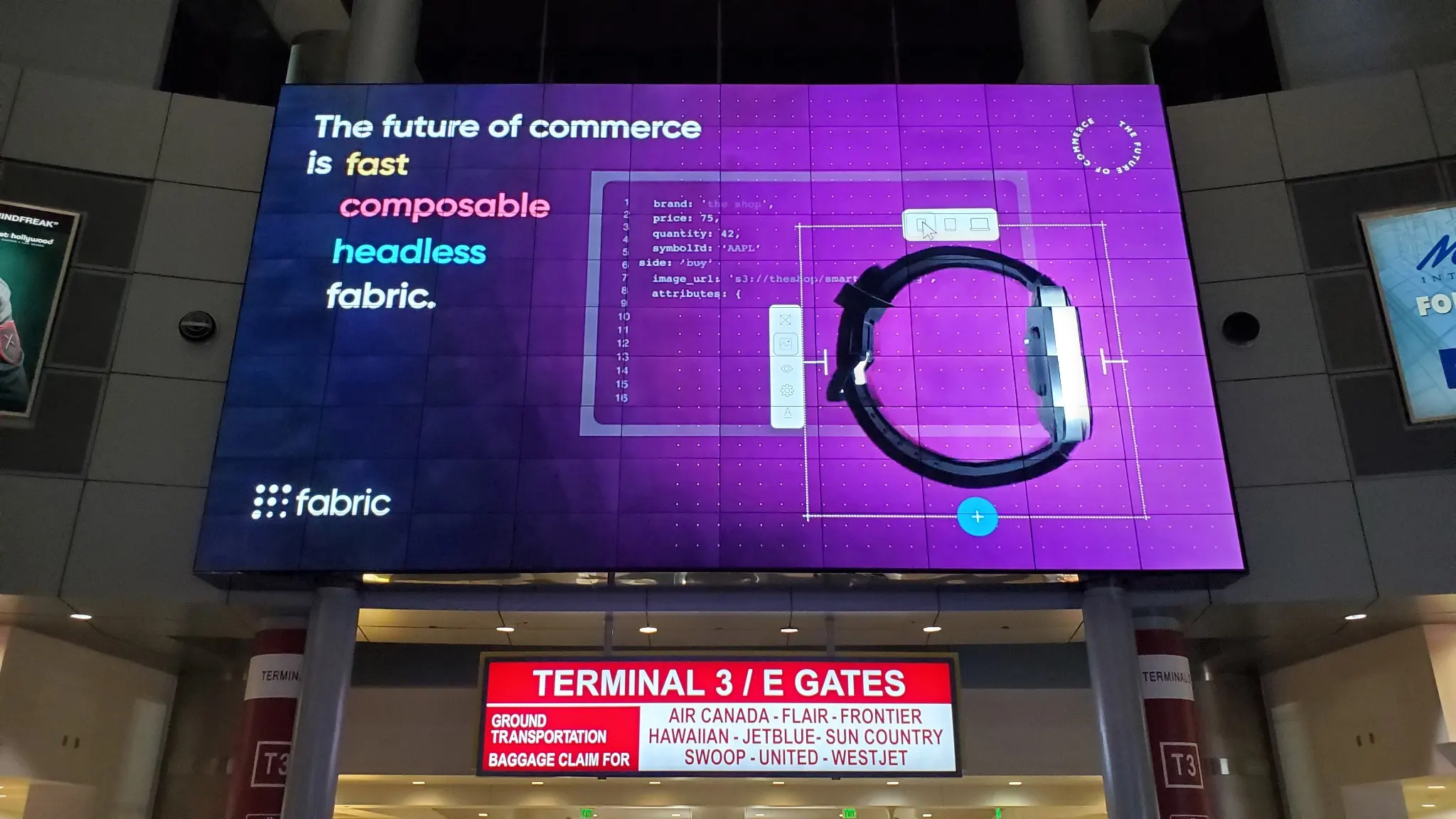
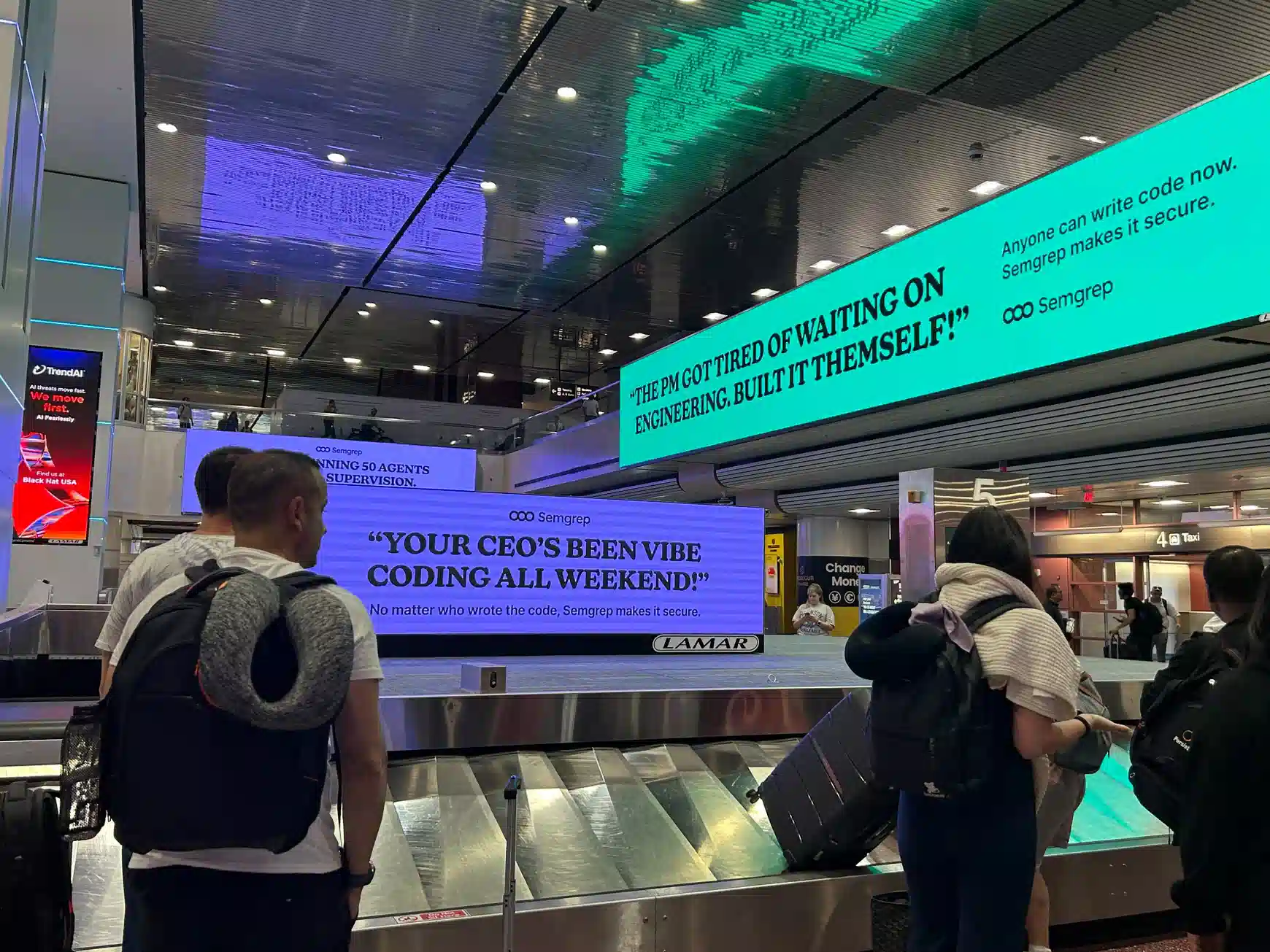
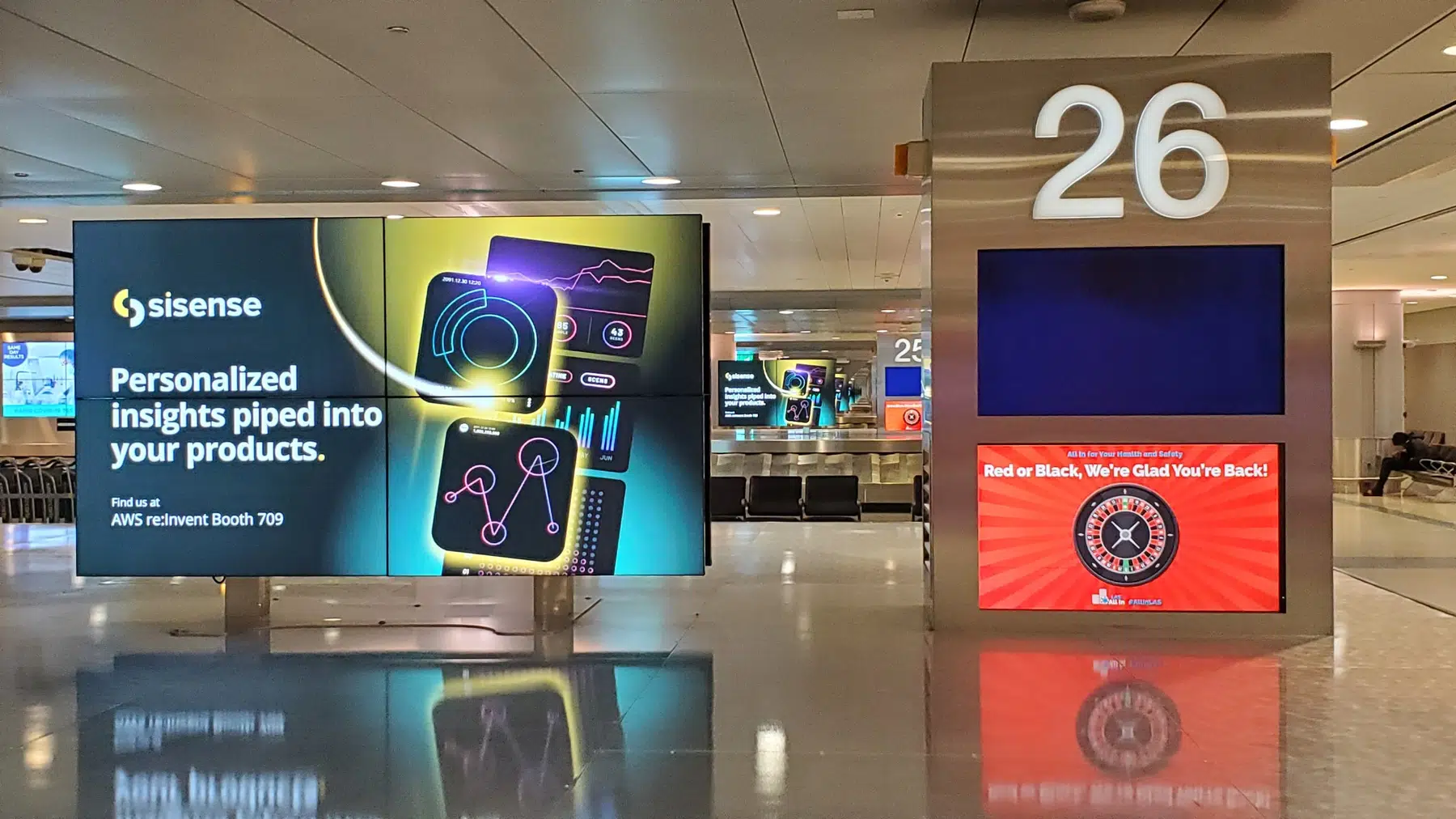
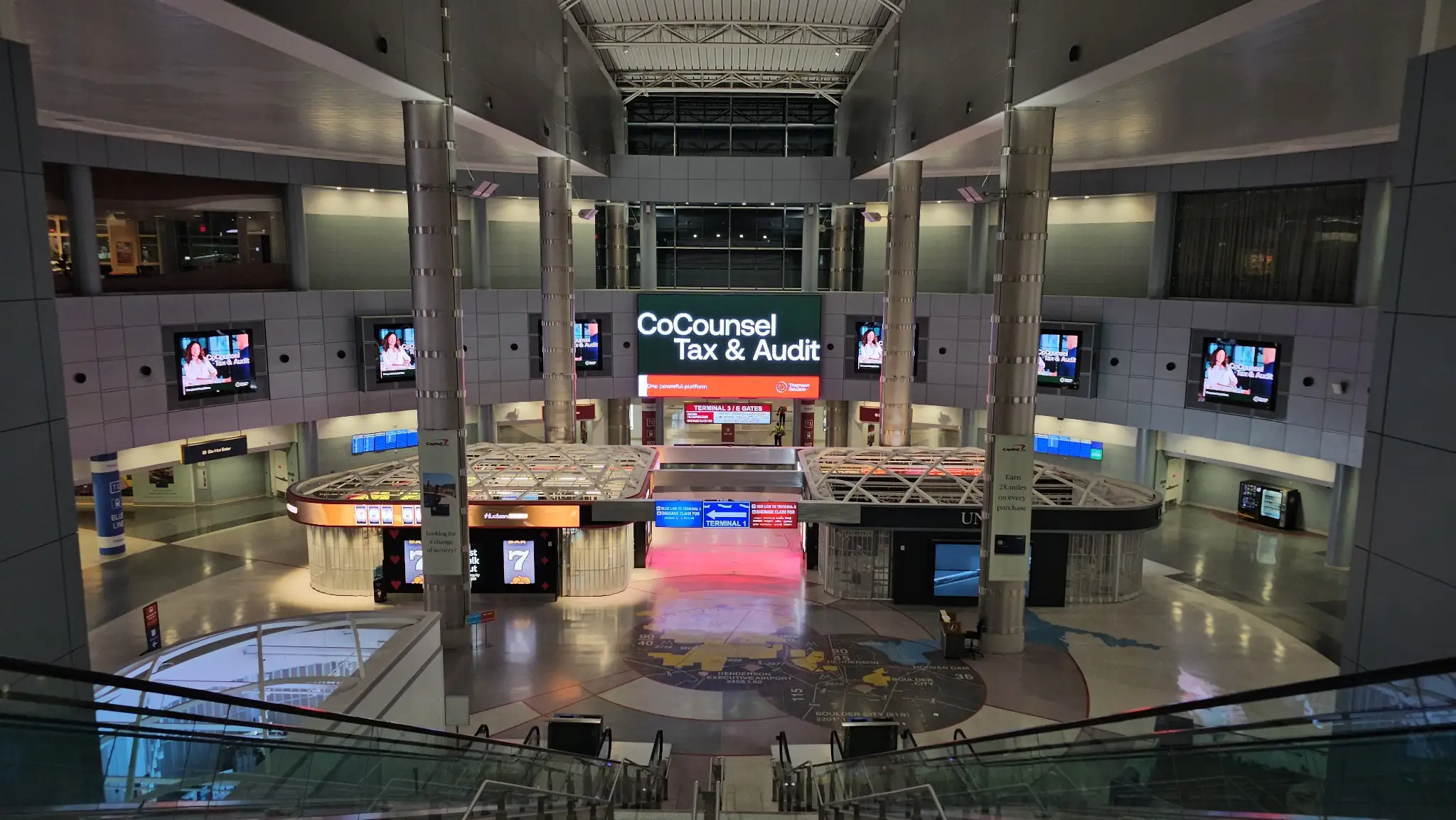
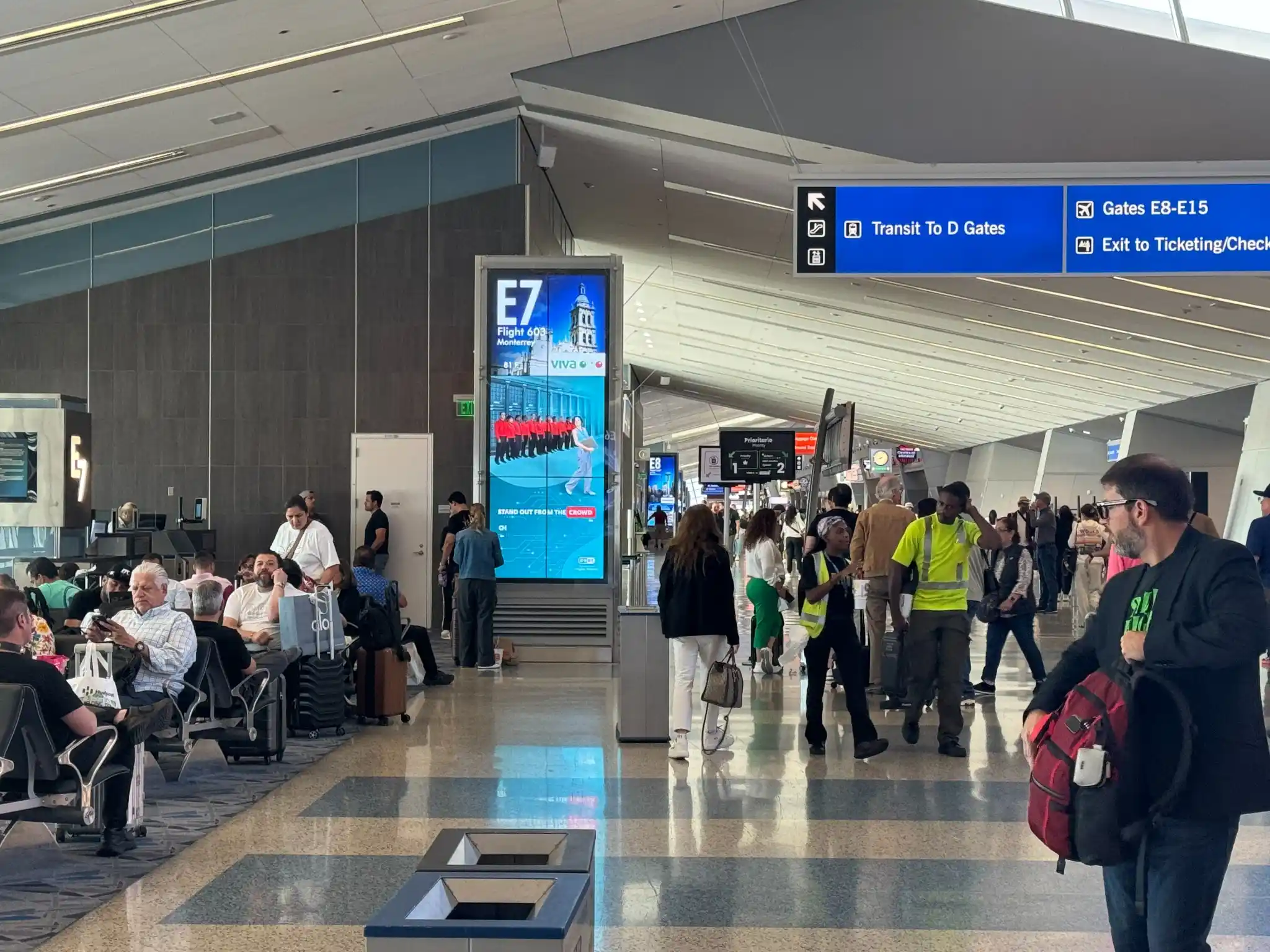
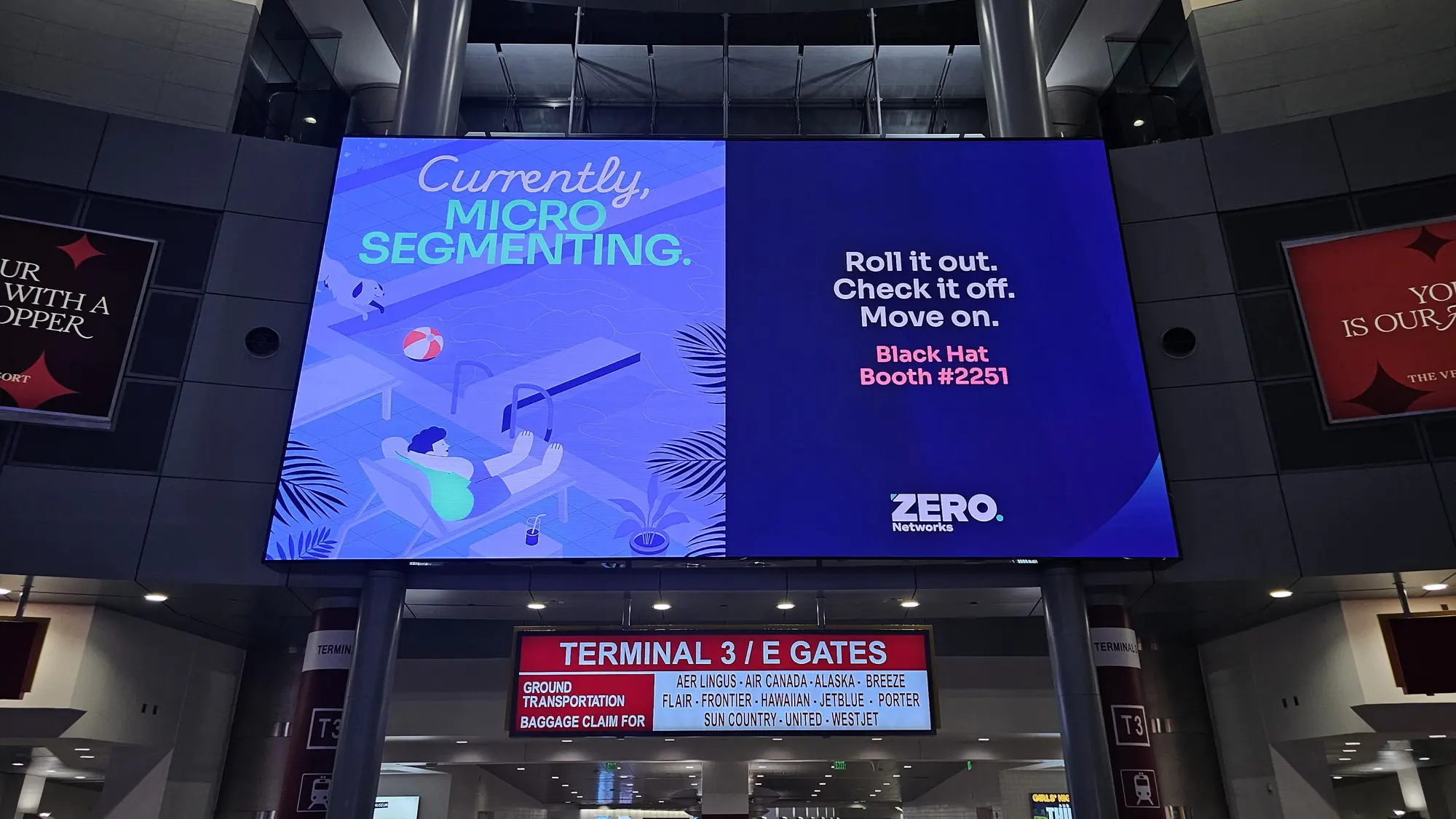
- What do real ads at LAS look like?
- Should you advertise at LAS or on the Las Vegas Strip?
- How far in advance do you need to book — and what do event weeks cost?
- Where should your ads run inside LAS?
- What has EAM run beyond Las Vegas?
- How do you measure an LAS event-week campaign?
- How does EAM run an LAS event campaign?
- Frequently asked questions
- Related reading
Why is advertising at LAS different from any other airport?
LAS is a calendar channel. You are not buying airport travelers or a connecting crowd. You are buying a specific industry’s arrival moment, in the one building they all pass through.
First, a naming note for anyone who last bought this market a few years ago: Harry Reid International is the former McCarran International Airport, renamed in 2021. Same airport, same LAS code, same inventory — only the name on the building changed.
Las Vegas hosts roughly six million convention and trade-show attendees a year, which means the composition of LAS foot traffic changes completely from one week to the next. During CES week, LAS arrivals are the tech industry. During SEMA, they’re the automotive aftermarket. During Money20/20, they’re fintech decision-makers.
Almost everyone walking those concourses is starting or ending the trip in Las Vegas. You are not buying a connecting crowd that will never enter the city.
That is why LAS is a media channel you can target by calendar. You’re not buying “airport travelers” — you’re buying a specific industry’s arrival moment, at the one point in their trip when every single one of them funnels through the same building.
This is why most of the LAS campaigns EAM handles are event-anchored. A brand exhibiting at AWS re:Invent, sponsoring at Black Hat, or hosting customers during F1 week uses LAS to reach its exact audience hours before the event starts — while plans for the week are still forming.
Who actually flies through LAS?
54.99 million passengers in 2025, almost all beginning or ending in Las Vegas. Southwest is the largest carrier. Terminal 1 vs. Terminal 3 follows the airline, and the useful audience is the 100,000–150,000 people arriving during your industry week — not the annual total.
LAS served 54.99 million passengers in 2025 (54,988,547 in the Clark County year-end release) across more than 30 airlines, connecting to over 170 direct markets. That was the third-highest year on record and 5.9% below 2024’s record. Because it is an origin-and-destination airport, that traffic is people actually coming to Las Vegas rather than changing planes. Southwest carried about 21.8 million of those passengers. Which carriers your audience flies decides where they arrive: Southwest, Delta, American, Spirit, Allegiant, and Contour passengers come through Terminal 1; United, JetBlue, Alaska, Frontier, Hawaiian, Sun Country, and all international arrivals through Terminal 3 — as of 2026 planning. Confirm against the current LAS map. That is why the placement plan starts with the airline mix.
What matters for advertisers isn't the average — it's the composition by week. During the roughly 15–20 major event weeks each year, business travelers and industry attendees dominate arrivals. A B2B brand doesn't need LAS's 55 million passengers; it needs the 100,000–150,000 arriving during its industry's week. That's a level of audience precision outdoor almost never offers, and it's why most B2B campaigns EAM runs at LAS are tied to an event week rather than an always-on flight.

Business decision makers and conference arrivals
CES, Black Hat, Money20/20, AWS re:Invent. The people who decide what gets bought fly in for these weeks with meetings booked, booths to visit, and sponsors to see. The airport reaches them on the way in, before any of that starts, when the week is still open. Digital loops on the arrival path beat a departure-side buy.
Terminal follows the airline as of 2026 planning: Southwest, Delta, American, Spirit, Allegiant, and Contour through T1; United, JetBlue, Alaska, Frontier, Hawaiian, Sun Country, and international through T3. Confirm against the current map.
Affluent and premium traffic
F1 week in November, the international arrivals in Terminal 3, and the passengers inside the club lounges. This audience is smaller than the conference crowd and worth more per head: international visitors flying in for the race, business-class travelers on the long-haul routes, and the executives who use the Terminal 3 lounges every week.
F1 week is also a B2B week. The race brings team partners and sponsors, many of them enterprise technology, cloud, cybersecurity, and financial brands, along with the executives and clients they host in hospitality suites and at the Paddock Club; partner summits and client dinners cluster around it. Luxury, automotive, hospitality, and private-banking brands compete for the same loops, so the week is short, contested, and priced at a premium. A brand that wants this audience plans for F1 week specifically, weights Terminal 3 arrivals and the lounge inventory, and expects to pay for the position.
Which Las Vegas events matter for airport advertising?
For B2B, the marquee conventions: CES, NAB, Black Hat, Money20/20, SEMA, AWS re:Invent, and F1 week, when sponsors host clients and partners. For hospitality and luxury, F1 week and the leisure weekends. Everything else at LAS is bought for the always-on audience, not the calendar.
The table below covers the marquee weeks that drive the most airport advertising demand at LAS, with what each one means for the media buy.
| Event | Timing | What It Means for the Buy |
|---|---|---|
| CES | Jan 6–9, 2027 | The most contested week of the year. Premium units committed by early fall; heaviest loop crowding on digital networks. |
| World of Concrete | Jan 19–21, 2027 | Construction and building products. Less contested than CES — strong value for industrial B2B brands. |
| NAB Show | Apr 4–7, 2027 | Broadcast, media, and entertainment tech. Mid-tier demand; an 8–12 week booking window is usually enough. |
| Google Cloud Next | Apr 13–15, 2027 | Google Cloud customers, partners, and practitioners at Mandalay Bay. Cloud-buyer week — book like a mid-tier tech show, 8–12 weeks out. |
| Dell Technologies World | May 24–27, 2027 | Dell customers and channel at The Venetian. Enterprise hardware and infrastructure buyers — less contested than CES or re:Invent. |
| JCK Las Vegas | Jun 2–7, 2027 | Jewelry and luxury trade. High-value buyer audience with almost no competing airport advertisers — one of the least contested premium weeks on the LAS calendar. |
| Black Hat USA | Jul 31–Aug 5, 2027 | The cybersecurity industry's annual Vegas migration. Dense security-buyer audience. Immediately before DEF CON. |
| DEF CON | Aug 5–8, 2027 | Follows Black Hat. Same industry in the building across two adjacent weeks — not one combined buy. |
| NetApp INSIGHT | Sept 29–Oct 1, 2026 | Data-infrastructure and hybrid-cloud practitioners at MGM Grand. Concentrated IT-buyer week; 8–12 weeks is usually enough. |
| Money20/20 | Oct 19–21, 2027 | Fintech and payments executives. Density beats size — this week is bought for who is in the building, not how many. |
| SEMA Show | Nov 3–6, 2026 | Automotive aftermarket. Second-most contested week after CES for arrival-path inventory. |
| F1 Las Vegas Grand Prix | Nov 19–21, 2026 | Team partners and sponsors, many of them enterprise technology, cloud, and financial brands, host executives and clients all week; luxury, hospitality, automotive, and consumer brands compete for the same loops. Premium pricing on exterior and arrival formats. |
| AWS re:Invent | Nov 29–Dec 3, 2027 (tentative) | Cloud and enterprise software buyers. Follows F1 closely — November inventory at LAS is effectively one long premium season. |
Attendance numbers do not equal audience value. Money20/20 draws a fraction of CES’s crowd, but that crowd is almost entirely payments and fintech — for a payments brand, that week can deliver more qualified impressions per dollar than CES. The right question is not “which event is biggest.” It is “which week is my exact buyer walking through bag claim.”
What does Las Vegas airport advertising cost?
One-week minimum. Two-week and four-week flights are also available. Typical single placement: $10,000–$50,000. Network domination: north of $100,000. Most conference packages (two or three arrival-path networks): $40,000–$250,000. Those are planning ranges, not a rate card.
The minimum campaign at LAS is one week. Two-week and four-week flights are also available. For a campaign built around a convention, one week is the natural unit. Expect $10,000 to $50,000 for a single placement, depending on the network, the specific units, frequency, and how close your dates fall to a major event. Digital domination takeovers, every screen on a network with no rotation and no competing brands, run north of $100,000 for the week.
Rather than a rate card, the table below shows how LAS inventory is actually structured: where each placement reaches people, how many screens it runs on, and what your spot looks like inside the loop. That last column is the one most buyers never see before they sign.
| Placement | Where It Reaches Them | Screens | Your Spot in the Loop | Best For |
|---|---|---|---|---|
| Concourse Digital Network | Post-security walkways and tram holding areas in T1 and T3 — the post-security concourse network covering domestic arrivals in T1 and T3 | 36 | :08 spot · 16-spot loop | Airport-wide reach on the walk to bag claim |
| Concourse D Rotunda | Synchronized takeover of every screen in the rotunda serving T3 / D-gate traffic, including a large share of premium cabins | 15 | :08 spot · 16-spot loop, synced across all 15 screens | Executive and business-class audiences |
| Baggage Carousel Screens | Above every carousel in T1 and T3, during a 20–30 minute wait for luggage | 46 | :15 spot · 24-spot loop | Longest dwell time on the arrival path |
| Bag Claim Spectaculars | 12 large overhead screens in T1 bag claim — rotates, then dominates all 12 at once every 6 minutes | 12 | :15 spot rotating, plus a full 12-screen domination every 6 minutes — posted over 50% of the time | Scale and domination moments in bag claim |
| Taxi and Rideshare Screens | Ground-transportation pickup zones in T1 and T3 — waits run up to 30 minutes at peak | 14 | :10 spot · 15-spot loop | The last impression before the Strip |
| Bag Claim Audio & Visual Screens | The only in-terminal network with sound — :30 spots across T1 and T3 bag claim | 22 | :30 spot with audio · 40-spot loop | Video creative that needs a soundtrack |
| T3 Arrivals Escalators and Exits | Domestic and international arrivals descending into T3 bag claim — multiple exposures per passenger | 14 | :04 spot · 10-spot loop | International and T3-heavy carriers |
| Bag Claim Full Sponsorship | 46 vertical digital walls across T1 and T3 bag claim — your brand on every wall, 100% of the time | 46 | Exclusive — every wall, 100% of the time | Takeover weeks and category-leader statements |
A few contract realities worth knowing before you plan: digital creative is typically due 14–18 business days before the flight starts (confirm the spec deadline on the contract — networks differ), contracts are non-cancellable once signed, and one creative runs per contracted spot — you cannot rotate multiple executions in a single slot. Static, wraps, and tray branding need more production and installation time regardless of flight length. Booking early matters as much for production timing as for availability.
One pricing nuance specific to LAS: standard-period rates track its passenger volume, but during its busiest weeks it prices like the most premium coastal hubs, because for those weeks it effectively is one. CES, SEMA, and F1 are the obvious ones. NAB, Black Hat, Money20/20, and AWS re:Invent carry a premium for the same reason, and so do the weeks that fill the airport without a convention: New Year's Eve, March Madness, EDC in May, the National Finals Rodeo in December, and any weekend with a major fight or a stadium event. The calendar is the pricing model.
A typical conference campaign at LAS — two or three networks along the arrival path, with share-of-voice protection during the event week — lands between $40,000 and $250,000 depending on format weight and whether a full sponsorship is in the mix.
What airport advertising formats are available at LAS — and what do they look like?
These are the units a typical event-week buy uses, with photos from LAS. Click a card for specs, lead time, and what to ask before you buy.
12 large overhead screens in Terminal 1 bag claim. One advertiser is posted on at least one screen more than half the loop, then all 12 dominate together for 15 seconds every 6 minutes.
Covers T1 arrivals only: Allegiant, American, Contour, Delta, Southwest, and Spirit. Static creative — no motion on this network.
- Units12 in T1 bag claim
- TypeStatic only
- Spot15 seconds
- Loop360 seconds (6 minutes)
- Share of voice195 of 360 seconds live — about 54% of the loop
- SizesSix 108″ × 768″, four 52″ × 94″, two 60″ × 360″
- AirlinesT1 domestic: WN, DL, AA, NK, G4, Contour
15 screens around the Concourse D rotunda, sold as a synced package. One large face plus 14 smaller faces. D is where most business-class LAS passengers come through.
Airlines on this network: Delta, American, United, JetBlue, Hawaiian, and Frontier.
- Units15 synced screens
- TypeFull motion
- Spot8 seconds
- Loop128 seconds / 16 spots
- Share of voice1 of 16 spots (6.25%)
- SizesOne 228″ × 396″; fourteen 96″ × 132″
- AirlinesDL, AA, UA, B6, HA, F9
14 screens on the T3 domestic and international escalators into bag claim, plus the bag-claim lobby exits. Same passenger can see the message more than once before they leave the building.
Built for T3 arrivals: United, Alaska, JetBlue, Frontier, Hawaiian, Sun Country, and the international carriers that use T3.
- Units14 in T3
- TypeFull motion
- Spot4 seconds
- Loop40 seconds / 10 spots
- Share of voice1 of 10 spots (10%)
- CoverageDomestic escalators and exits, international escalators and exits
- AirlinesUA, AS, B6, F9, HA, SY and T3 international
36 screens in the T1 and T3 concourses — the only digital network post-security that covers the walk to bag claim for every domestic arrival. International departing T3 / Concourse E also pass it.
Units sit in walkways and tram holding areas: 8 in T1, 28 in T3.
- Units36 (8 in T1, 28 in T3)
- TypeFull motion
- Spot8 seconds
- Loop128 seconds / 16 spots
- Share of voice1 of 16 spots (6.25%)
- ReachDomestic arrivals moving through the T1 and T3 concourses
- AirlinesWN, DL, AA, NK, G4, AS, F9, HA, B6, SY, UA and Contour
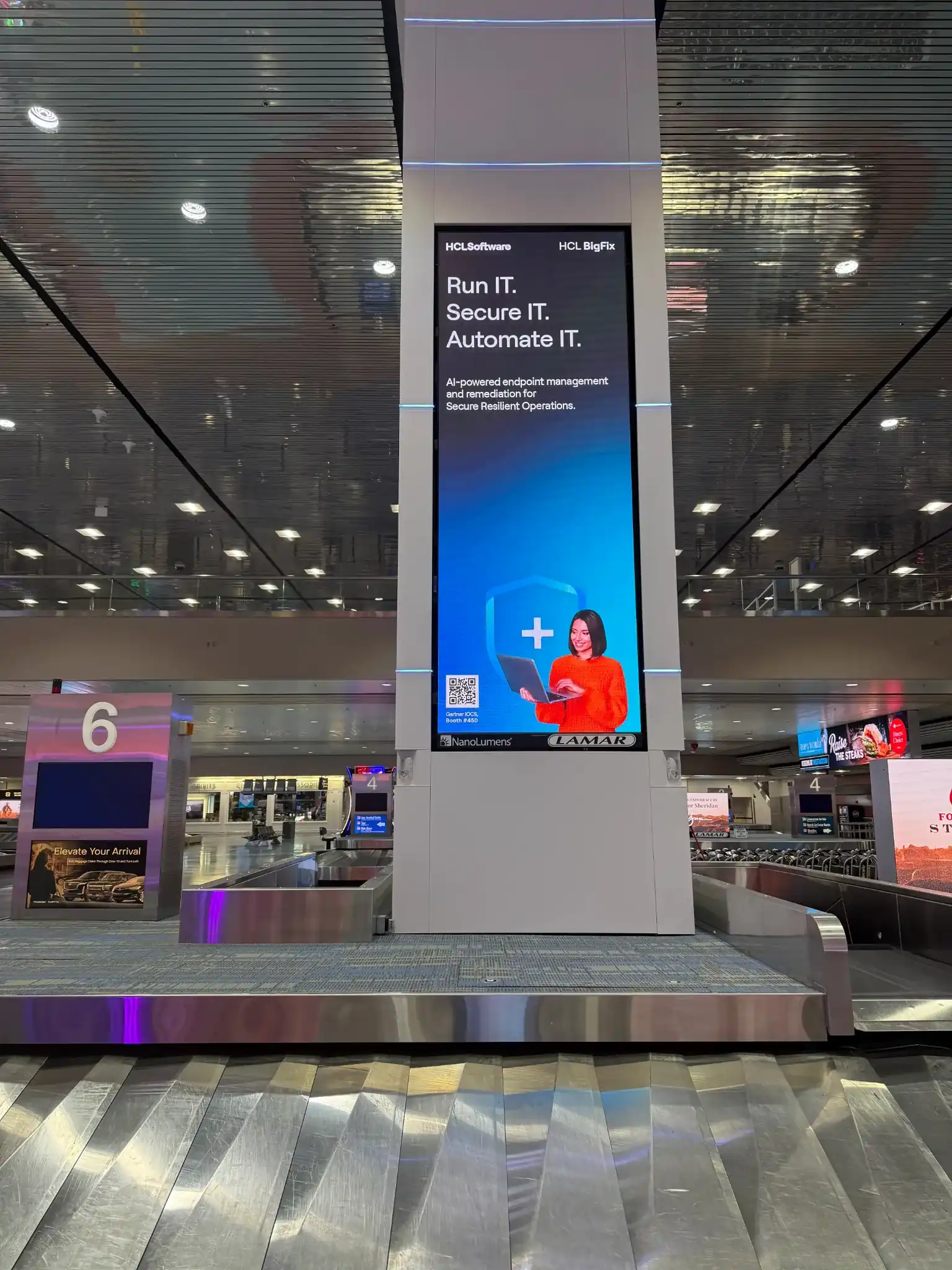
46 vertical digital walls in T1 and T3 bag claim, exclusive. Your creative is on every unit, 100% of the time — no loop, no other advertiser on this network.
Bag claim is the exit path even for passengers who did not check a bag. Dwell on a busy week is often 30–35 minutes.
- Units46 (26 in T1, 20 in T3)
- TypeStatic only
- Share of voice100% — exclusive
- LoopNone. You own the network for the week.
- SizesT1 tall 156″ × 60″ (18); T1 short 108″ × 60″ (8); T3 72″ × 42″ (20)
- AirlinesAll domestic arrivals through T1 and T3
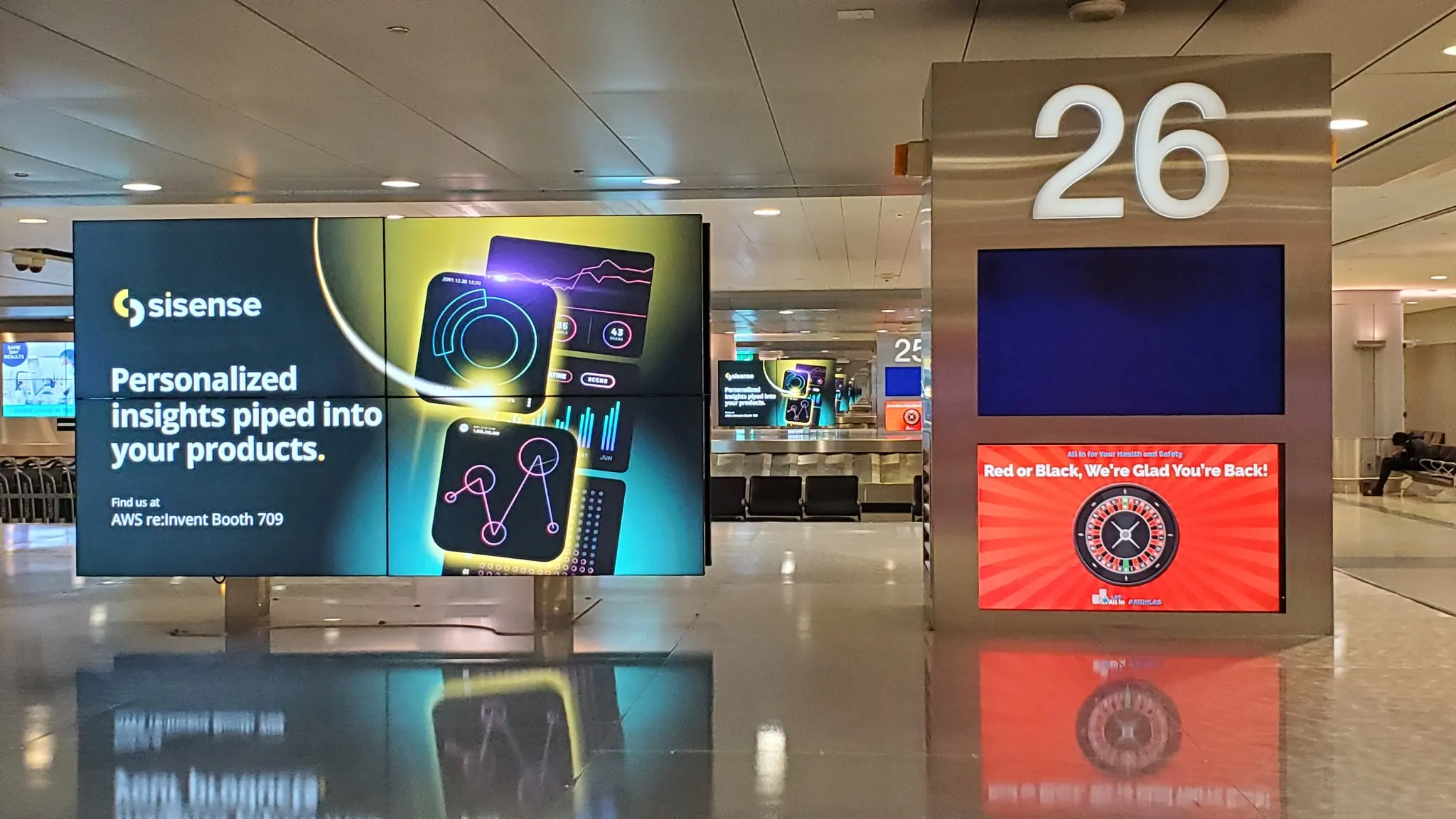
46 screens sitting on the carousels in T1 and T3 bag claim. Passengers wait 20–30 minutes here. People who did not check a bag still walk through this hall to ground transportation.
Static only. One of the most requested digital networks at LAS.
- Units46 (26 in T1, 20 in T3)
- TypeStatic only
- Spot15 seconds
- Loop360 seconds / 24 spots
- Share of voice1 of 24 spots (4.2%)
- SizesT1 42″ × 150″; T3 48″ × 72″
- AirlinesAll domestic arrivals through T1 and T3
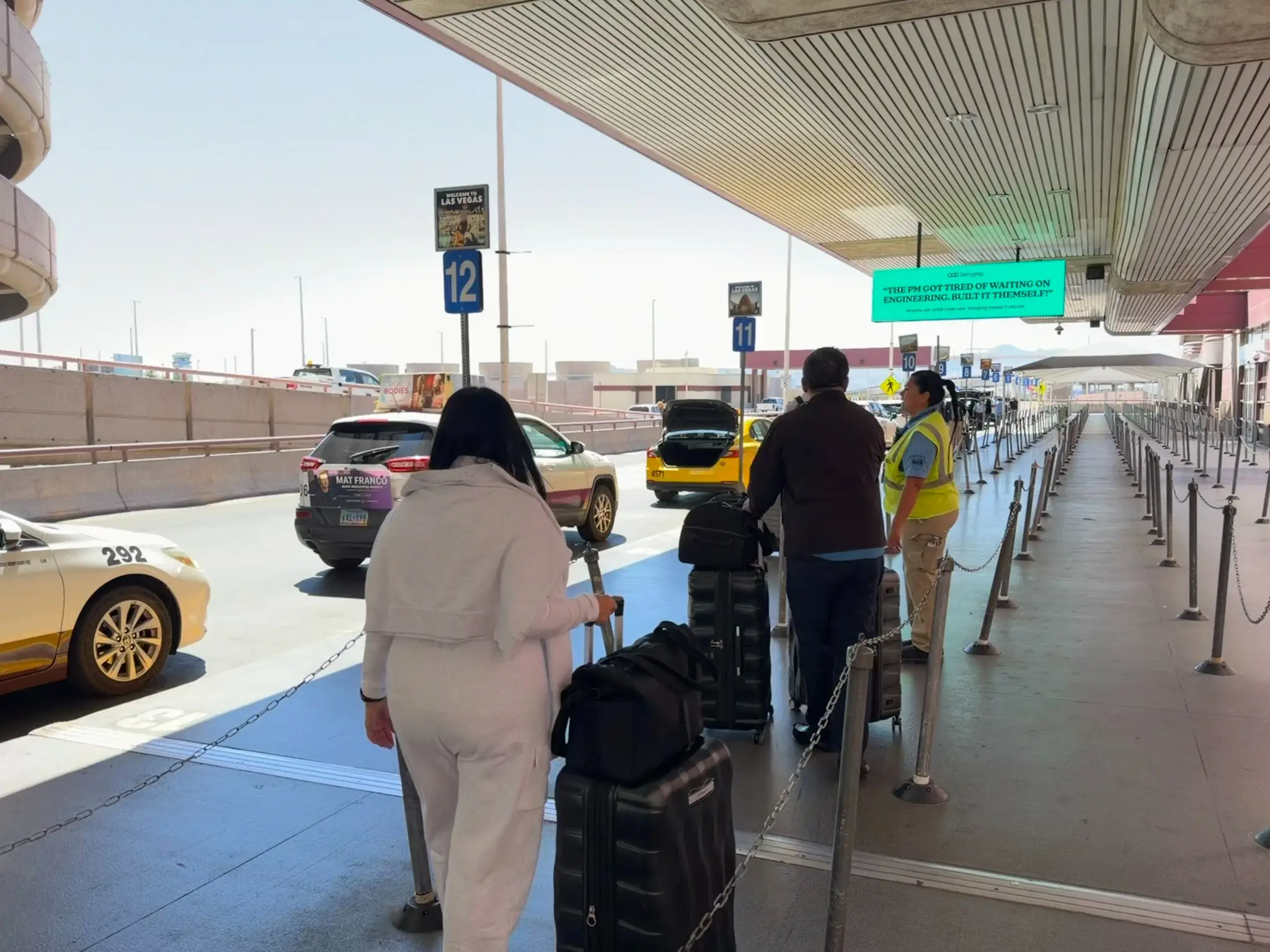
14 screens in the T1 and T3 taxi and rideshare halls. Wait times run long on event weeks — often 30 minutes when volume spikes.
Reaches every passenger leaving by taxi or rideshare, including international arrivals.
- Units14 (7 in T1, 7 in T3)
- TypeFull motion
- Spot10 seconds
- Loop150 seconds / 15 spots
- Share of voice1 of 15 spots (6.7%)
- SizesRideshare 25″ × 86″ (6); T1 taxi 39″ × 137″ (4); T3 taxi 20″ × 118″ (4)
- AirlinesAll T1 and T3 arrivals, including international
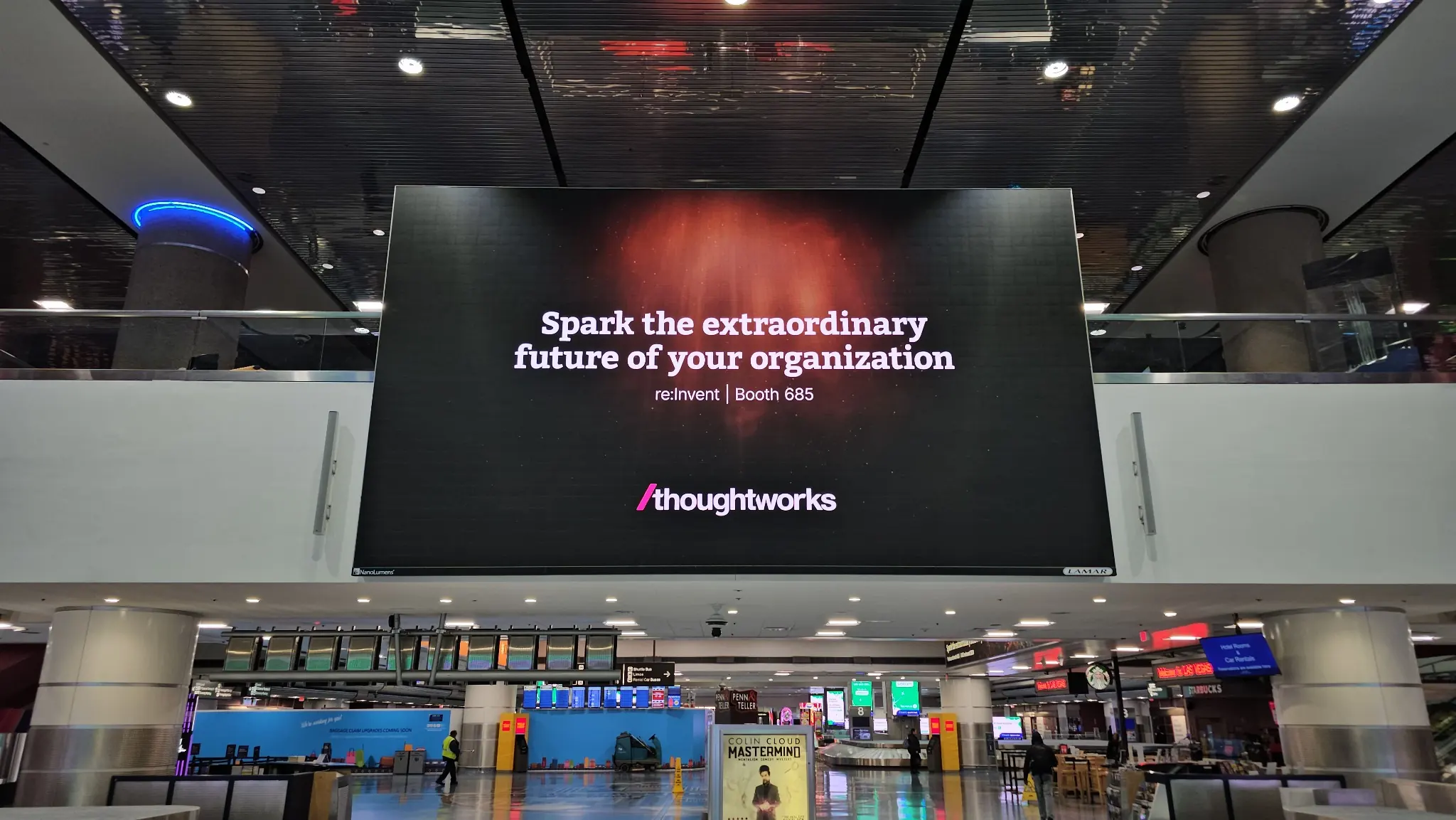
22 screens with sound in T1 and T3 bag claim: two large end units in T1 and 20 carousel units in T3. This is the only digital network inside LAS that runs audio.
Creative must include audio. A :30 in a 20-minute loop is a long spot and a long wait between plays.
- Units22 (2 in T1, 20 in T3)
- TypeFull motion + audio required
- Spot30 seconds
- Loop1,200 seconds / 40 spots
- Share of voice1 of 40 spots (2.5%)
- SizesT1 216″ × 384″ (2); T3 44″ × 79″ (20)
- AirlinesAll domestic arrivals through T1 and T3
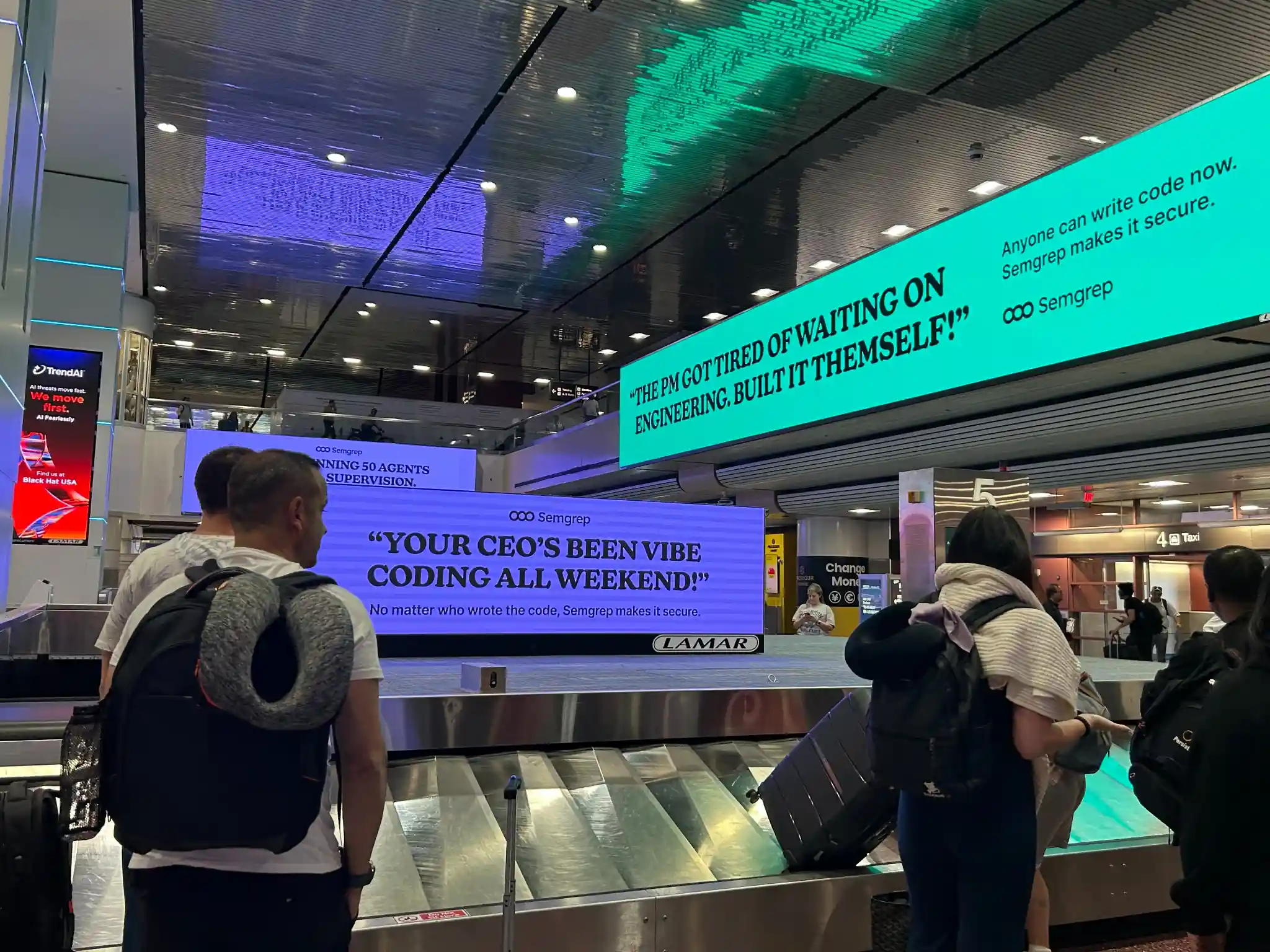
A coordinated buy across multiple bag-claim and curb screens in the same week — overheads, wall units, and carousel faces running one brand instead of a mixed loop.
This is the format that reads as “the airport is theirs” during CES, Black Hat, or F1 week. It is sold as a package, not as leftover spots on separate networks.
- TypeMulti-network digital package
- Best useEvent-week arrival path
- Artwork14–18 business days
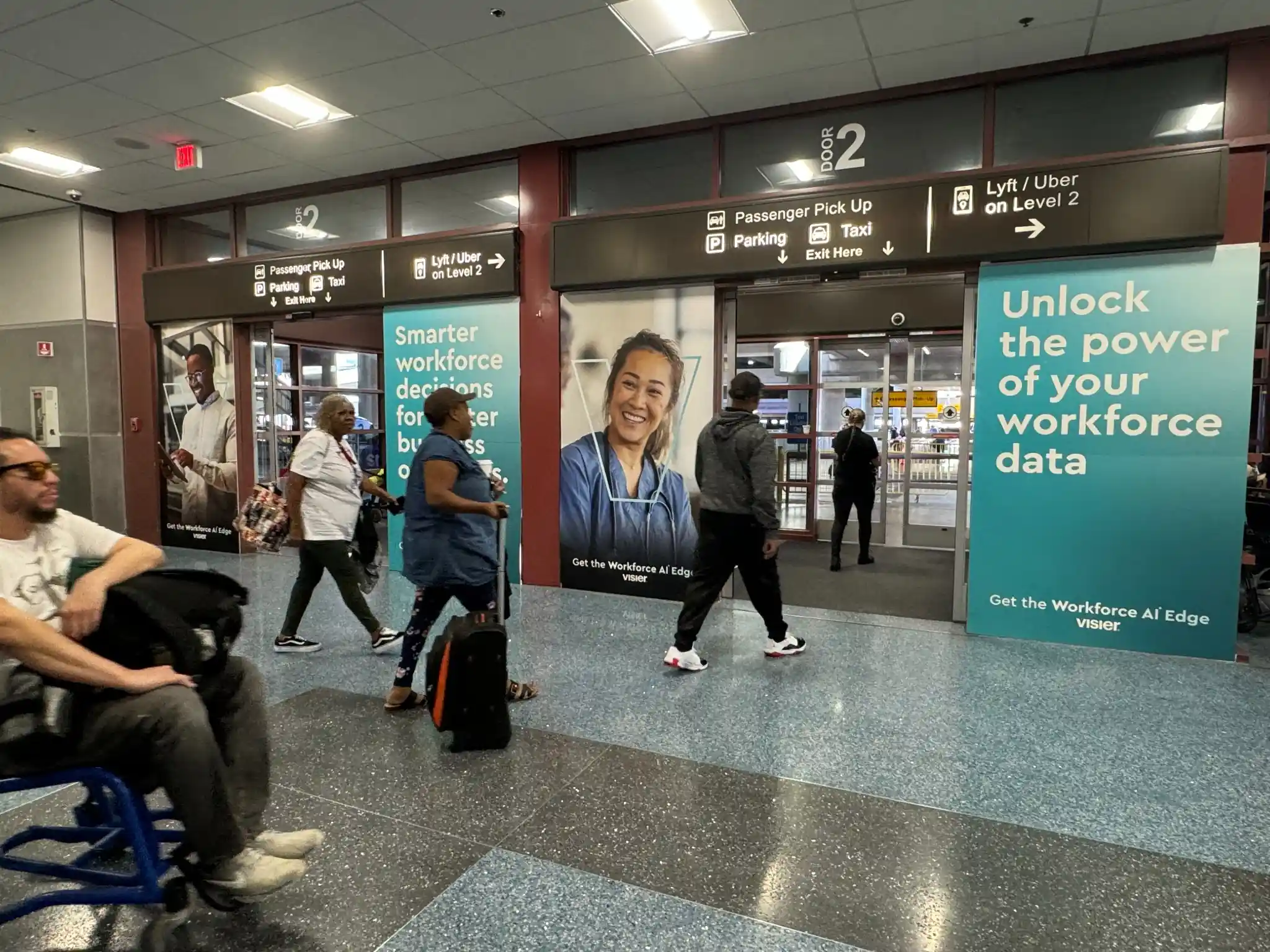
Door surrounds and adjacent panels at the passenger-pickup exits. Every arriving passenger who walks out to taxi, rideshare, or parking passes these faces.
Static production — printed panels, not a loop. One brand owns the doorway for the contracted week.
- TypePrinted exit wraps and panels
- LocationPassenger pickup / ground-transport exits
- Production14–21 business days
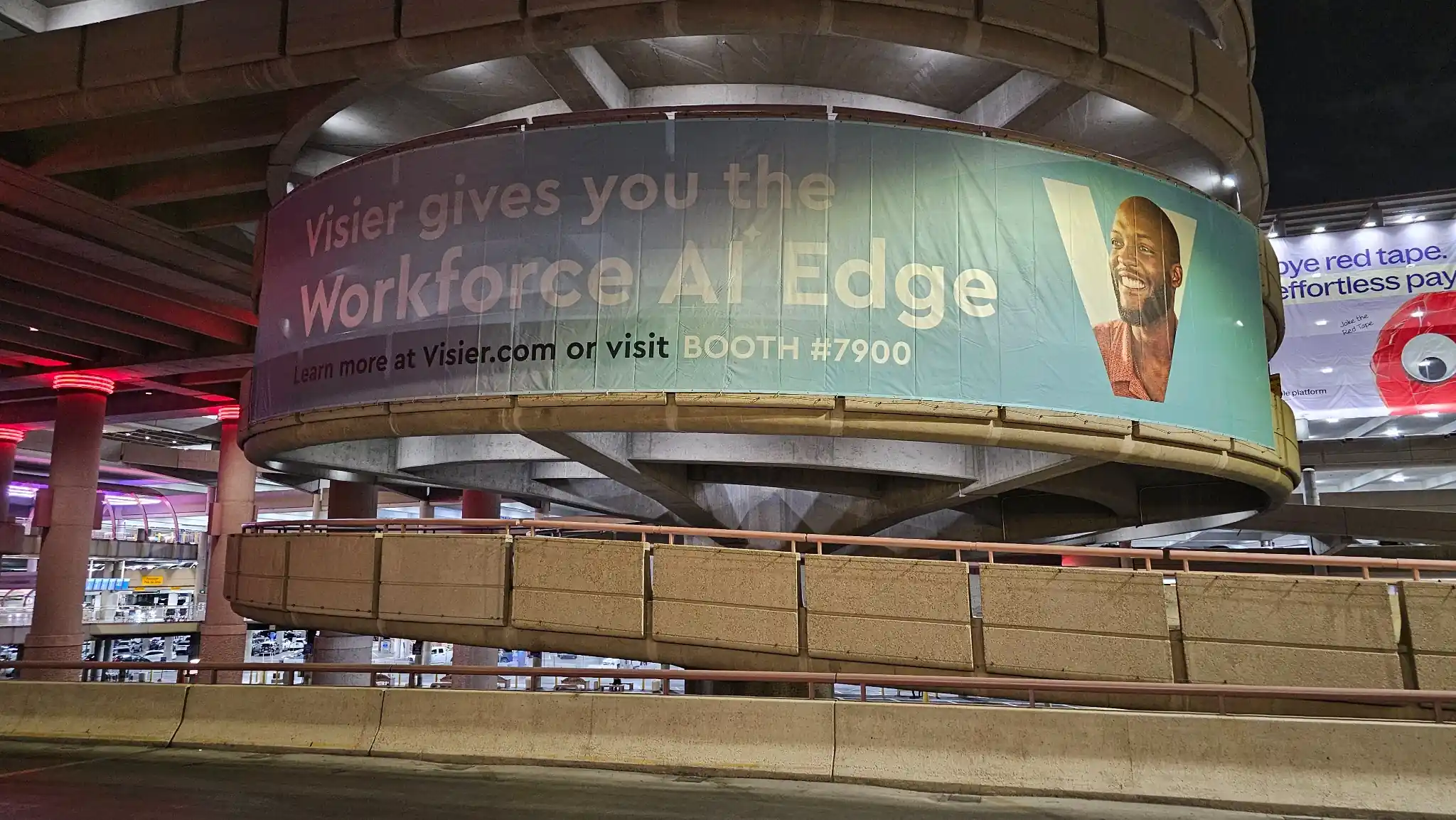
Large printed wrap on the parking-garage helix. Seen by drivers entering and leaving the airport, including attendees who rented a car or parked for the week.
Not an arrival-path digital unit. Use it as an overlay when the week already has terminal coverage, or when the audience is driving the campus.
- TypePrinted outdoor banner / wrap
- LocationParking garage helix
- Production14–21 business days
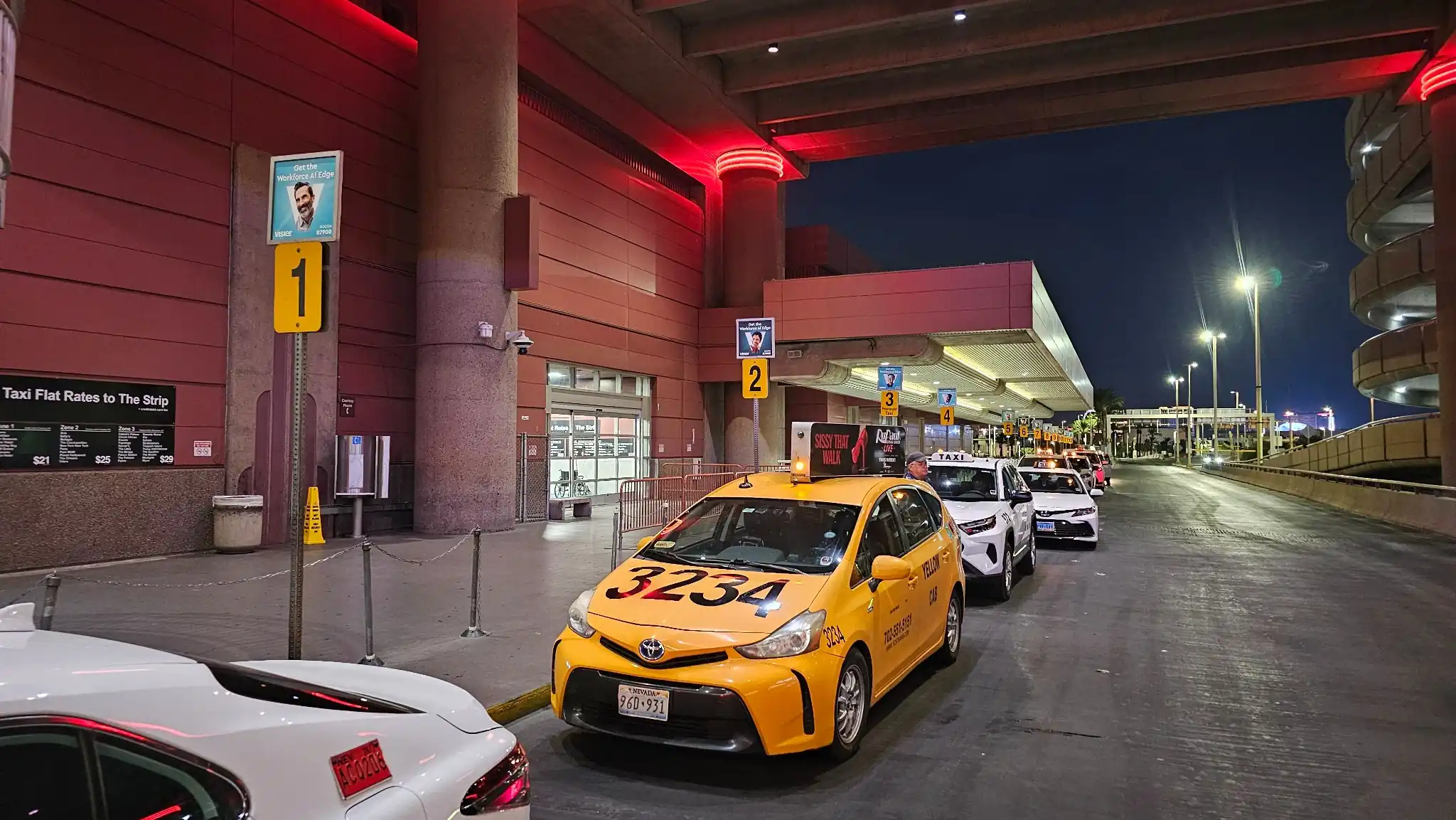
Toppers on the taxi queue at the curb. Reaches attendees the moment they step out to ground transport — after bag claim, before the Strip.
Pairs with the transportation digital network on the same curb. One is a screen on the canopy; this is the moving fleet in the lane.
- TypeTaxi topper package
- LocationTerminal curb / taxi queue
- Lead time7–10 business days
What do real ads at LAS look like?
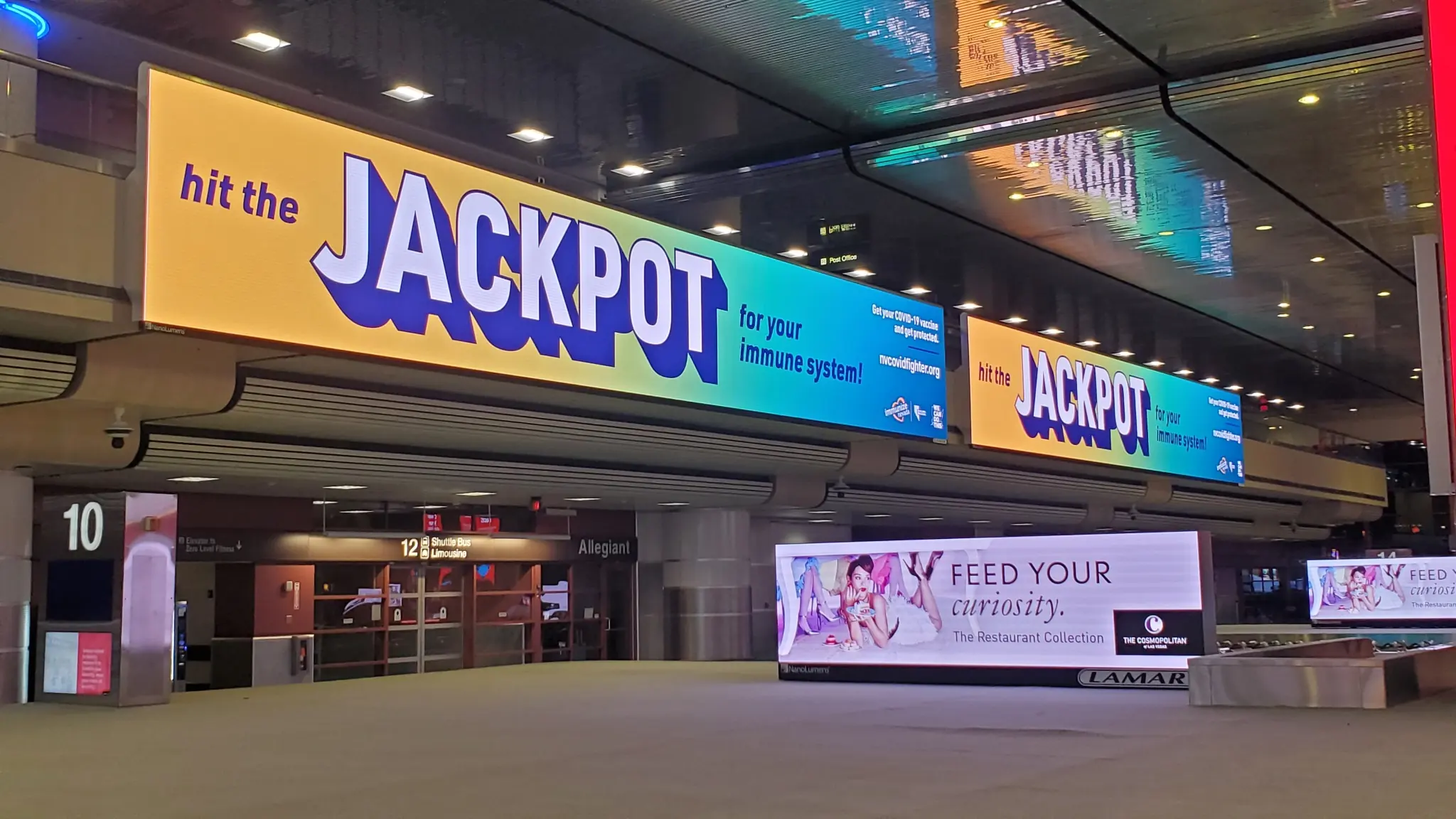
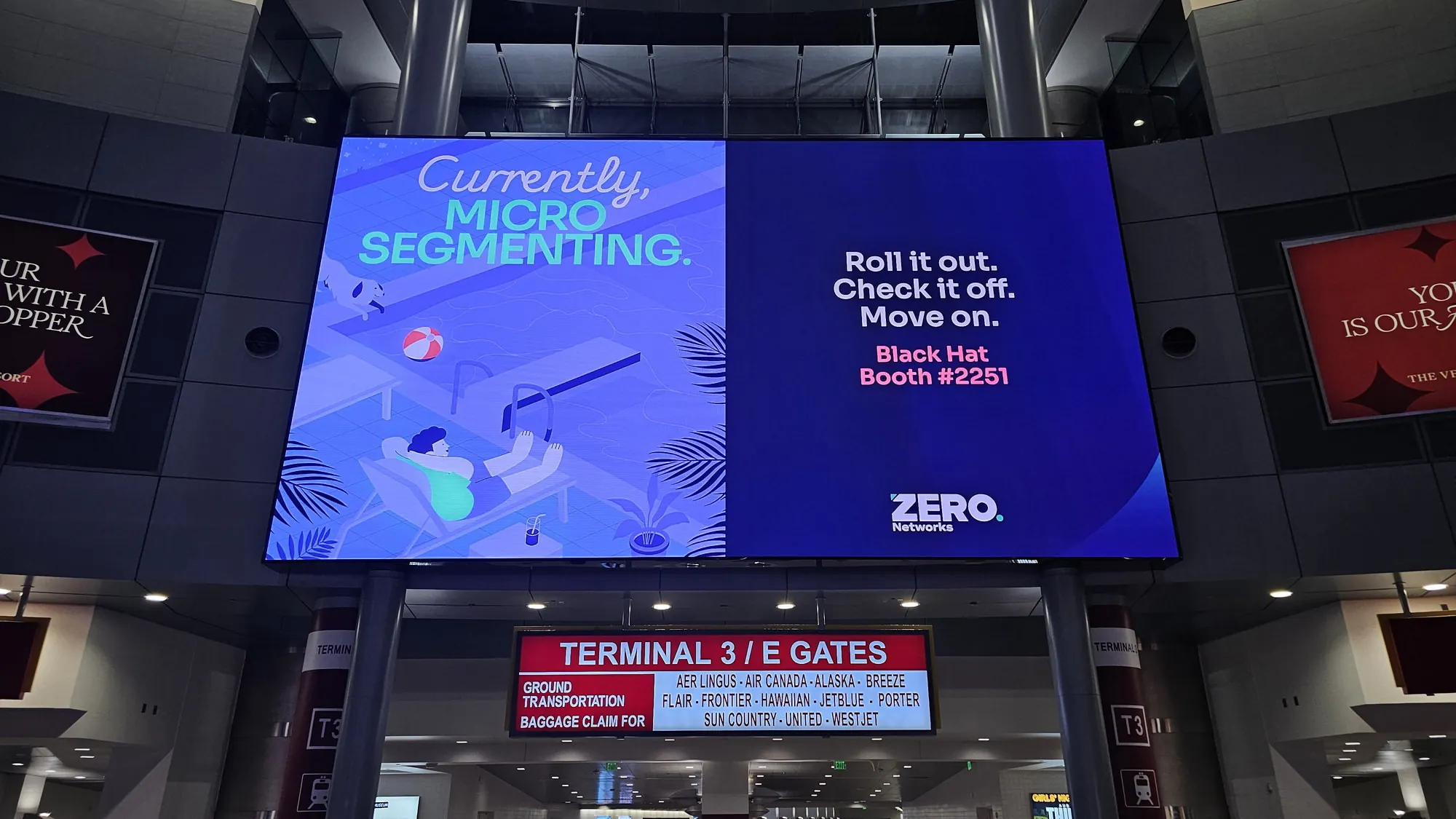
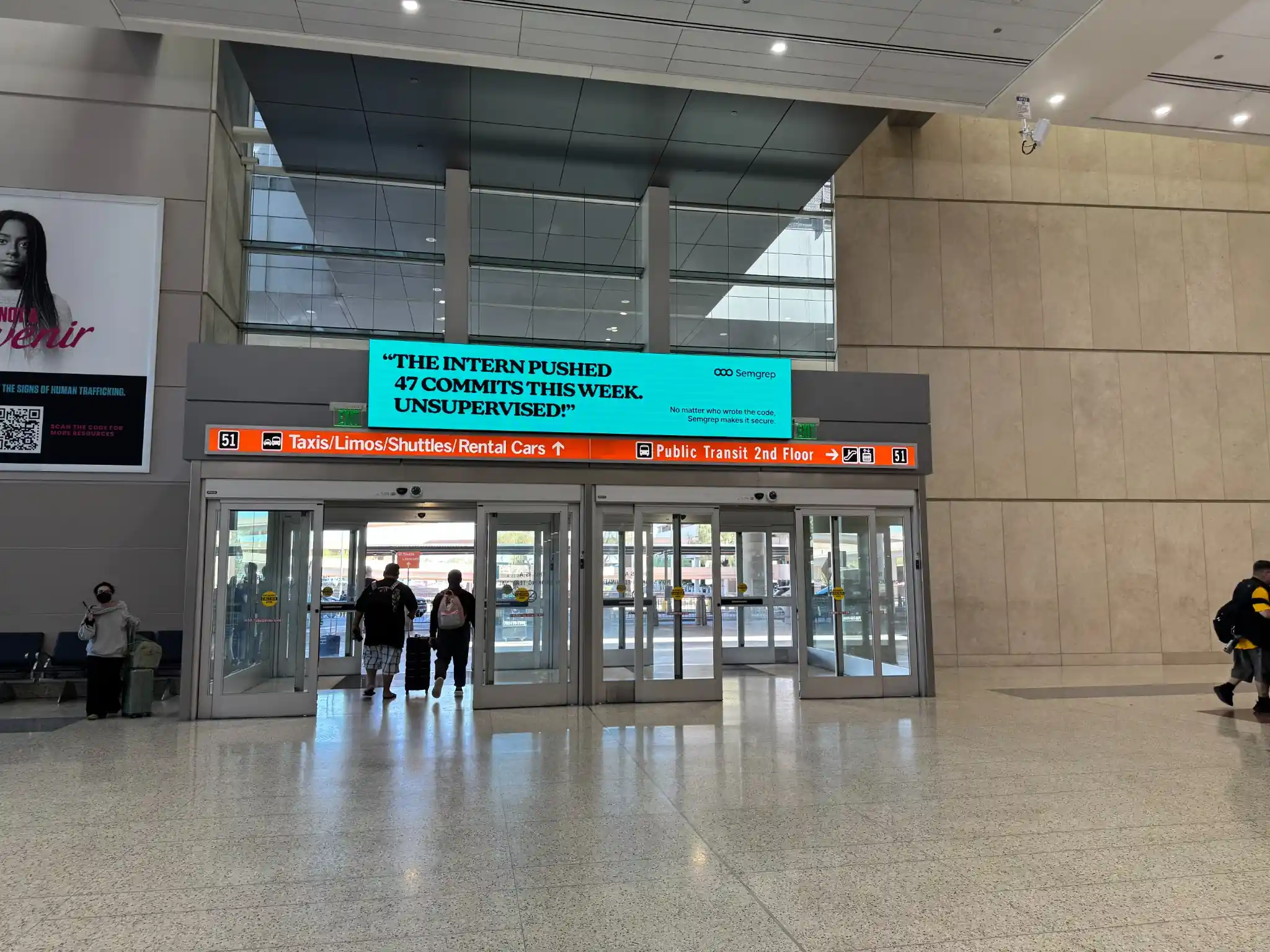
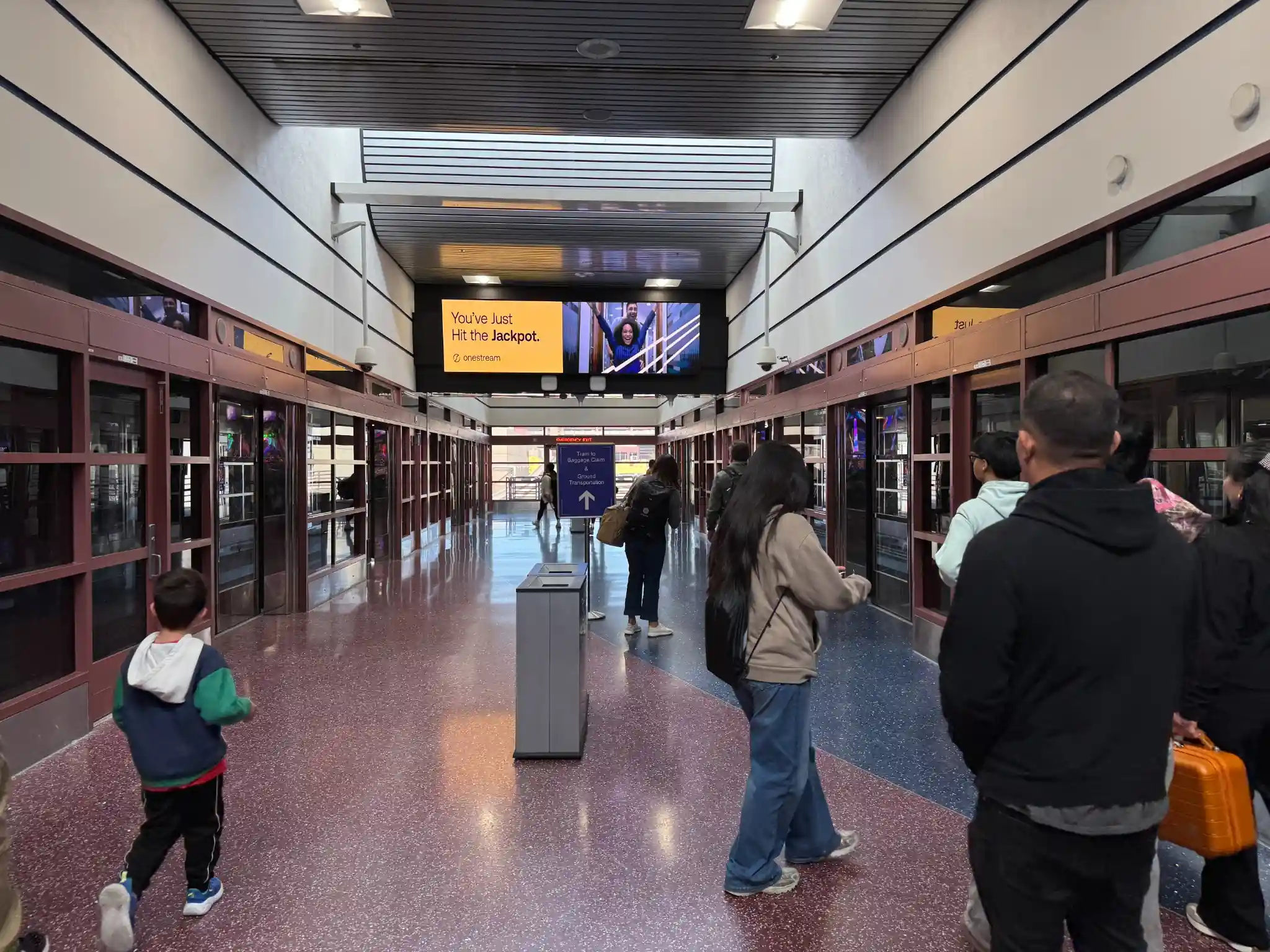
Just some of the advertising campaigns at Harry Reid (LAS) Airport.
Should you advertise at LAS or on the Las Vegas Strip?
For an event-week B2B campaign, the airport usually wins on timing and attention. The Strip wins on week-long saturation. If budget forces a choice, start at LAS. If it does not, run both.
For an event-week B2B campaign, the airport usually wins — and the reason is timing and attention, not exclusivity. During a major convention, the Strip is the most saturated ad environment in the country: every digital board, taxi top, and resort screen is sold to an exhibitor, and it reaches attendees when they're mid-schedule and distracted. The airport reaches the same people at a better moment. Every flying attendee funnels through one building at the start of the trip — bags in hand, badge not yet picked up, deciding which booths and meetings are worth their time. A digital network puts your brand into that window on repeat as they move from gate to bag claim to the curb, in a captive environment with nowhere else to look. It's the right canvas at the right time.
There is an authority effect on top of the timing. Concession-funded studies — Ipsos/JCDecaux (2024) and ResearchBods/JCDecaux (2021) — find that travelers index airport-advertised brands as more prestigious or as category leaders (one widely cited prestige index sits at 113). Those studies are paid for by inventory owners. They are useful as a directional signal, not as independent proof. For a B2B brand trying to look like the category’s safe choice ahead of a show full of competitors, that perception is still part of what the placement buys — just do not take the index into a board deck as if EAM or an academic journal produced it.
The honest counterpoint: the Strip adds reach across the week that a single arrival moment can't match, and well-funded campaigns run both. But when budget forces a choice, the airport is usually the cleaner reach — your industry, on the way in, before the floor opens. The Strip adds week-long presence. It does not replace the arrival path.
- 100% of flying attendees funnel through one building on the way in
- Reaches them at the best moment: bags in hand, schedule still open, deciding who's worth their time
- Captive environment — a digital network repeats your message from gate to bag claim to curb
- Airport presence reads as category leadership, a perception backed by industry research
- Fraction of the cost of premium Strip digital during event weeks, bookable by the week
- Reaches attendees mid-schedule, between sessions and dinners, with attention divided
- Every exhibitor with budget is present during a major convention — the most saturated ad environment in the country
- Premium units price at multiples of comparable airport inventory
- Adds week-long repeat exposure that a single arrival moment can't
- Strongest as a layer on top of an airport buy, not instead of one
How far in advance do you need to book — and what do event weeks cost?
Marquee weeks (CES, SEMA, F1): book 4–6 months out. Mid-tier events: 8–12 weeks is usually enough. High-demand weeks carry a material premium over standard-period rates. Exact unit prices are quoted against avails — not posted here.
Lead time scales with demand. The best arrival-path inventory commits first. Once those units are gone, what remains is network digital with crowded loops — you can still buy a spot, but you are negotiating position inside someone else’s week. As a rule, the more your event moves the city, the earlier you book. CES arrivals also start before show open: press days run January 3–4, 2027, with show days January 6–9, so a CES flight has to cover the inbound wave, not just the badge-pickup days.
Event weeks cost more than a standard January or August week at the same airport. That premium is real and it moves with demand.
| Tier | Examples | Book by | What sells first | Pricing character |
|---|---|---|---|---|
| Marquee | CES, SEMA, F1 week | 4–6 months | Bag claim networks, Concourse D rotunda, spectaculars, full sponsorship | Material premium over standard-period rates; loops crowd with exhibitors |
| High | AWS re:Invent, Black Hat / DEF CON | 3–5 months | Arrival-path digital; T3-heavy units for tech and security mixes | Material premium vs. standard period. November at LAS is effectively one long premium season |
| Mid | NAB, World of Concrete, Money20/20, JCK | 8–12 weeks | Strongest units still go early; standard network spots last longer | Modest premium. Audience density can beat raw attendance |
| Open calendar | Off-peak / always-on | 4–8 weeks | Most networks available | Standard-period rates; one-week minimum still applies |
Unit-level rates, loop-position premiums, and week-specific quotes. Those numbers move with availability and with the week. What you can plan against: one-week minimum; two-week and four-week flights also available; $10,000–$50,000 for a typical single placement; north of $100,000 for a network domination; $40,000–$250,000 for a two- or three-network conference package. Specific units and weeks come back as a quote.
Where should your ads run inside LAS?
Along the arrival path: concourse digital, Concourse D rotunda for business-class traffic, bag claim for dwell, then taxi and rideshare screens at the curb. Terminal follows the airline mix. Departure-side is the wrong default for a conference week.
For conference campaigns, along the arrival path — and at LAS, every step of that path has a digital network built for it. Arriving passengers move through the same sequence: gate, tram, bag claim, curb. The concourse network is the airport's post-security backbone — 36 screens across the T1 and T3 concourses — giving broad frequency through the gate areas in both directions. Concourse D's rotunda, ringed by synchronized screens, carries a large share of LAS premium-cabin traffic — Delta, American, United, and JetBlue — which for a B2B campaign is the most concentrated executive audience in the building. Then bag claim, where the networks catch essentially everyone: every arriving passenger exits through bag claim whether or not they checked a bag, and dwell time peaks at 20–30 minutes under the carousel screens. Finally the taxi and rideshare zones, where waits run up to 30 minutes at peak — the last impression before the Strip.
Terminal choice follows your audience's airlines. Terminal 1 handles Southwest, Delta, American, Spirit, Allegiant, and Contour; Terminal 3 handles United, JetBlue, Alaska, Frontier, Hawaiian, Sun Country, and all international arrivals. The D gates serve both terminals by tram, which is why the rotunda reaches business-class flyers regardless of where they land. A conference crowd heavy on Delta, American, and United arrives through Concourse D and T1 bag claim; a West Coast tech or international audience on United, Alaska, or JetBlue comes through T3.
The direction matters more than most advertisers realize. An attendee flying in is forming plans — which booths to visit, which vendors to take meetings with, which parties to attend. An attendee flying out is done: tired, heads-down, mentally back at the office. The same unit that performs on arrival day is wallpaper on departure day. This is why EAM weights conference buys toward arrival-side and bag claim networks rather than spreading budget evenly through the airport.
| Step | Network | Screens | The Moment | Event-Week Priority |
|---|---|---|---|---|
| 1. Off the plane | Concourse digital network, T1 and T3 | 36 | Walking and tram-waiting; post-security concourse digital covering domestic arrivals in T1 and T3 | Medium-high — full reach, brief exposure per screen |
| 2. Concourse D rotunda | Synchronized rotunda screens | 15 | A large share of premium-cabin traffic passes through; every screen plays your spot at once | High for B2B — densest executive audience in the airport |
| 3. Bag claim wait | Carousel screens, T1 and T3 | 46 | 20–30 minutes standing at the carousel; travelers without checked bags still exit through here | Highest — dwell time and attention peak here |
| 3b. Bag claim overheads | Bag claim spectaculars, T1 | 12 | Large overheads that rotate, then dominate all 12 at once every 6 minutes | Highest — scale and domination moments in the busiest terminal |
| 3c. Bag claim with sound | Audio-enabled screens, T1 and T3 | 22 | The only in-terminal network with audio; :30 spots while passengers wait | High for video creative — the only place a soundtrack plays |
| 3d. T3 arrivals | Escalator and exit screens into T3 bag claim | 14 | Domestic and international arrivals see the message multiple times on the way down and out | High for T3 and international audiences |
| 4. The curb | Taxi and rideshare screens, T1 and T3 | 14 | Waiting for a car, up to 30 minutes at peak — the last impression before the Strip | High — the final touch before the event |
| Departure side | Eye-level wall branding, concourse digital | — | Attendees heading home, heads-down | Low for conference buys; strong for always-on |
- Bag claim carousel network — 20–30 minutes of dwell across both terminals
- Concourse D rotunda for business-class and executive arrivals
- Concourse network for frequency across T1 and T3
- Bag claim spectaculars when the brief calls for scale
- Taxi and rideshare screens for the last impression before the Strip
- Concourse network for frequency in both directions across T1 and T3
- Bag claim and curb networks for arrivals, concourse for departures
- Audio & Visual network when video creative carries a soundtrack
- Multi-week flights across standard and event periods; suits always-on, tourism, and consumer brands
What has EAM run beyond Las Vegas?
Other airports and multi-market campaigns. Click a card for the campaign and the result.
Sources: published campaign summaries on theairport.org/case-studies. Fabric is the takeover ceiling, labeled San Jose, not Las Vegas. Impressions are vendor-reported delivery, not pipeline attribution.
How do you measure an LAS event-week campaign?
Proof of posting and digital play logs are factual. Delivered impressions are modeled. Brand lift is the only method that speaks to effect, and it has to be fielded before the flight. Direct pipeline attribution is not reliably available. Do not let a vendor tell you otherwise.
Airport advertising is measurable, but not in the way digital media is measurable, and the gap between those two things is where most internal arguments about this channel happen. Decide what you're measuring before the buy — retrofitting measurement after a flight has ended rarely produces anything defensible.
Four things can be verified for an LAS campaign, and one thing can't. Being clear about which is which is what makes the numbers hold up when someone senior pushes on them.
| Measure | What It Actually Tells You | When to Set It Up | Confidence |
|---|---|---|---|
| Proof of posting | Photographic confirmation that every unit ran, in the right place, for the full flight. Verification, not performance — but it's the base layer everything else sits on. | Written into the contract before signing | High — factual |
| Delivered impressions | Modeled audience delivery based on passenger volume and unit position. An estimate built from traffic data, not a count of people who looked. | Requested at proposal stage | Moderate — modeled |
| Digital play logs | Actual spot counts and share of voice on digital networks. The check on whether the loop crowding you negotiated against actually materialized. | Requested at contracting | High — logged |
| Brand lift study | Survey-based awareness or perception change against a control. The only method that measures effect rather than exposure. | Fielded pre-flight for a baseline | Moderate — needs budget and lead time |
| Direct attribution to pipeline | Not reliably available. Airport media has no click, and event weeks are saturated with other touchpoints from the same brands. | — | Low — treat claims here with skepticism |
An event campaign has a measurement advantage a year-round buy doesn't: a defined population and a defined window. You know roughly who is arriving and exactly when, which makes a pre- and post-event survey of that audience far more meaningful than a general market study. If you are going to run a lift study on airport media, an event week is the cleanest opportunity you'll get — and the baseline has to be fielded before the flight starts, not after.
The honest framing for anyone defending this spend internally: proof of posting and play logs prove the campaign ran as bought, delivered impressions size the audience, and a lift study is the only line that speaks to effect. A vendor promising attributed pipeline from airport media is overselling. EAM contracts proof of posting and delivery reporting on every campaign as standard and will tell you plainly when a proposed measurement approach won't produce a number worth presenting.
How does EAM run an LAS event campaign?
One call, one plan, one contract. We follow up to learn the event and the objective, then come back with current availability and a recommended mix.
Tell us the event, the objective, and the budget range. We follow up to learn the event and the objective, then come back with current LAS availability, a recommended format mix, placement along the arrival path, and a quoted range. Once approved, EAM handles the rest.
- Scope the week. Event dates, inbound airlines, whether the brief is a B2B conference, F1 week hosting, or a consumer push, and whether one week or a surrounding flight.
- Check avails and loop position. Which arrival-path networks are still open, how crowded the loops already are, and whether a domination or sponsorship is even possible.
- Quote the mix. Formats, share of voice, and a range. After we know the event and the objective, we come back with current availability and a plan you can take inside.
- Contract and traffic creative. Specs across every screen size in the buy, airport approval, files in 14–18 business days before digital start (earlier for static).
- Go live and close the loop. Confirm posting before the first arrival wave. Deliver proof of posting and play logs after the flight.
EAM Advertising is an independent airport and in-flight media agency, founded in 2015. We specialize in airport and in-flight media and nothing else, and we do not own media assets at LAS or any airport. That independence is why the recommendations hold up. We plan and buy across 125+ airports and 45+ airlines worldwide, which is the leverage and the current-availability knowledge a one-time LAS buyer does not have. Clients include Fortinet, Dynatrace, Rubrik, McGraw-Hill, and Wharton. When the event strategy extends beyond Las Vegas — a roadshow, a multi-city launch, an international push — the same relationship covers the other markets. See the main airport advertising hub.
Frequently Asked Questions
The minimum campaign at LAS is one week. Two-week and four-week flights are also available. A single placement runs $10,000 to $50,000 for the week, depending on the network, the specific units, frequency, and how close the dates fall to a major event. Digital domination takeovers — every screen on a network, 100% share of voice — run north of $100,000 for the week. Most conference-focused LAS campaigns, combining two or three networks along the arrival path, land between $40,000 and $250,000.
For the busiest weeks — CES, SEMA, F1 — book 4–6 months ahead. The best arrival-path inventory commits first; once it is gone, what remains is network digital with crowded loops. Mid-tier events are workable at 8–12 weeks, though the strongest units still go early. Digital creative is typically due 14–18 business days before the flight starts. Static, wraps, and tray branding need more production time, so the booking window has to leave room for both availability and files.
The best positions do. Bag claim networks, the Concourse D rotunda, and the bag claim spectaculars are usually committed months before a major convention, and the full-sponsorship takeover goes to one brand per week. Standard network spots stay available longer, but loops fill with exhibitors as the event approaches — and once a loop is full, the only thing left to negotiate is which spot you hold in it. Booking early is how you control both availability and position.
Along the arrival path, on the digital networks built for each step: the concourse network on the walk from the gate, the Concourse D rotunda for business-class arrivals, the bag claim carousel screens where passengers wait 20–30 minutes, and the taxi and rideshare screens at the curb. Which terminal depends on your audience's airlines. As of 2026 planning, Southwest, Delta, American, Spirit, Allegiant, and Contour arrive through Terminal 1; United, JetBlue, Alaska, Frontier, Hawaiian, Sun Country, and all international flights through Terminal 3. Confirm against the current LAS map before the buy. Attendees are receptive and plan-forming on the way in; on the way out they're exhausted and heads-down.
Yes — one week is the minimum campaign at LAS. Two-week and four-week flights are also available. A one-week flight timed to your event's arrival days is a standard placement, not a special request. Static units, wall wraps, and tray branding carry production and installation lead time regardless of duration, so they're worth planning earlier. Many advertisers pair a one-week digital flight with a static overlay for the same window.
For B2B brands, usually yes — because of timing and attention, not reach. During a major convention the Strip is the most saturated ad environment in the country and reaches attendees mid-schedule, with attention divided. The airport reaches flying attendees at the start of the trip, while their schedule is still open. Concession-funded studies (Ipsos/JCDecaux, ResearchBods) find airport presence indexes as category leadership; treat those studies as directional, not independent proof. Well-funded campaigns run both; if budget forces a choice, the airport is usually the cleaner reach against people actually flying in for the show.
Everything after the objective. We check what's open for the week, which loops are crowded and which units will sell out, and where on the arrival path your audience actually walks. We recommend the mix, secure the units, traffic the creative through airport approval, confirm posting on day one, and deliver proof of posting and play logs after. If LAS is one market in a larger plan, the same relationship covers the others.
Digital network creative is typically due 14–18 business days before the flight starts. Confirm the exact spec deadline when the contract is issued — networks differ. Static units, wall wraps, and tray branding carry production and installation lead time regardless of how short the flight is, so those files need to move earlier than digital.
- Passenger statistics from Clark County Department of Aviation year-end 2025 release (published January 2026): 54,988,547 passengers (−5.9% vs. 2024), 170+ direct markets, Southwest at 21.8 million passengers. Page copy rounds the total to 54.99 million.
- Convention attendance figures from the Las Vegas Convention & Visitors Authority annual reporting.
- Event attendance figures are approximate, based on organizer-published numbers from recent editions. Money20/20 USA 2025 reported roughly 11,000–12,000 attendees; CES organizer materials cite ~140,000–148,000 (CTA CES 2026 attendance audit).
- CES 2027 official show days are January 6–9, 2027, with press days January 3–4. World of Concrete 2027: January 19–21. NAB Show 2027: April 4–7. JCK Las Vegas 2027: June 2–7. Black Hat USA 2027: July 31–August 5. DEF CON 35: August 5–8. Money20/20 USA 2027: October 19–21. SEMA 2026: November 3–6. Formula 1 Las Vegas Grand Prix 2026: November 19–21 (official calendar). AWS re:Invent 2027 is tentatively expected November 29–December 3, 2027.
- Pricing ranges, booking windows, and premium character based on EAM Advertising planning and buying data across 125+ airports, 2015–2026. Unit-level rates are negotiated and are not published on this page. Ranges vary by unit, timing, and availability.
- Network descriptions, screen counts, loop structure, terminal and airline assignments, and dwell-time figures from current LAS airport media specifications, 2026. Carrier terminal assignments can change; verify against the airport’s current map when planning.
- Perception / prestige findings cited from concession-funded research: Ipsos/JCDecaux 2024; ResearchBods/JCDecaux 2021 (prestige index 113). Framed on this page as directional, not independent.