$50,000+
One U.S. carrier
- Possible formats
- Pre-roll, 1 million or more impressions.
- Planned on
- Impressions (U.S.) or months (international)
More than 5 billion airline passengers a year worldwide: business travelers, families and vacationers on every continent, seated for hours with a screen in front of them, with summer and holiday peaks on top. Get the in-flight media kit for formats, planning ranges, and booking windows.
You’re in good company






Start here
Pick the one that fits where you are
Planning on one airline or several, with a date in mind or just a budget: start with the kit, a brief, or a call.
An airport and in-flight media agency, founded in 2015. 125+ airports, 45+ airlines, campaigns on five continents.
Airports too? Start at the airport advertising overview, or see how an airport advertising agency runs a multi-airport campaign.
What you can buy
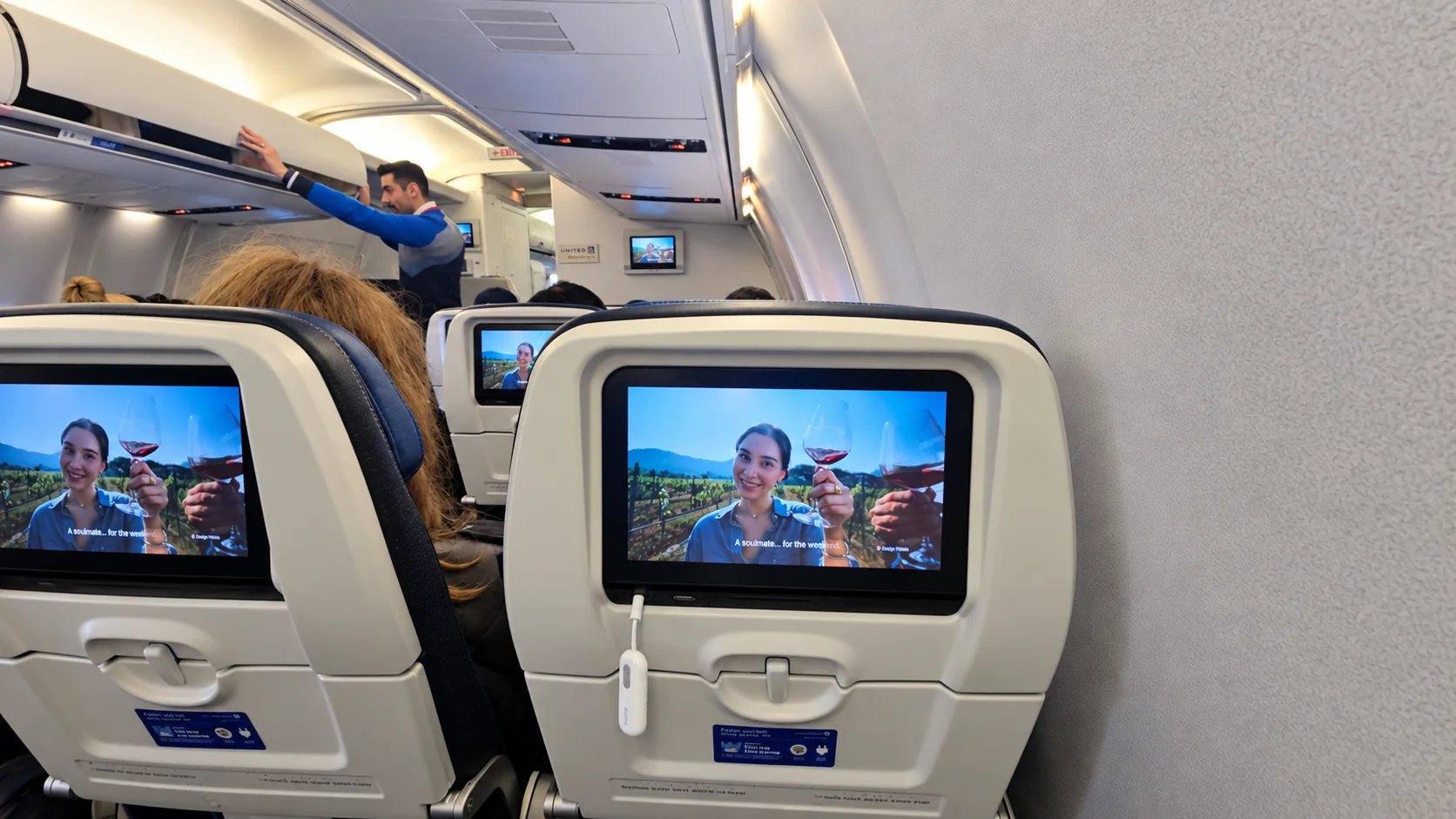
In-flight advertising is paid media on the aircraft and on the airline's own screens: a video that plays before the movie a passenger chose, on the seatback screen or on their phone; ad tiles on the entertainment menu; a slideshow during boarding; a banner on the Wi-Fi login page; a page in the in-flight magazine; a printed napkin or boarding pass. On U.S. airlines it is almost all screens now, and the magazines are gone. On many international carriers, print is still sold next to the screens.
Pre-roll is the product nearly every airline sells. It plays automatically before the movie or show the passenger picked, usually 15 or 30 seconds, and on United, American, Alaska and Southwest it cannot be skipped. United runs 6 to 15 seconds on its newest screens and 15 or 30 seconds elsewhere. Singapore Airlines and Emirates take spots up to 60 seconds and longer. British Airways sells it as a monthly package of up to seven 30-second spots before every movie on its long-haul fleet, bought in 30- or 60-second pieces. Austrian's is skippable; that is the exception.
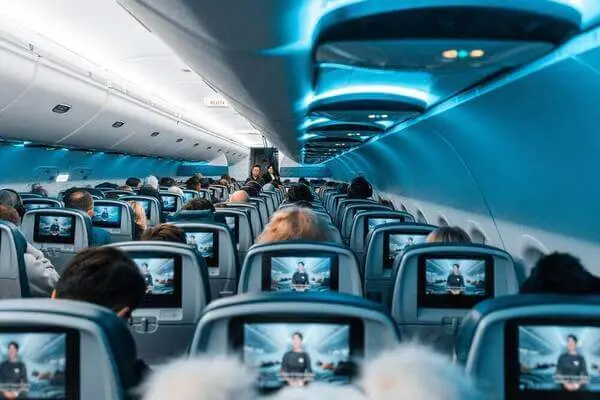
Two screens, one buy. On widebody jets the ad runs on the seatback screen. On most U.S. domestic flights it runs on the passenger's own phone or laptop, through the airline's free entertainment portal. American reports 15.3 million passengers a month on its wireless entertainment against 1.5 million on seatback screens. Southwest has no seatback screens at all. On domestic routes, plan for the phone, not the seatback.
Beyond pre-roll, the menu gets long on some airlines and stays short on others. United sells ad tiles on the entertainment menu that open a full-screen page or a video of up to five minutes, a silent slideshow that runs while passengers board, a 30-second spot with sound after the safety video, full-screen ads when someone pauses a film, and placements on the moving map. Southwest sells spots inside live-TV breaks and banners on its Wi-Fi portal. The European and Asian carriers sell print pages, seat-pocket brochures, printed boarding passes, napkins and towels, and sponsored content. The cards below cover every format sold today, with the airlines that sell it and the rule that matters most when you buy it.
Tap any format for what it is, which airlines sell it, the specs, and the thing to know before you buy.
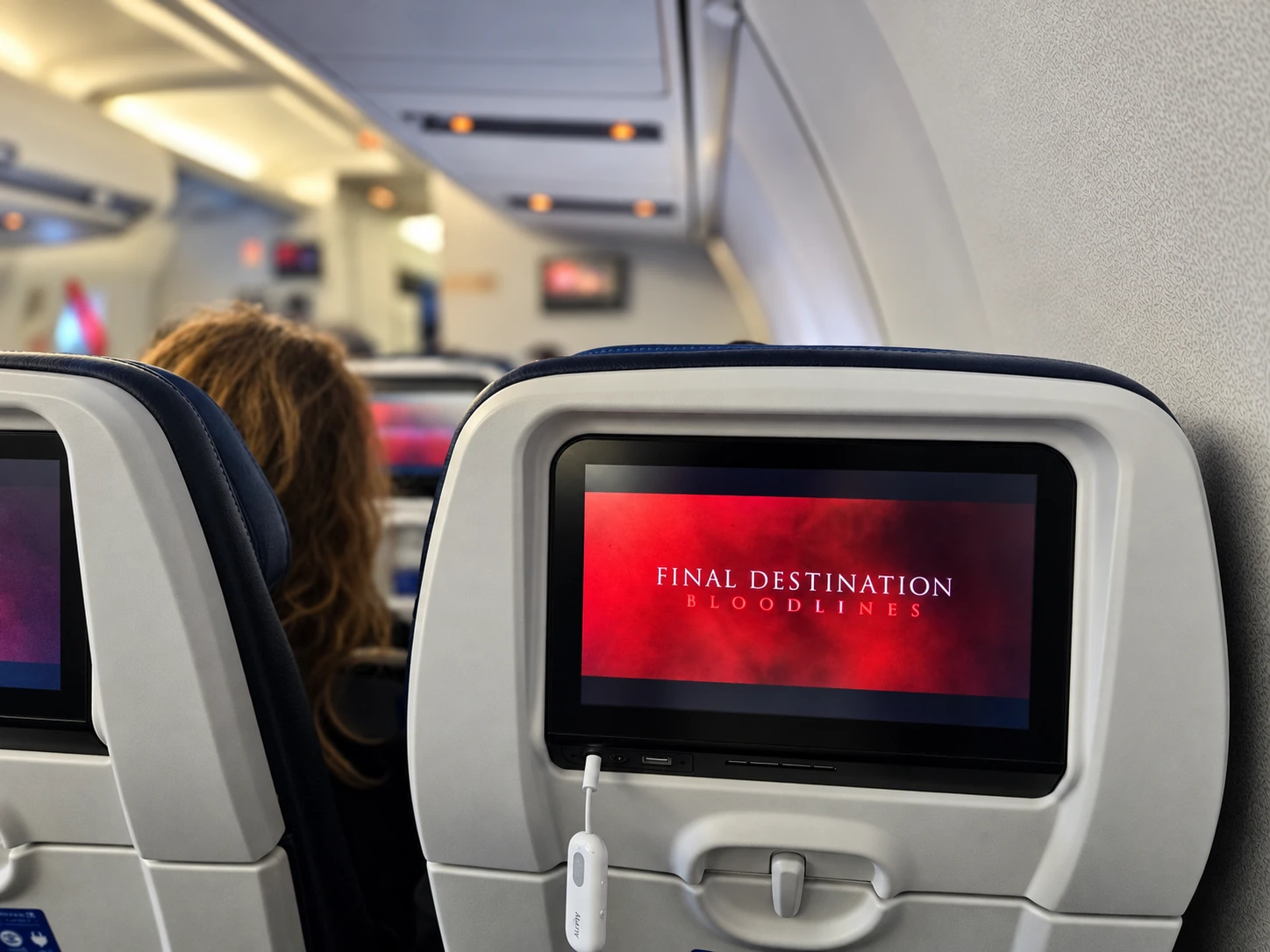
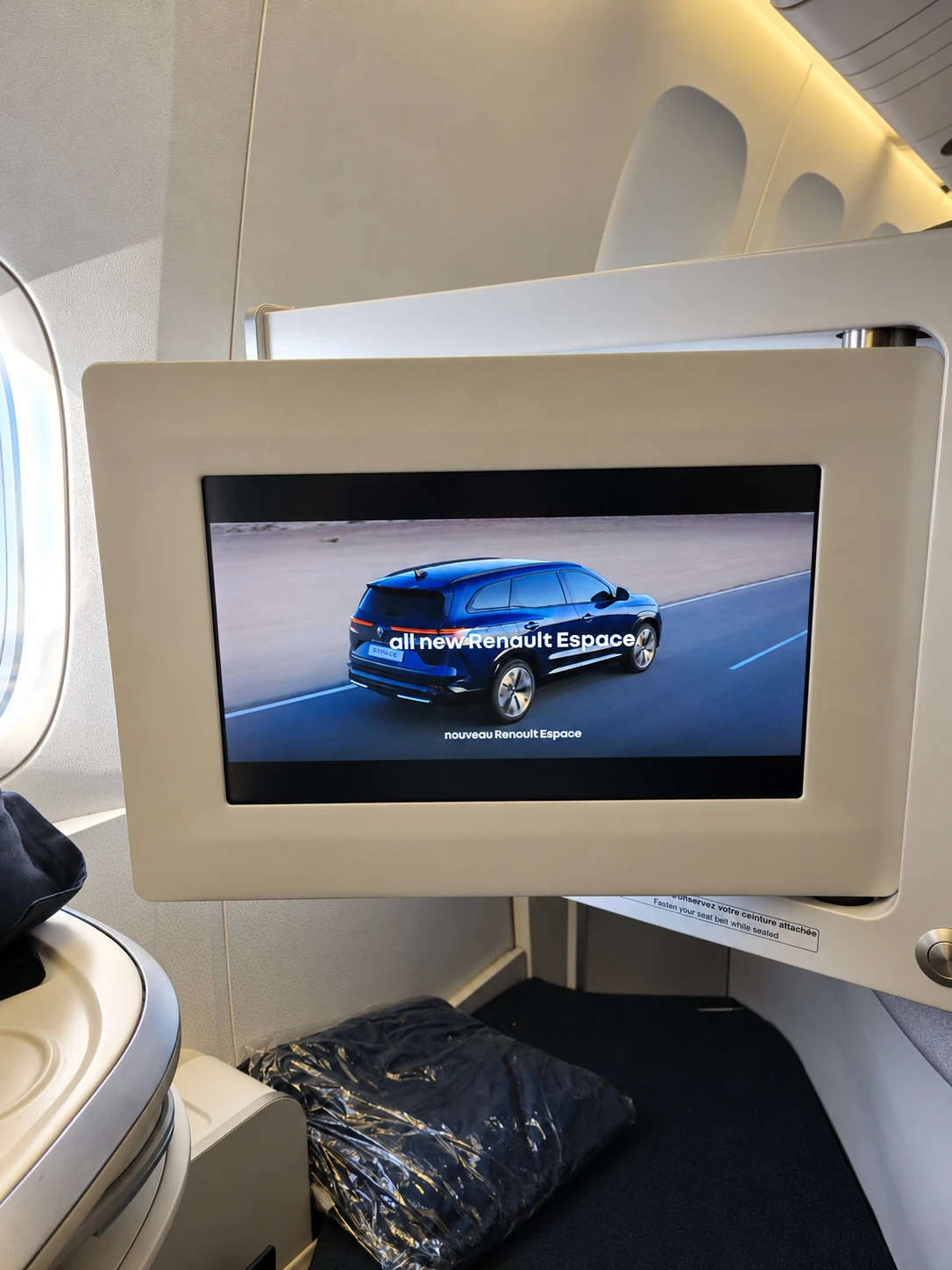
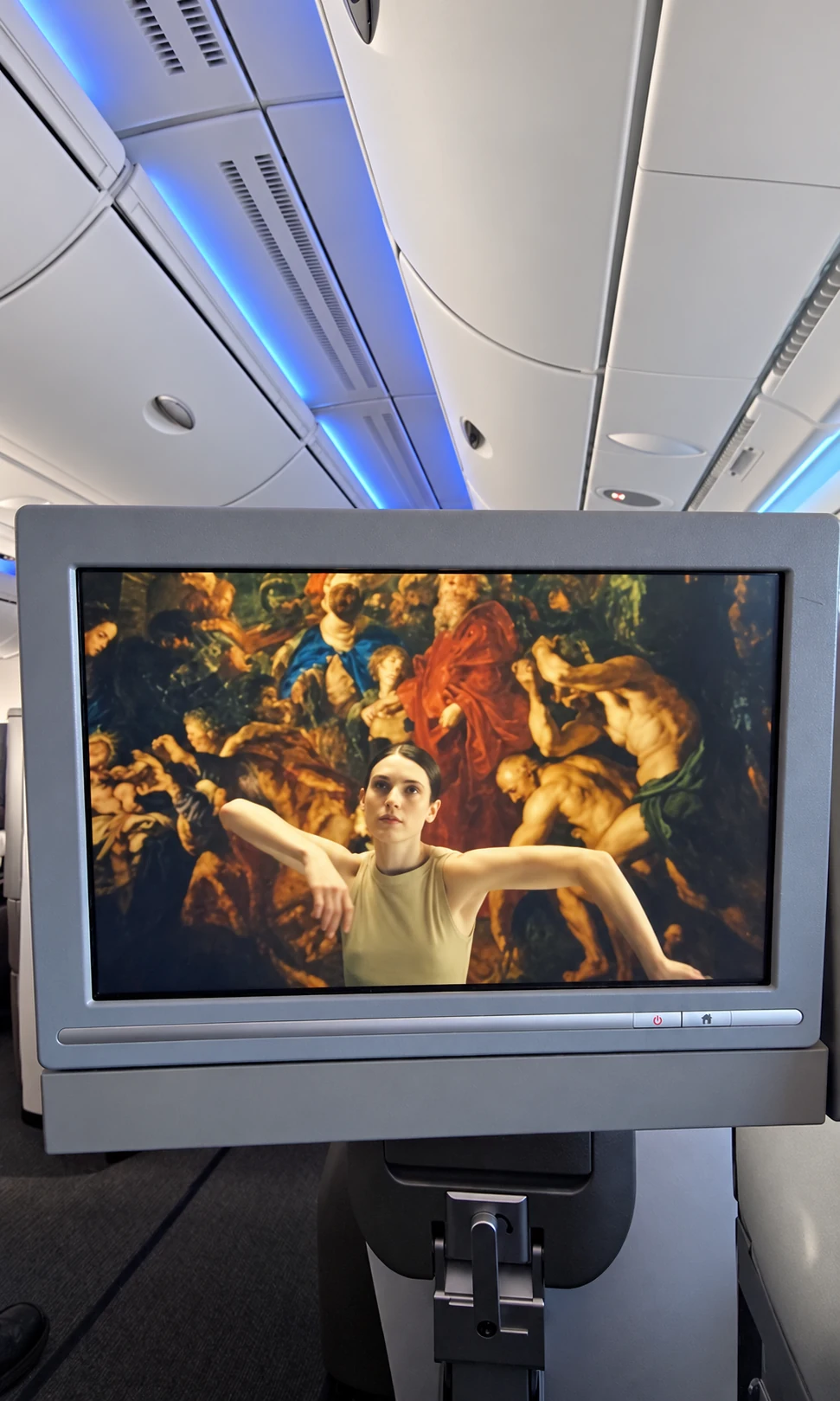
A 6- to 30-second video that plays automatically before the movie or show the passenger chose, on the seatback screen. Non-skippable on United, American and JetBlue. Up to four advertisers share United's slot each month; Emirates and Singapore Airlines sell longer spots inside a monthly package.
British Airways runs up to seven spots before a movie, so position in the pod matters. Austrian's version is skippable; SWISS and Iberia keep it off children's content.
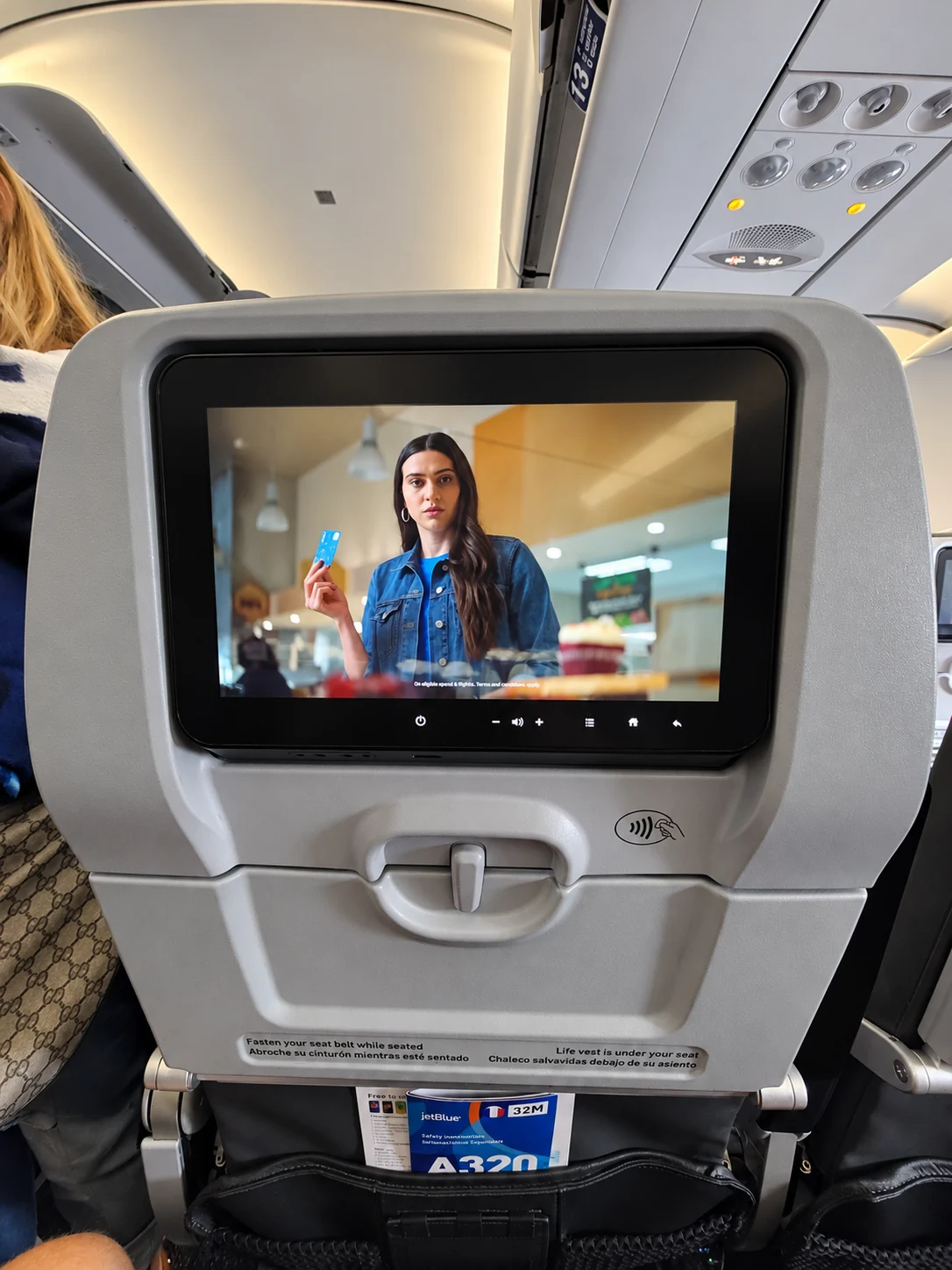
The same pre-roll, served through the airline's free entertainment portal to the passenger's phone, tablet or laptop. This is where most U.S. domestic impressions are: American reports 15.3 million monthly passengers on wireless entertainment against 1.5 million on seatback screens, and Southwest and Alaska have no seatback screens.
Forced view at Southwest and Alaska, one paid spot against one airline spot.
15-, 30- or 60-second spots inserted into commercial breaks on the live-TV channels streamed to the passenger's device.
A standard broadcast spot works; no new creative needed.
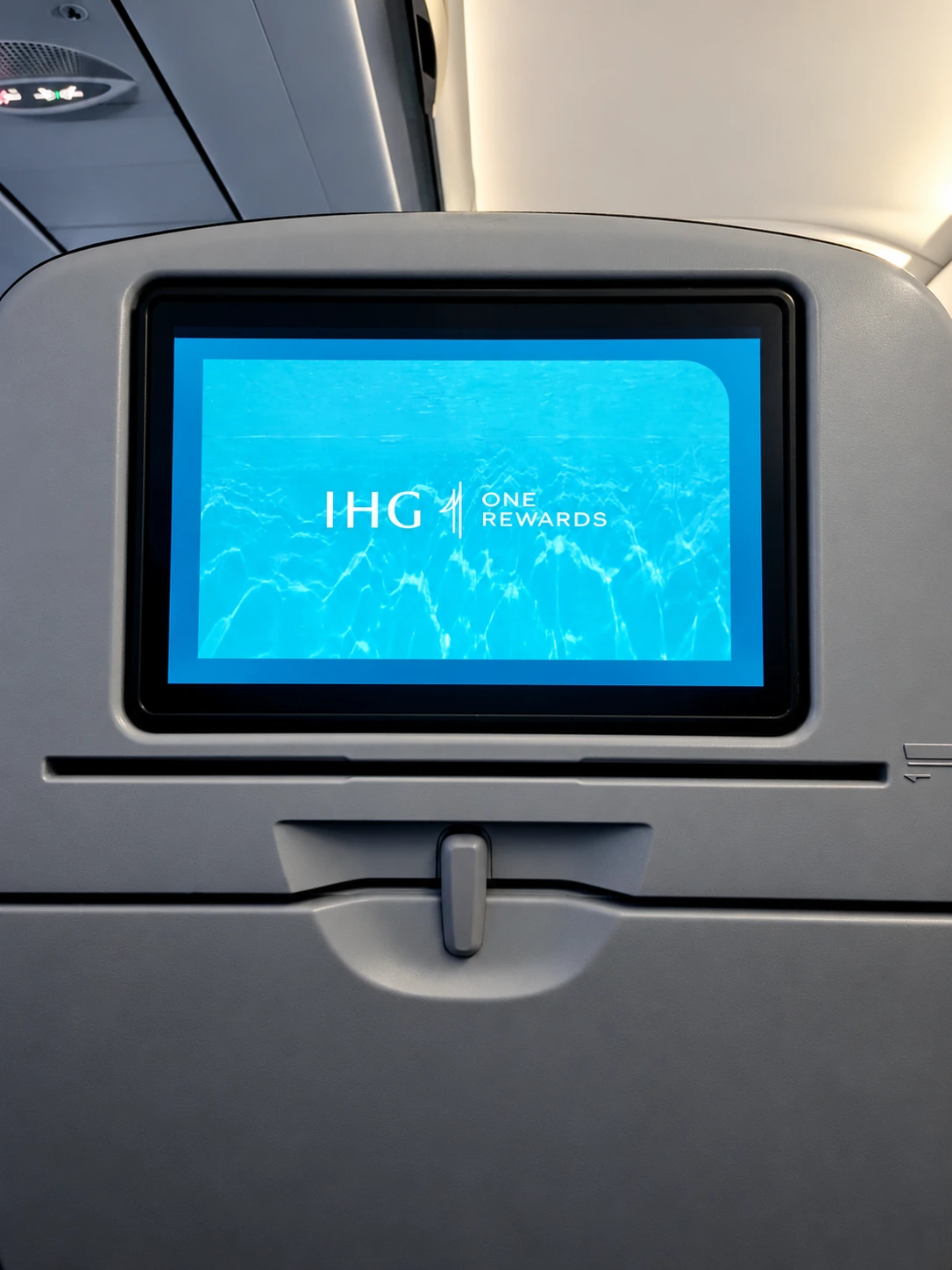
Native tiles on the home screen and inside the movie, TV, food and audio menus. A tap opens a full-screen page or a video of up to five minutes. Reported as impressions, clicks and video quartiles; targetable by cabin, route and loyalty tier.
The fastest unit in the sky to change.
A silent, animated slideshow that runs on every seatback screen while passengers board, 20 to 30 slides of about 10 seconds each, until the passenger touches the screen. Headline of 24 characters, body of about 160. Up to three advertisers a month.
The most visible unit on the aircraft and the slowest to book.
Up to 30 seconds with sound over the cabin PA, right after the safety video, non-skippable, bought by the month.
The one in-flight unit everyone on board hears.
A full-screen static ad when a passenger pauses a film, held until they touch the screen; and tiles inside the notification center that carries gate, baggage and meal alerts, with a QR code if you want one.
Pause ads are the highest-attention static unit: the passenger chose to stop.
A points-of-interest card in the map's side rail that expands to full screen, a logo in the map's ticker, or a full-screen screensaver after five minutes of idle. The ad can appear anywhere on the map, whatever is being flown over.
Newest United screens only.

A banner on the pages passengers see when they connect: the login page, the plan page, the flight tracker. On Southwest it is 728x90 on laptops and 300x50 on phones, 25% share of voice, up to about 6 million impressions a month. On SWISS and Austrian it comes with an advertorial page.
On the U.S. carriers the free-Wi-Fi sponsorship itself is sold fleet-wide to a telecom; this is the space beside it. British Airways' portal reaches every cabin on long- and short-haul and can whitelist your site so passengers reach it without buying Wi-Fi.
A full-screen, non-skippable video the passenger watches to earn free Wi-Fi minutes, then lands on the sponsor's page. Priced per activation, about $0.35 to $1.00 depending on the destination market.
Shrinking: once an airline gives members free Wi-Fi, there is nothing to reward.
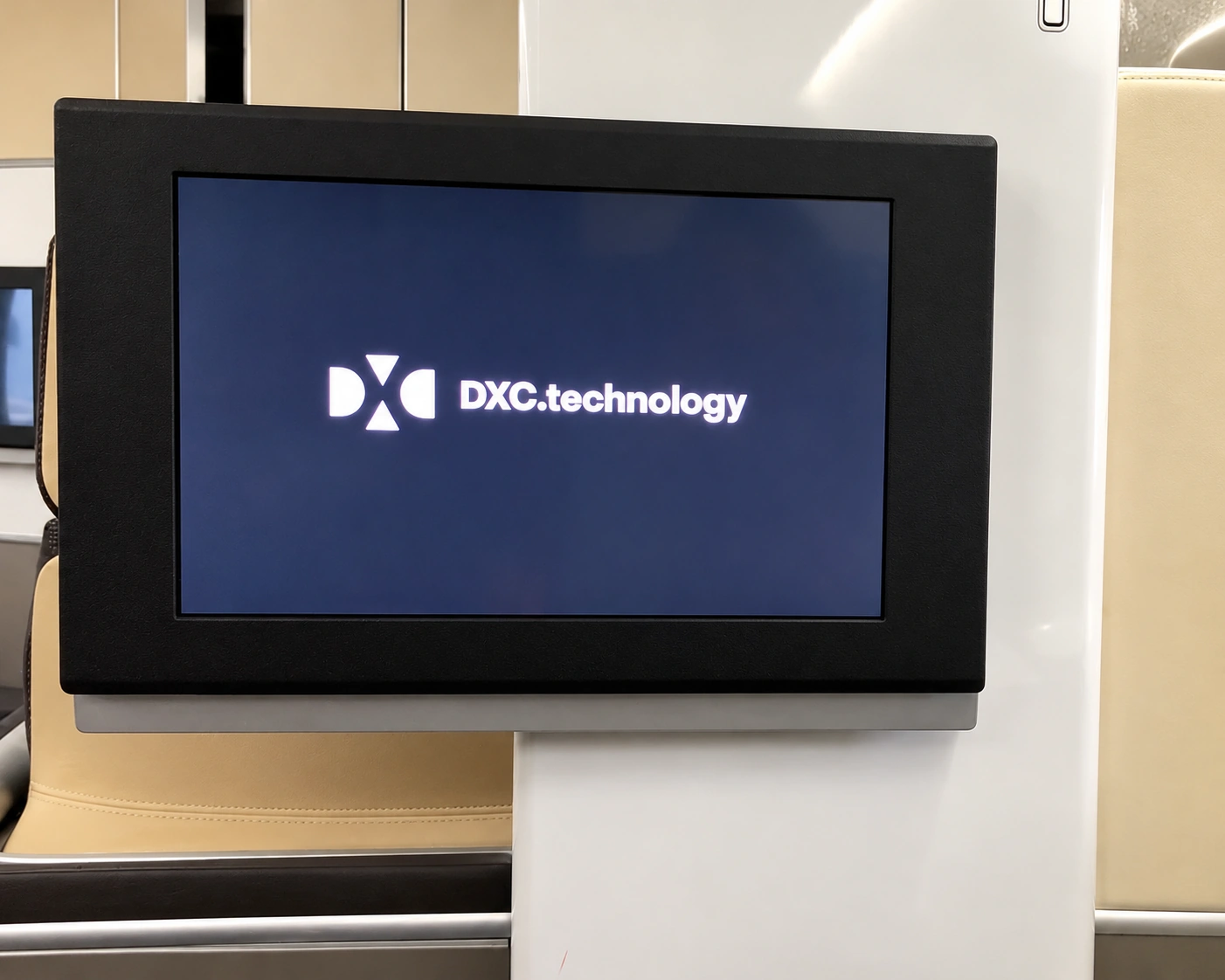
Image-and-copy placements on the booking confirmation, the check-in confirmation, the online check-in page, and the mobile or printed boarding pass. Reach is the airline's whole passenger flow for that month.
Check-in opens 47 hours before departure at Austrian; the boarding pass is seen several times.
A banner or a dedicated send to the airline's loyalty list, by market and language. Austrian's worldwide edition reaches about 9.4 million addresses; ANA's about 10 million; British Airways sends two monthly emails to about 12 million readers.
Often restricted to travel partners and destinations.
A page, spread or cover in the seat-pocket magazine, which most European and Asian carriers still print: Air France (150,000 copies), KLM (every seat pocket), ANA (about 178,000 copies), Iberia, Singapore Airlines, Aeroméxico. U.S. carriers stopped printing between 2020 and 2024.
Print also appears in the airline's app and Wi-Fi edition on ANA and Iberia. British Airways' High Life is mailed to the homes of 35,000 top-tier members six times a year rather than placed in seat pockets.
A 15-minute sponsored episode on the seatback channel, a content integration beside the pre-roll, a branded interview series in the magazine, or a web advertorial with guaranteed visits.
Editorial approval and two rounds of changes are normal.
Up to 60 minutes of brand-supplied audio (a podcast, a playlist, a guided piece) listed under the airline's audio categories with your logo, and promoted in the airline's digital magazine. British Airways reports about 677,000 audio impressions a month.
A content play, not an ad slot; allow time for the airline's editorial approval.
Printed boarding passes (about 2.6 million a year at Austrian), napkins (about 11.7 million), refreshing towels, and seat-pocket brochures on the short-haul fleet.
Printing is on you.
Up to 200 square metres of livery on a single aircraft, sold as a special project with about 15 million visual contacts a year. Rare, priced on request, and months of lead time.
A publicity play more than a media plan.
Real brands. Real campaigns.
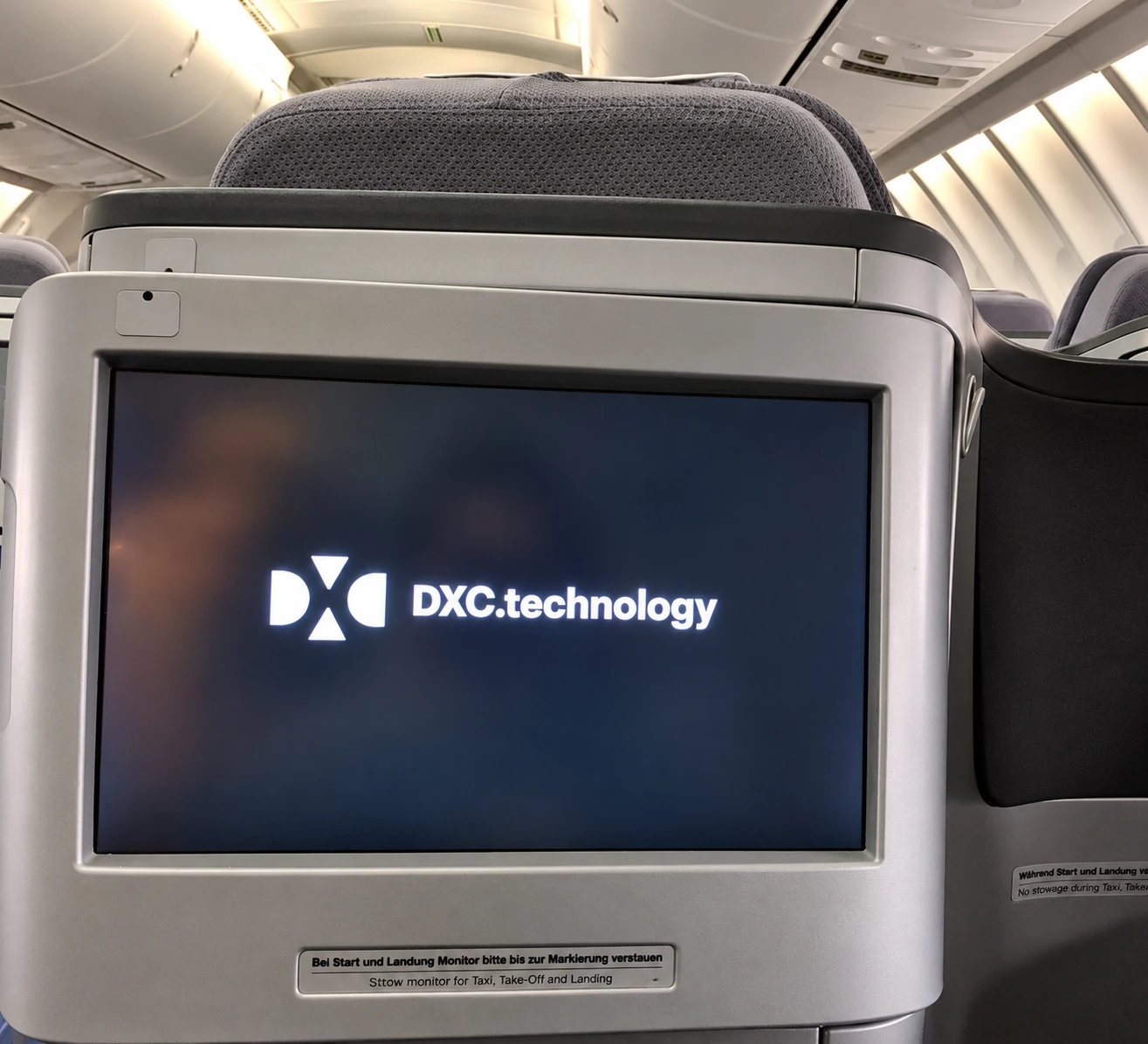
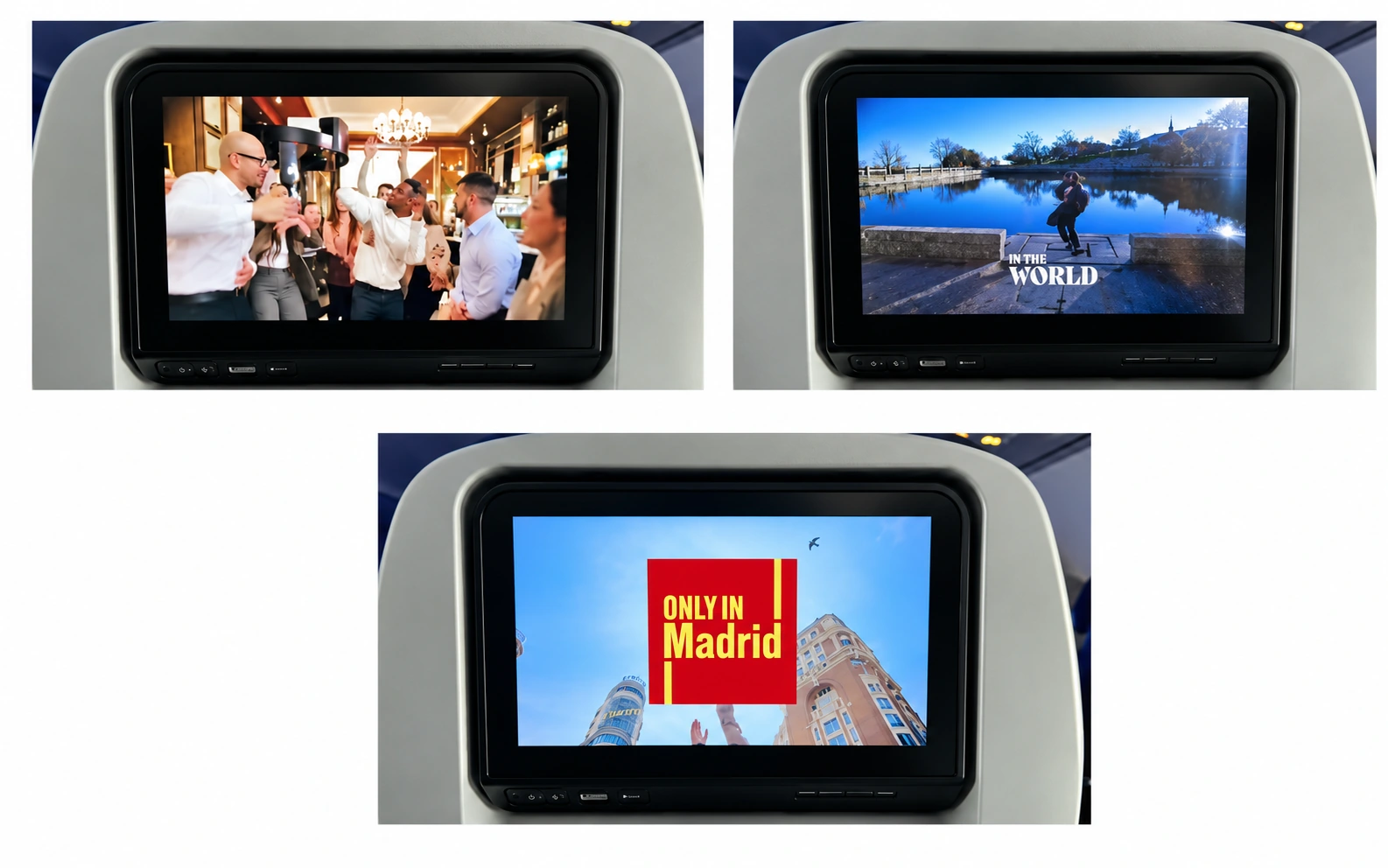
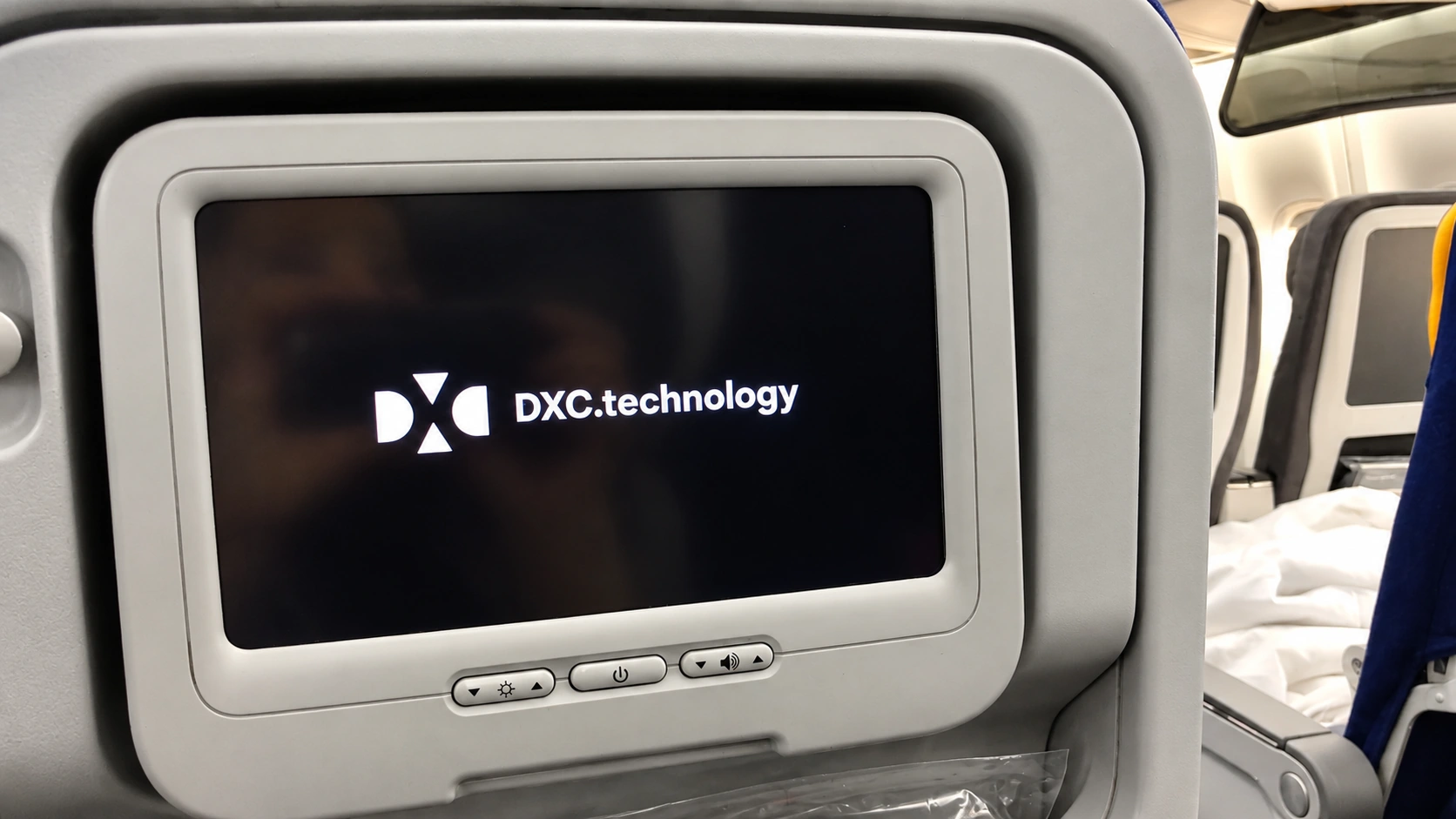
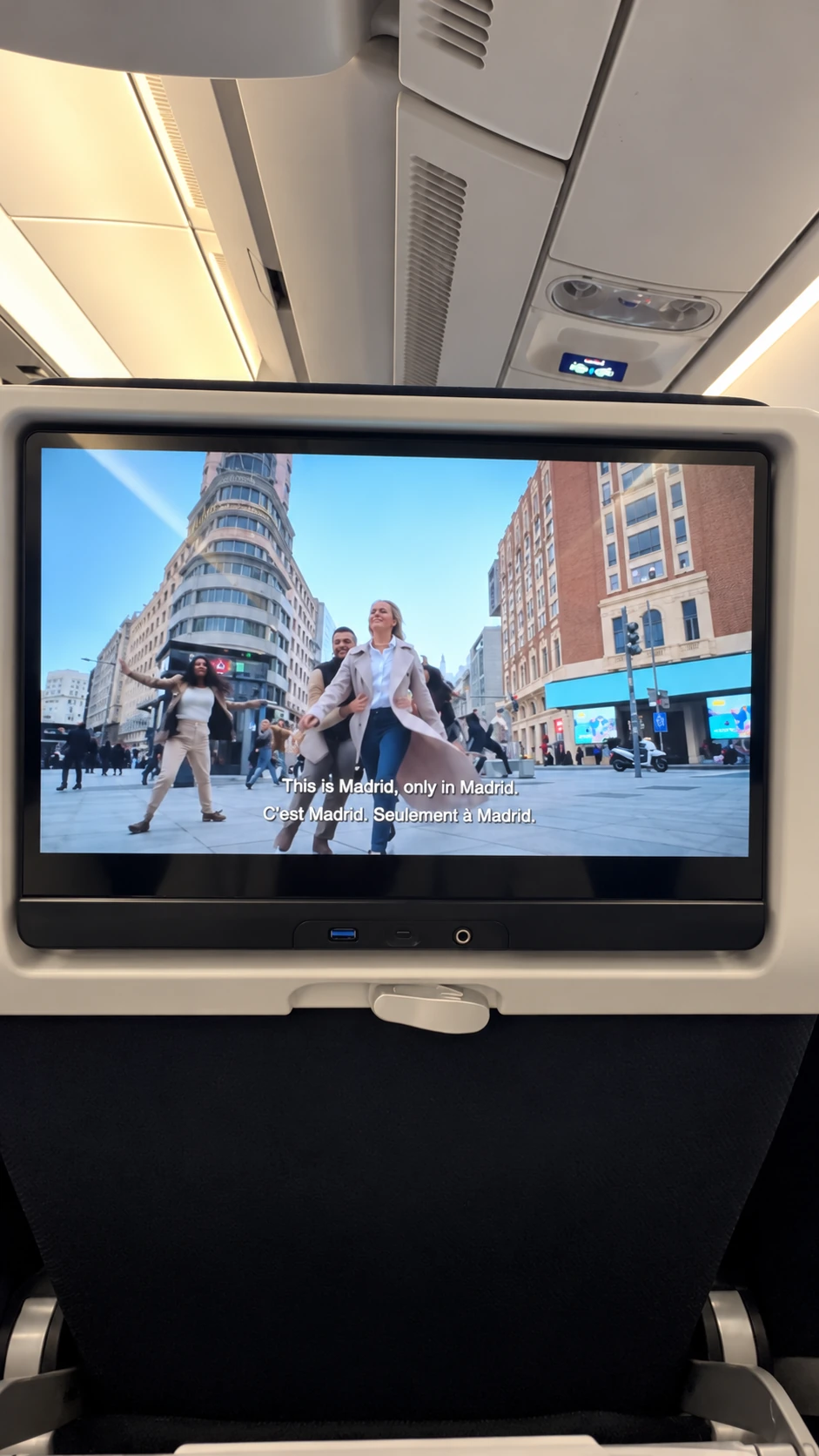
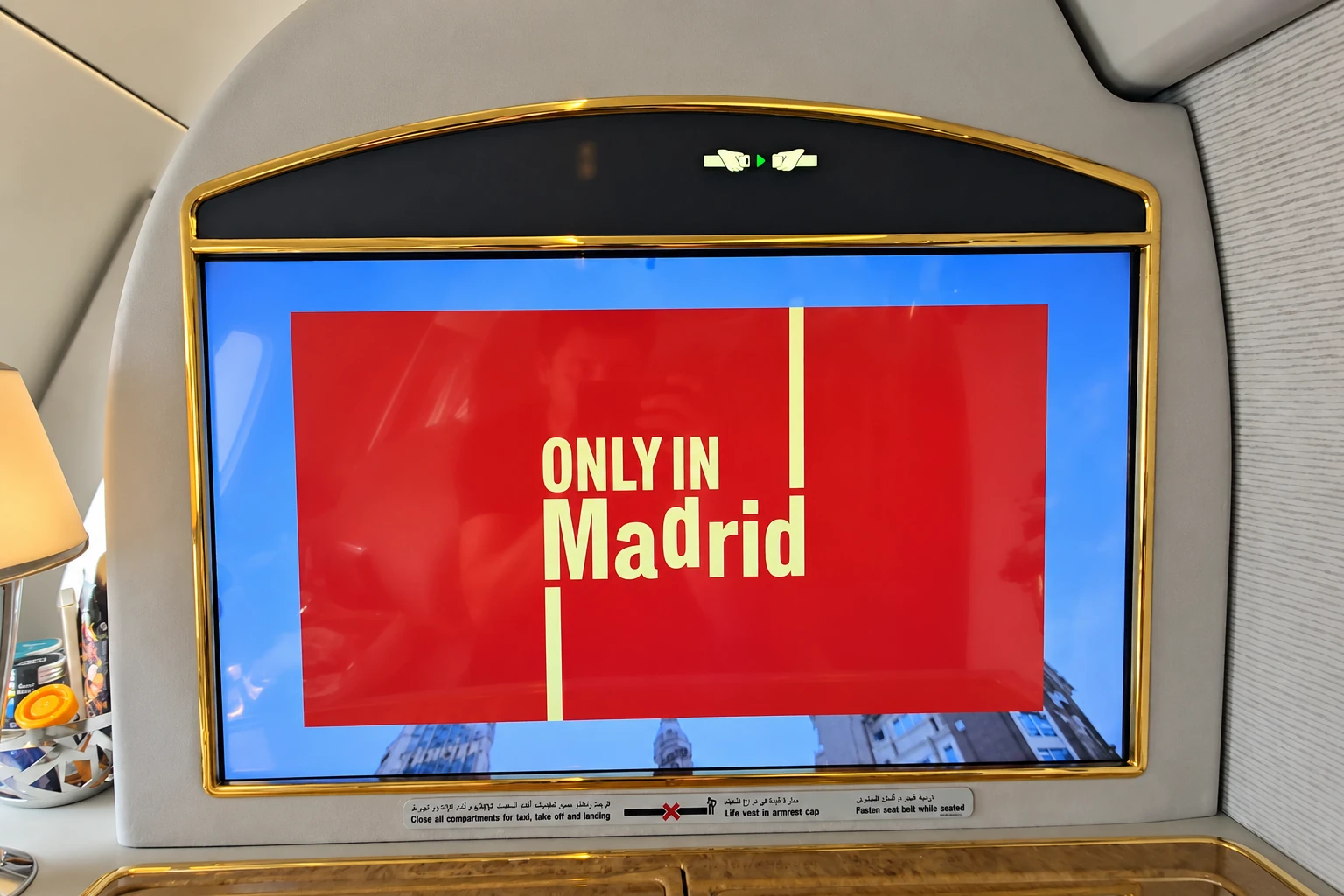
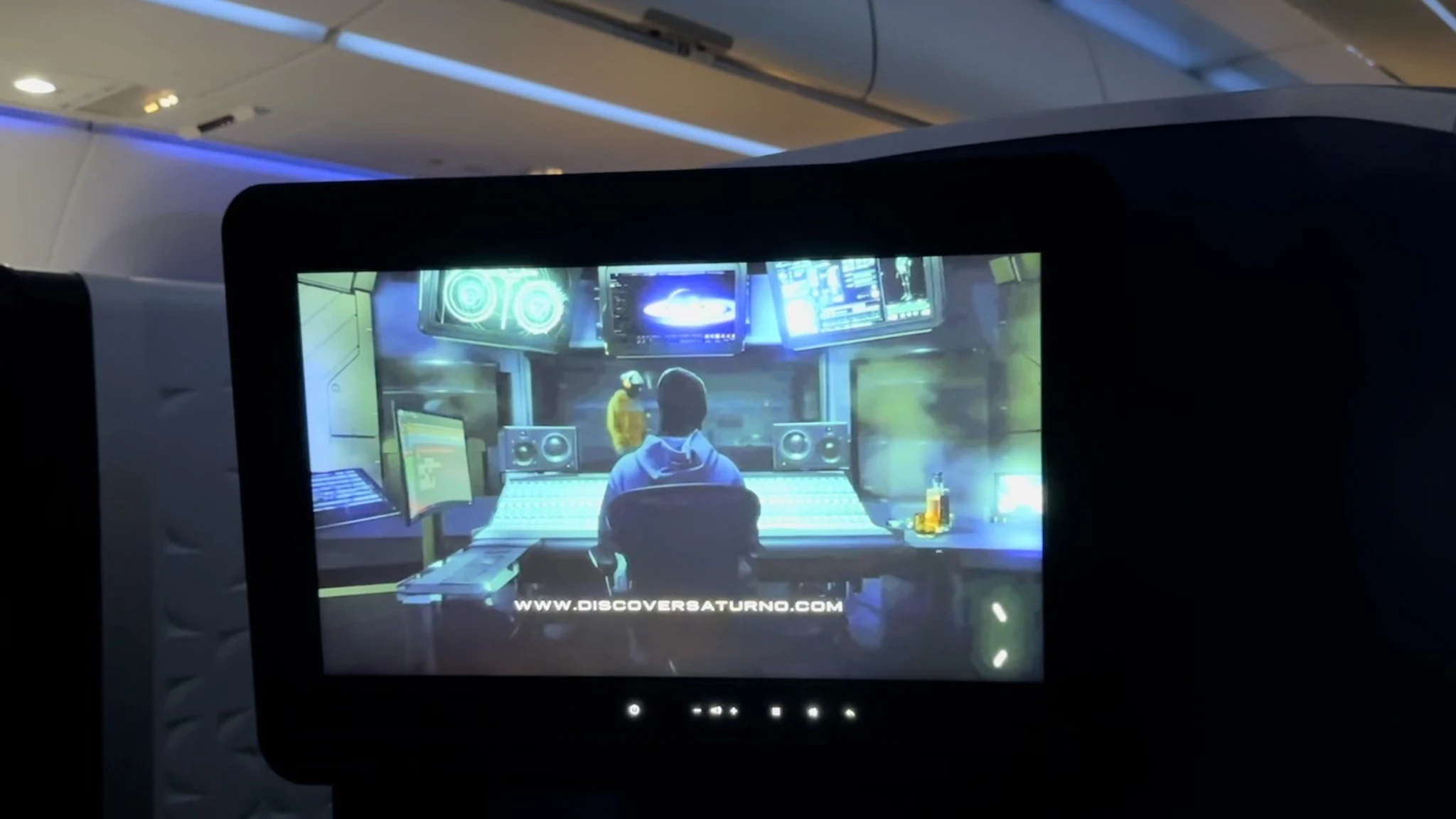
Travel Madrid ran on 10 airlines into Madrid, from United and Air Canada to Emirates, Qatar Airways and Japan Airlines, as one plan with more than 30 million impressions. DXC Technology ran on British Airways, Lufthansa and Emirates. Rauw Alejandro's album launch ran across JetBlue's fleet. EAM has planned and bought in-flight media on 45+ airlines since 2015, from a single carrier's pre-roll to campaigns that pair airline screens with the airports the same passengers walk through.
10 airlines · seatback video
One destination.
Ten airlines' screens.
A tourism board on the seatback screens of 10 airlines flying into Madrid, bought as one plan: United and Air Canada from North America, British Airways, Air France and KLM from Europe, Emirates and Qatar Airways from the Gulf, Korean Air, EVA Air and Japan Airlines from Asia. Ten contracts, ten spec sheets, one buy, and more than 30 million seatback impressions.
British Airways · Lufthansa · Emirates
A B2B brand.
On the long-haul screens its buyers fly.
An enterprise IT services company on the seatback screens of three long-haul carriers, reaching executives on transatlantic, intra-European and Gulf business routes.
 JetBlue · fleet-wide
An album launch.
Every JetBlue seatback.
For the Saturno release, EAM bought seatback pre-roll across the JetBlue fleet and paired it with airport advertising in Miami, New York, Chicago, Madrid and Barcelona.
United · British Airways
A treasury platform.
In front of CFOs at 35,000 feet.
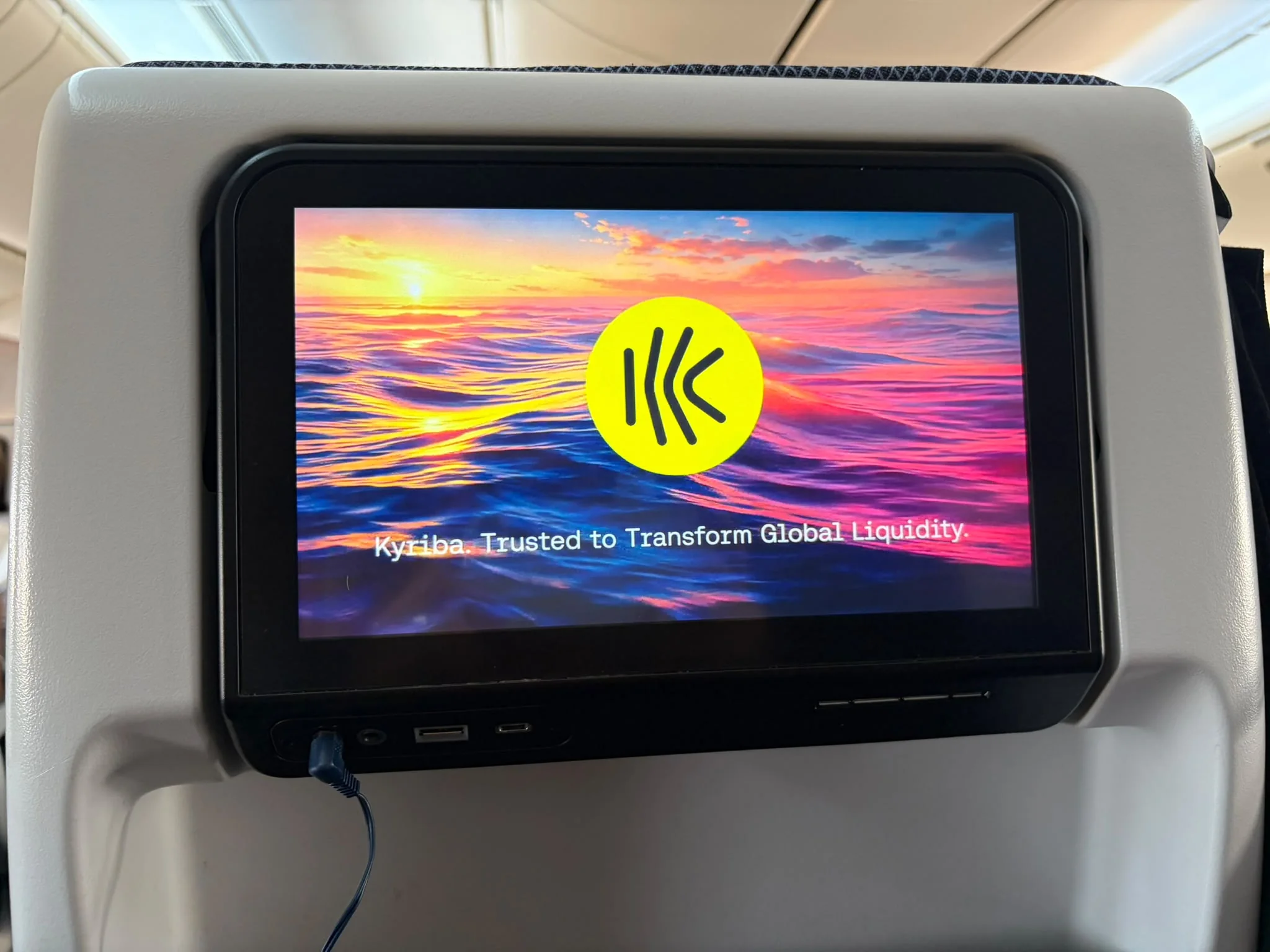
Kyriba, the treasury and cash management software company, ran seatback video on United and British Airways as one plan, putting AI cash forecasting, payments fraud detection and FX risk management in front of the finance leaders who fly those routes for work.
 United · international VOD
A travel eSIM.
Two years on United’s long-haul screens.
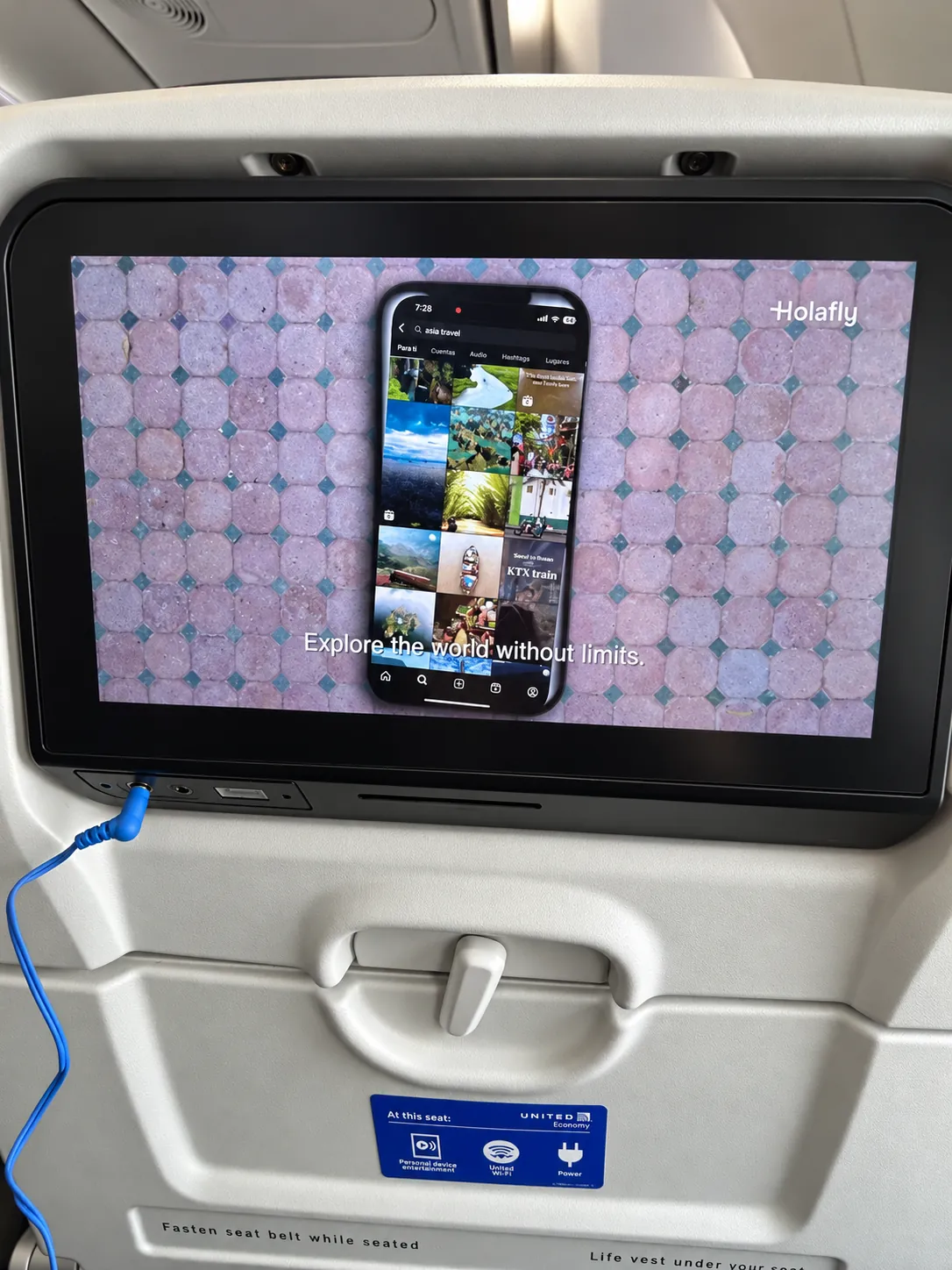
Holafly, the travel eSIM brand, ran video on United’s seatback video-on-demand for two years, focused on international flights, in front of passengers about to land somewhere their phone plan doesn’t work.
“EAM made a nationwide airport campaign feel much easier to manage. The team was responsive, organized, and always on top of the details. They helped us make smart decisions with the budget, kept everything moving, and ultimately delivered exactly what we were looking for.”
 Chief Marketing OfficerFortinet · nationwide airport campaign
These examples show past EAM campaigns, not a minimum campaign size, a forecast, or a guarantee of results. Single-airline briefs are welcome, too.
More inflight advertising examples Airport advertising examples
Airline by airline
Every major U.S. airline except Delta sells advertising on board. United has the deepest menu: pre-roll, menu tiles, a boarding slideshow, a post-safety spot, pause and map ads, all targetable by cabin, route and loyalty tier. American sells pre-roll by aircraft type and entertainment system. Southwest sells pre-roll, live-TV spots and Wi-Fi portal banners, all on the passenger's own device. Alaska sells fleet-wide pre-roll with category exclusivity. JetBlue sells seatback pre-roll through an outside media rep. Delta's seatback screens carry no outside advertising; its Sky Club lounges do. Internationally, British Airways, Emirates, Singapore Airlines, ANA, the Lufthansa Group airlines, Air France, KLM and Iberia all sell screens, and most still sell print.
The table lists what each airline sells on board, where it runs, how it is targeted, and how far ahead it books. Who flies each airline is in the next section, and prices follow in the cost section. Airline pages with the full detail will follow for the carriers EAM buys most, starting with United.
| Airline | What's for sale on board | Screens and devices | Targeting and share of voice | Lead time and notes |
|---|---|---|---|---|
| United | Pre-roll (6–30 s), menu tiles that open a page or a video, boarding slideshow, post-safety spot, pause ads, notification-center ads, moving-map ads | 120,000+ seatback screens on 800+ aircraft; free Starlink Wi-Fi rolling out fleet-wide | Seat or cabin, route, U.S. residency, age, loyalty tier; frequency caps; up to 4 pre-roll advertisers and 3 slideshow advertisers a month | 2 weeks (tiles) to 60 days (slideshow). Sold through an in-house media network it launched in 2024. Planned on impressions |
| American | Pre-roll before every movie and show, sold by placement: widebody seatback, narrowbody seatback, own-device streaming on two Wi-Fi systems | Seatback on all widebodies and 7% of narrowbodies; streaming on all narrowbodies and 79% of regional jets | By aircraft type and movies vs TV; category exclusivity for the term | 60 days. Free Wi-Fi for loyalty members from 2026 on about 90% of the fleet |
| Delta | Nothing on board for outside brands | Seatback screens carry Delta's own and partner content only | — | Sky Club lounges: 40+ clubs, 61 screens, 25% share of voice per 30-second unit, 500+ plays a day. See airport lounge advertising |
| Southwest | Pre-roll before free movies and TV; 15/30/60-second spots in live-TV breaks; Wi-Fi portal banners | No seatback screens; everything on the passenger's device; 60% Wi-Fi take rate; 730 aircraft, 4,000+ daily flights | Pre-roll 50% share of voice with about 3.3 million guaranteed monthly impressions; live TV 25%, up to 5 million; portal 25%, up to 6 million | About 45 days. Free Wi-Fi for loyalty members since October 2025 |
| Alaska | 30-second pre-roll before all movies and TV on the passenger's device, fleet-wide | Own-device streaming; 800+ titles | Forced view; 50% share of voice (one paid spot, one airline spot); category exclusivity; about 1.5 million impressions a month | 30 days; creative can refresh monthly. Free Wi-Fi for loyalty members from 2026 |
| JetBlue | Seatback pre-roll, bought by the month | Seatback screens on every aircraft | Monthly buy; no targeting or share-of-voice split | Sold through an outside media rep; about 45 days |
| British Airways | Monthly pre-roll packages: up to 7 x 30-second spots before any movie (about 2.6 million impressions per insertion) and 3 x 30 seconds before TV (about 1.9 million a month); branded audio channel of up to 60 minutes; Wi-Fi portal ad on the landing and "you're connected" pages, all cabins, long- and short-haul (about 800,000 impressions a month); home-mailed High Life magazine; High Life emails; first-party Meta retargeting | Seatback on 126 long-haul aircraft to 200+ destinations including 26 U.S. cities; about 4.4 million seatback ad impressions a month; 46 million passengers a year | Pre-roll bought by the month in 30- or 60-second pieces; no route or cabin split published. Meta retargeting by booking status, loyalty tier, departure airport, destination and travel window | Sold through an outside media rep; about 45 days. 13 UK lounges: see airport lounge advertising |
| Emirates | 30- to 60-second commercials in the seatback entertainment package | All seats on the seatback-equipped fleet, about 246 aircraft; about 5 million passengers a month | No route or cabin split; language matched to content; English version required | Book 2 months ahead, files 7 weeks; discounts 5–15% for 3–10+ months |
| Singapore Airlines | Pre-roll 10–90 s, 5-second non-skippable billboards, Wi-Fi portal banners, own-device portal, in-flight magazine, loyalty email | Seatback fleet-wide; Wi-Fi ads on about 30% of the fleet | Pre-roll on 25% of movies and 10% of TV; billboards on 100% | 12 weeks. Rates subject to Singapore tax |
| ANA | 15/30-second spots in a 90-second block before international movies; spots before Japanese and overseas programme channels; 15-second domestic cabin-screen spots (no audio); in-flight magazine; loyalty email | International seatback (about 680,000 passengers a month); domestic cabin screens (about 3.7 million a month); magazine about 178,000 copies | Cannot choose route, cabin or movie; content type only | 45–60 days. Yen, sometimes in advance; no refund for a spot that doesn't air |
| Lufthansa Group (Lufthansa, SWISS, Austrian, Brussels, Eurowings, Edelweiss, Discover) | Group-level: Wi-Fi portals and data-based ads. SWISS and Austrian: long-haul pre-roll, after-takeoff video, Wi-Fi portal, boarding passes, check-in and confirmation placements, printed items | About 850 aircraft on Wi-Fi by 2029; SWISS pre-roll about 800,000 views per two months; Austrian about 296,000 reach a month on 10 long-haul aircraft | Austrian: skippable, 33% share of voice, no class or direction split. SWISS: before 30% of the library, two-month minimum. Kids content excluded | 12 weeks for IFE; 3 weeks for data-based. Euros and francs |
| Air France and KLM | Air France: in-flight magazine (150,000 copies), app, newsletter, Wi-Fi portal, long-haul seatback. KLM: in-flight magazine in every seat pocket | Air France about 1.4 million long-haul seatback passengers a month; KLM 30 million passengers a year | Print by position; digital by section | Print 6+ weeks. Euros |
| Iberia | Long-haul pre-roll (30/60 s), in-flight magazine, website display, loyalty digital magazine | A350 and A330 long-haul fleet, 800,000+ impressions a month | Pre-roll limited to 60 seconds of ads a month; not before children's films | Monthly cycle. Euros |
| Aeroméxico | In-flight magazine content inside two Mexican business titles, in the premium cabin and lounges; branded content and events | Premium cabin and 9 lounges | By title and editorial calendar |
Two things the table can't show
First, the buying unit differs: U.S. carriers plan on impressions, so a campaign is sized by how many passengers you want to reach; international carriers sell by the month, so a campaign is sized by how many months you want on the screen. Second, Wi-Fi changed the room. Free Wi-Fi for loyalty members arrived at Southwest in October 2025 and at American and Alaska in 2026, and United is rolling it out fleet-wide; the sponsor's name on that free Wi-Fi is a phone company's, fleet-wide, so what's left for other brands is the login page and the portal, not the headline. Rewarded Wi-Fi, where a passenger watches an ad for free minutes, matters less every month because of it.
What it costs, by airline and format Send a brief for these airlines
Who is on board
Airline passengers earn more, travel more and hold more senior jobs than the general public, by the airlines' own surveys. United reports 41% of its customers with household income above $250,000. ANA and Iberia each put about 4 in 10 passengers as business decision-makers. But the mix changes by airline, route and cabin: Emirates reports 68% of its passengers in economy and 53% flying for leisure. How precisely you can choose who sees the ad depends on the airline. United targets by cabin, route and loyalty tier; ANA lets you choose only the type of program. Pick the airline for the audience first, then the format.
Every figure below is the airline's own, taken from its current media kit, with the year of the survey behind it. Several are a few years old and two carry no date, so read them as a profile of who flies the airline, not as a guarantee of who sees a given ad.
| Airline | Reach | Passenger profile, as published | Survey year |
|---|---|---|---|
| United | About 9 million seatback customers a month on 800+ aircraft | 55% college graduates; 41% with household income above $250,000; 65% married | 2024 |
| Alaska | 42 million passengers a year; 1.5 million pre-roll impressions a month | Average age 45; 54% male; median household income $114,300; C-suite index of 252 (100 is the U.S. average) | 2022 |
| Southwest | 3.3 million guaranteed pre-roll impressions a month; 60% Wi-Fi take rate | Average household income $113,400 | Undated |
| British Airways | 46 million passengers a year; 126 long-haul aircraft with seatback screens | 57% male; average age 39; 66% in the top two UK social grades; 58% from the UK, 29% from the U.S. Among loyalty-club members who fly for business, 1 in 4 is a board or senior-level director | 2024 |
| Emirates | About 5 million passengers a month | 75% aged 25–54; 72% male; 68% in economy; 53% flying for leisure | Undated |
| Air France | 3.5 million passengers a month; 1.4 million on long-haul seatback screens | 55% male; 75% in professional and managerial occupations | 2024 |
| KLM | 30 million passengers a year | 54% male; 84% in the upper and middle social grades | 2020 |
| Lufthansa Group | 130 million passengers a year across the group's airlines | 64% of lounge guests are U.S. residents; 61% of Wi-Fi users are flying for leisure | Undated |
| SWISS | 18 million passengers in 2025 | 50% with household income above CHF 100,000; 66% university-educated | 2024 |
| Austrian | About 296,000 pre-roll views a month | 58% male; 41% flying for business; half with household income above €60,000 | 2024 |
| Iberia | 25 million+ passengers a year | 72% university-educated; 39% business decision-makers | 2018 |
| ANA | About 4.55 million monthly users: 3.8 million domestic, 750,000 international | About 60% male; about 72% aged 30–50; about 40% decision-makers; 47.1% of international passengers with household income of ¥10 million or more | Undated |
| Singapore Airlines | 1.8 million+ monthly audience | 52% male; 70% of top-tier loyalty members are C-level or senior managers | 2022–2023 |
Targeting is where the airlines differ most, and no single airline's kit shows how the others compare. On some carriers the plan can follow a cabin or a route. On others the buy is the whole fleet for a month, and the audience is chosen by picking the airline.
| Airline | What you can choose | What you cannot |
|---|---|---|
| United | Cabin or seat, route, U.S. residency, age range, loyalty membership and tier, and the section of the entertainment menu. First-party segments include Spanish-language, family, frequent flyers and passengers with an upcoming trip | The deepest targeting on any airline; frequency caps available |
| American | Aircraft type (widebody or narrowbody), seatback or own device, movies or TV | No route or cabin split |
| Southwest and Alaska | Fleet-wide share of voice; category exclusivity on Alaska | No route or cabin split; everything runs on the passenger's device |
| British Airways | Off the plane: social retargeting by booking status, loyalty tier, departure airport, destination and travel window | Seatback pre-roll is bought by the month across the long-haul fleet, with no route or cabin split |
| Austrian and SWISS | Off the plane, with booking data: First or Business cabin, origin and destination, departure dates, language | On-board pre-roll is not split by class or direction |
| ANA | Type of content: movies, Japanese programmes or overseas programmes | Cabin, route and the specific title cannot be chosen |
| Lufthansa Group | Verified loyalty members on the Wi-Fi portal; campaigns built on the group's own customer data | Varies by airline within the group |
| Emirates | Language matching | Otherwise the audience is whoever is on the aircraft that month |
Business decision-makers
Buy the carriers whose own surveys show the seniority: British Airways, ANA, Iberia and Singapore Airlines on board, United by cabin and loyalty tier. Add airport lounge advertising for the same people before they board. This is how Kyriba and DXC Technology reached finance and IT leaders.
Inbound international travelers
A destination or a brand that needs visitors buys the airlines those visitors arrive on, not the home carrier alone. Travel Madrid ran on 10 airlines from North America, Europe, the Gulf and Asia as one plan.
Broad U.S. reach
American, Southwest and Alaska deliver most of their impressions on phones and laptops through the free entertainment portal, at household incomes well above the national average. Planned on impressions, not routes.
High-value repeat flyers
The airline's own list reaches frequent flyers at home, by market and language: about 12 million readers at British Airways, about 10 million at ANA, about 9.4 million at Austrian. Often limited to travel partners and destinations.
Cost
On U.S. airlines, in-flight advertising is planned on impressions, not slots. A United campaign starts around $80,000 for about 1 million impressions and scales to $300,000 and up for the larger impression tiers. The other U.S. carriers run $50,000 to $200,000 for 1 to 5 million impressions. International carriers still sell by the month: a 30-second pre-roll on a European or Japanese flag carrier runs about $15,000 to $25,000 a month; on the big Gulf and Asian long-haul carriers, $100,000 to $350,000 and up. Every figure here is a planning range for media only, in U.S. dollars.
What moves the price. Impressions first: on U.S. carriers the same campaign costs more or less depending on how many passengers it reaches, and United lets you scale up or down inside a flight. Then fleet share: a buy on every aircraft costs more than a buy on the widebodies or on one entertainment system. Then the formats bundled with the pre-roll: menu tiles, the boarding slideshow, the Wi-Fi portal. Then the length of commitment: Emirates, ANA, Iberia and Air France publish discounts of 5 to 20 percent for three to twelve months. Season matters less than at airports; there is no CES week in the sky.
What the ranges leave out. Production and translation are yours: Emirates requires an English version of every spot, ANA recommends captions because its cabin screens have no audio, and Austrian takes standard-definition files only. Several European carriers charge 50 percent to cancel more than four weeks before the material deadline, 70 percent inside four weeks, and 100 percent after it. ANA does not refund a spot that doesn't air because of an entertainment fault. We build all of that into the plan before you sign.
| Airline | What the range buys | Planning range (media only) | Impressions | Notes |
|---|---|---|---|---|
| United | Seatback pre-roll, menu tiles, boarding slideshow, post-safety spot, map and pause ads, in any mix; scales up or down inside the flight | $80,000–$300,000+ per campaign | 1–10 million | Targetable by cabin, route, U.S. residency, age and loyalty tier |
| American, Southwest, Alaska, JetBlue | Pre-roll on seatback and own-device entertainment; Southwest adds live-TV spots and portal banners; Alaska adds category exclusivity | $50,000–$200,000 per campaign | 1–5 million | American sells by placement (widebody seatback, narrowbody seatback, two streaming systems) |
| Delta | Nothing on board for outside brands | — | — | Sky Club lounge screens are sold: see airport lounge advertising |
| Format | Who sells it | Planning range | Unit | Notes |
|---|---|---|---|---|
| Seatback pre-roll, 30 seconds, European or Japanese flag carrier | Austrian, SWISS, Iberia, ANA | $15,000–$25,000 | per month | Share of voice 25–33%; SWISS has a two-month minimum |
| Seatback pre-roll, 30 seconds, Gulf and Asian long-haul carriers | Emirates, Singapore Airlines | $100,000–$350,000+ | per month | Emirates: 100% of seats, one-month cycle, about 5 million passengers; longer spots cost more. British Airways sells the same kind of monthly package; price on request |
| Wi-Fi portal banner | Austrian, SWISS, Singapore Airlines, British Airways (price on request) | $6,000–$21,000 | per month | Login page and portal pages; the free-Wi-Fi sponsorship itself is held by telecoms on the U.S. carriers |
| In-flight magazine, full page | Air France, KLM, Iberia, ANA, Singapore Airlines, British Airways (price on request) | $8,000–$25,000 | per issue | Covers and opening spreads run to about $45,000–$60,000 |
| Sponsored content and advertorial | Singapore Airlines, KLM, Austrian, Air France, Iberia | $8,000–$90,000 | per placement | From a content integration to a 15-minute sponsored episode |
| Printed onboard items (boarding passes, napkins, towels, seat-pocket brochures) | Austrian, SWISS, Air France | $15,000–$210,000 | per 6–12 months | Printing is extra; 12–16 weeks lead time |
| Rewarded Wi-Fi (watch an ad for free minutes) | Wi-Fi providers on several carriers | $0.35–$1.00 | per activation | Shrinking as free member Wi-Fi spreads |
Budget floors
What an in-flight budget can buy
Each level is a floor with the formats that become possible at it, not a package; the mix is built around your airlines, dates and impressions.
One U.S. carrier
Two U.S. carriers, or United at mid-scale
United at full scale, or three to four airlines including an international carrier
Your airlines, your dates
Tell us the airlines and the dates and we'll come back with current availability and a planning range.
Who sells it
Airlines sell it, each in its own way. United sells through an in-house media network it launched in 2024. American sells its screens itself. JetBlue, British Airways, Emirates, Singapore Airlines and Delta's lounges sell through outside media reps; Southwest and Alaska sell through the companies that run their Wi-Fi and entertainment; the magazines are sold by publishers. There is no marketplace. A campaign on four airlines is four contracts in up to four currencies, with four sets of specs, deadlines and approval rules. EAM, an airport and in-flight media agency founded in 2015, plans and buys across 45+ airlines as one campaign, and owns no inventory, which is what keeps its recommendations independent.
What four contracts actually means. United and American invoice in dollars; Austrian and Air France in euros; SWISS in francs; ANA in yen, sometimes in advance. United and American want 1920x1080 ProRes at 23.98 frames a second with the captions baked in; Austrian wants standard definition; American wants two seconds of black at the head and one at the tail, United one and one. United will not run ads for streaming services; ANA will not run a competitor of its group, a superlative without third-party proof, or a QR code in video; Emirates needs an English version and content that fits the Gulf; SWISS and Iberia keep ads off children's content. United, American, Emirates, ANA and Singapore Airlines all reserve the right to reject creative, and the seatback systems on most airlines load new content once a month, so a file that misses the upload date misses the cycle.
What an airline's media team can and can't do for you. It will build a good plan on its own airline, and the price it quotes is the price. What it cannot tell you is whether the same budget reaches more of your buyers on another carrier, whether the routes you care about are mostly flown on aircraft without screens, or whether part of the money belongs at the airport instead. Its job is to sell that airline's inventory. A media rep that sells several airlines has the same limit, one layer up.
What EAM handles on an in-flight campaign: the plan by airline, format and impressions; avails holds and contracts; the specs and deadlines for every system; creative trafficking and approvals; one invoice; one report. The same team plans the airports those passengers walk through, so an in-flight buy can be paired with the departure and arrival terminals without a second agency.
| Compared on | Airline media team | Media rep or publisher | EAM Advertising |
|---|---|---|---|
| Airlines covered | One | Several, the ones it represents | 45+, any mix |
| Contracts and invoices | One per airline, in its currency | One per rep, several currencies | One contract, one invoice |
| Specs, deadlines and trafficking | That airline's | Each airline's, handled by you | Every airline's, handled by EAM |
| Creative approvals | That airline's rules | Each airline's rules | Pre-checked against every airline before you shoot |
| Reporting | That airline's numbers | Per airline | One report across airlines |
| Recommendation | Its own inventory | Its own airlines | Independent of any media owner; airports included when they fit |
Airport advertising Airport advertising agency for multi-airport campaigns
Timing
Plan 30 to 60 days ahead on U.S. carriers, 8 to 12 weeks on most international carriers, and 12 to 16 weeks for anything printed on board. Seatback systems on most airlines load new content once a month, usually on the first, so a late file doesn't run a few days late; it misses a whole cycle.
From brief to report
Brief: airlines or routes, dates, budget, the creative you have.
Plan and holds: formats by airline, impressions, a planning range per carrier, avails held where the airline allows it.
Contracts: one with EAM; EAM signs each airline's paper, in its currency.
30 to 60 days before launch on U.S. carriers, 7 to 12 weeks internationally; the table below has each airline's window.
The first of the month on most seatback systems; United's newer screens update inside the month.
The flight runs; impressions are reported during and after.
One report across every airline: impressions, completions, clicks, and the brand study if one was commissioned.
| Airline or format | Book by | Creative due | Upload | Notes |
|---|---|---|---|---|
| United menu tiles | 4 weeks | 2–4 weeks | Rolling on newer screens | Subject to upload schedule |
| United pre-roll | 6 weeks | 30 days (60 for library video) | 1st of the month | |
| United boarding slideshow | 10 weeks | 60 days | 1st of the month | Max 2 rounds of revisions if United builds the creative |
| American | 10 weeks | 60 days | Monthly cycle | |
| Alaska | 6 weeks | 30 days | Monthly cycle | |
| Southwest | 45 days | Inside the 45-day window | — | Pre-roll, live TV and portal on one calendar |
| JetBlue | 45 days | Inside the 45-day window | — | Fleet-wide seatback |
| British Airways seatback | 45 days | Inside the 45-day window | Monthly package | Monthly package |
| Emirates | 2 months before the cycle | 7 weeks | Monthly cycle | Cycle deadlines fall on the 1st, two months out |
| ANA | 50–60 days | 40–45 days | Monthly cycle | |
| SWISS and Austrian seatback | 12 weeks | 9–12 weeks | 1st of the month | |
| Singapore Airlines seatback | 12 weeks | 8 weeks | Monthly cycle | Digital products: 6 weeks / 3 weeks |
| In-flight magazines | 6–10 weeks | 4–8 weeks | Per issue | |
| Printed onboard items | 12–16 weeks | 9–12 weeks | Print run | |
| Airline data-based ads | 3 weeks | 1 week | — |
Specs in brief
Video: 1920x1080, 16:9, 23.98 frames a second, 48 kHz audio, ProRes preferred, one to two seconds of black at head and tail, captions burned in. Static: JPEG, sizes set by the airline; United's menu tiles are tall (about 920x1380) and its full-screen takeovers are 3840x2160. Wi-Fi portal banners: 728x90 and 300x50 at Southwest. Print: PDF at 300 dpi or better with 3 mm bleed. We send the exact spec sheet for each airline with the plan.
Honest view
The advantage is time with a seated audience and no competing screen: United reports 3.5 hours of average engagement with its seatback entertainment and an 87 percent take rate. The limits are real. On domestic flights the ad usually runs on the passenger's own phone, not a seatback. Delta sells nothing on board. Most inventory is shared with up to four advertisers. Reporting is delivery, not sales. And lead times run 30 to 90 days.
Advantages first, then the limits
United reports 3.5 hours of average engagement with its seatback entertainment and an 87 percent take rate; the average American flight runs about 145 minutes. No other screen gets that long with a seated adult.
Pre-roll on United, American, JetBlue, Alaska and Southwest is non-skippable. Only a few international carriers let passengers skip.
Cabin, route, U.S. residency, age and loyalty tier, with frequency caps. Free member Wi-Fi is turning that into live, in-flight personalization.
You can buy the widebodies only, or long-haul only, or first and business only on some carriers. ANA and Austrian do not split by route or cabin.
On U.S. domestic flights the ad usually runs on the passenger's own phone. Southwest has no seatback screens; American has them on 7 percent of its narrowbodies.
Delta's seatback screens carry its own and partner content only. The Sky Clubs can be bought; the flight cannot.
United allows up to four pre-roll advertisers a month; Alaska and Southwest run one paid spot against one airline spot. Exclusivity is a category deal, not a default.
Impressions, completions and clicks are standard. Brand lift is a paid study; sales attribution exists only where the ad links to a booking or a code.
Most seatback systems load once a month. Miss the file date and you miss the cycle, and some carriers do not refund a spot that doesn't air.
No streaming-service ads on United. No competitors of the ANA Group, no unproven superlatives, no QR codes in video on ANA. An English version on Emirates. Kids content excluded on SWISS, Austrian and Iberia.
Measurement
Airlines report delivery: impressions, completed views, clicks on menu tiles, scans of a QR code. Brand lift is available as a paid panel study on some carriers; United cites a 96 percent completion rate and a 15-point rise in aided awareness for a luxury brand measured that way. Sales attribution exists only where the ad links to a booking or a code. Plan to prove reach and completion on every campaign, and to run a lift study when the budget justifies it.
What can and cannot be measured in flight
Every airline reports them; Southwest guarantees a monthly floor on pre-roll. The unit most airlines price on.
HighloggedReported by quartile on United and American; near-total on non-skippable units.
HighloggedMenu tiles, notification-center ads and portal banners report clicks; United cites a 2.21 percent tap-through for a luxury brand's tiles. QR codes open full websites on the passenger's phone.
Moderatewhere the unit allows itA paid survey of exposed and unexposed flyers; United cites a 15.3-point rise in aided awareness for a luxury brand. Budget for it as a line item.
Moderatepaid studyUnited cites a third-party attention score for its seatback screens. Useful for comparing channels, not for proving a campaign.
Directionalthird-partyOnly where the ad links to a booking page or a code; United's tourism case counted bookings by passengers who saw the ad and later booked with United.
Lowonly with a link or codeWhat the airlines' own research says
The published numbers,
and who paid for them.
The figures below come from the airlines' media kits. The airline paid for each study, so read them as the seller's case, not a neutral one; we include them because they are the only published figures on how passengers use these screens.
with seatback entertainment on United, with an 87 percent take rate and about 9 million monthly seatback customers.
on a luxury brand's United pre-roll, with a 15.3-point rise in aided awareness in a third-party panel study; campaign undated.
on American's wireless entertainment, against 1.5 million on seatback screens.
of Southwest passengers connect to the Wi-Fi portal, up 10 points year on year.
of ANA's international passengers; 71 percent say an ad feels more refined in flight than in everyday life. Undated survey.
Emirates passengers use the entertainment system for more than half the flight, and about 6 in 10 never try to skip the ads. Undated survey.
Airport advertising effectiveness, with the independent research
Ready to plan?
Airlines or routes, dates, budget, and what you want people to do. We come back with avails and a plan.
125+ airports · 45+ airlines · Since 2015
Beyond the cabin
Four things, all off the plane: lounge screens; booking-path placements on confirmation emails, check-in pages and mobile boarding passes; loyalty newsletters; and ads on the open web, YouTube and Meta targeted with the airline's own passenger data. Lounges are airport media, covered on our airport lounge advertising page. The other three are useful when the goal is the airline's frequent flyer rather than the flight.
Booking-path placements run about $9,000 to $35,000 a month per placement on the European carriers that publish rates; a mobile boarding pass at Austrian reaches about 1 million users a month. Loyalty newsletters are the biggest lists an airline has: Austrian's worldwide edition goes to about 9.4 million addresses, ANA's to about 10 million, and British Airways sends two monthly emails to about 12 million readers. Data-based ads, where the airline's travel data targets your ad on other sites and platforms, run about $25 to $75 CPM, with surcharges per targeting parameter and for premium-cabin flyers; United, British Airways, the Lufthansa Group airlines, Austrian and SWISS all sell a version.
| Placement | Who sells it | Planning range (USD, approx.) | Reach example | Notes |
|---|---|---|---|---|
| Booking confirmation, check-in confirmation, mobile boarding pass | Austrian, SWISS, Iberia | $9,000–$35,000 per month | Austrian mobile boarding pass: about 1 million users a month | Images with short copy; 4–6 weeks |
| Loyalty newsletter | Austrian, ANA, Singapore Airlines, Air France, British Airways | $2,000–$90,000 per send | Austrian worldwide: about 9.4 million; ANA: about 10 million; British Airways: two monthly emails to about 12 million | Often limited to travel partners and destinations; BA sells four sponsored slots per email with regional and tier targeting |
| Airline data-based ads (web, YouTube, Meta) | United, British Airways, Lufthansa Group, Austrian, SWISS | $25–$75 CPM | Verified loyalty members and recent bookers; BA targets by booking status, tier, departure airport, destination and travel window | Surcharges per targeting parameter and for premium cabins |
| Lounge screens | United, Delta, British Airways, Lufthansa Group, SWISS, Austrian, Air France | See airport lounge advertising | United Clubs 15.5 million visits a year; Delta 40+ clubs; British Airways 13 UK lounges, about 390,000 visits a month | Airport media; not on this page |
Questions
Paid media on the aircraft and on the airline's own screens: video before the movie a passenger chose, on the seatback or on their phone; ad tiles on the entertainment menu; a slideshow during boarding; banners on the Wi-Fi login page; pages in the in-flight magazine; printed items in the seat pocket. On U.S. airlines it is almost all screens. On many international carriers print is still sold alongside them.
Passengers who earn more, travel more and hold more senior jobs than the general public, by the airlines' own surveys. United reports 41% of its customers with household income above $250,000; ANA and Iberia each put about 4 in 10 passengers as business decision-makers. The mix changes by airline and cabin: Emirates reports 68% of passengers in economy and 53% flying for leisure. United lets you target by cabin, route and loyalty tier; on most other airlines you choose the audience by choosing the airline.
On U.S. airlines it is planned on impressions. A United campaign runs from about $80,000 for 1 million impressions to $300,000 and up as the impressions scale. The other U.S. carriers run $50,000 to $200,000 for 1 to 5 million. International carriers sell by the month: a 30-second pre-roll on a European or Japanese flag carrier is about $15,000 to $25,000 a month, and on the large Gulf and Asian long-haul carriers $100,000 to $350,000 and up. All are planning ranges for media only, in U.S. dollars.
United, American on its widebodies, JetBlue, British Airways on its 126 long-haul aircraft, Emirates, Singapore Airlines, ANA, SWISS and Austrian on long-haul, Air France on long-haul, and Iberia on long-haul. Southwest has no seatback screens; its ads run on the passenger's device. Delta's screens carry no outside advertising.
No. Delta's seatback screens carry its own and partner content only. Delta's Sky Club lounges do sell screen advertising, which is airport media; see our airport lounge advertising page.
Usually not. Pre-roll on United, American, JetBlue, Alaska and Southwest plays through before the content starts. Austrian's long-haul pre-roll can be skipped, and Singapore Airlines' spots can be fast-forwarded but not skipped. Passengers can opt out of personalized targeting on United, which changes who sees the ad, not whether it plays.
On United, yes: by cabin, route, U.S. residency, age range and loyalty tier, with frequency caps. On American you choose the aircraft type and entertainment system, which is a rough route proxy. Alaska and Southwest sell fleet-wide. ANA and Austrian do not split by route or cabin at all. Route exclusivity is not a standard product on any airline.
Not in the United States. Delta and Southwest stopped first, American Way closed in 2021, and United printed its last issue in September 2024. Air France, KLM, Iberia, ANA, Singapore Airlines and Aeroméxico still print, and sell a full page for about $8,000 to $25,000 an issue. British Airways prints High Life six times a year and mails 35,000 copies to its top-tier members' homes instead of the seat pocket.
Yes, on the login and portal pages: banners on Southwest's portal at 25 percent share of voice, banner-and-advertorial packages on SWISS and Austrian, an ad on British Airways' portal landing page in every cabin on long- and short-haul, and portal placements on Singapore Airlines and across the Lufthansa Group. The free-Wi-Fi sponsorship itself is sold fleet-wide to a telecom at Delta, American, Southwest and Alaska, so the headline is taken; the space beside it is not. Rewarded Wi-Fi, where a passenger watches an ad for free minutes, is fading as free member Wi-Fi spreads.
Three kinds. The airlines' own media teams: United, American, ANA and the Lufthansa Group airlines sell their screens in-house. Outside sales reps, publishers and Wi-Fi providers that sell on an airline's behalf: JetBlue, British Airways, Emirates, Singapore Airlines, Southwest, Alaska and the European magazines are sold this way. And media agencies like EAM that plan and buy across airlines. EAM, founded in 2015, buys across 45+ airlines and owns no inventory.
No reliable public figure exists; the published market reports are paid studies that disagree with each other and mix in-flight retail with advertising. What is measurable: United launched the first airline-run media network in 2024, Delta hired a head of media network in 2026 for lounge and partner media, the Lufthansa Group sells 72 touchpoints across eight airlines, and airlines worldwide now carry more than 5 billion passengers a year.
30 to 60 days on U.S. carriers, 8 to 12 weeks on most international carriers, and 12 to 16 weeks for anything printed on board. Most seatback systems load new content on the first of the month, so a late file misses a whole cycle, and some carriers do not refund a spot that doesn't air.
Yes. Each airline is a separate contract with its own currency, specs, deadlines and approval rules; EAM plans and buys across 45+ airlines as one campaign. EAM handles the plan by airline, format and impressions, avails holds and contracts, the specs and deadlines for every system, creative trafficking and approvals, one invoice and one report, and pairs the in-flight buy with the airports those passengers walk through when that fits.
Airport and in-flight media agency. 45+ airlines. Est. 2015.
Formats by airline, planning ranges, and booking windows. Sent within minutes.
125+ airports · 45+ airlines · Since 2015
Sources
Updated November 12, 2026 · By EAM Advertising

EAM Advertising plans, secures, and buys airport and in-flight media across 125+ airports and 45+ airlines worldwide. Founded in 2015. It owns no advertising inventory, which is what keeps its recommendations independent. Past clients include Dynatrace, Fortinet, Rubrik, McGraw-Hill, and Wharton.