One airport
$7,000 to $50,000 per unit
One spot in a screen network, one banner, or one spectacular for one flight. A two- or three-network package at one airport runs $15,000 to $110,000; owning the airport for a flight starts north of $150,000.
Whether you’ve been handed a conference week, a launch across five cities, or a budget that has to move this quarter, this page gives the planning ranges: one unit at one airport to ten airports in one plan, by format, airport size, and campaign shape, from EAM Advertising, an airport advertising media agency that plans and buys across 125+ airports and 40+ media vendors. Get our media kit for the full ranges, formats, and booking windows.
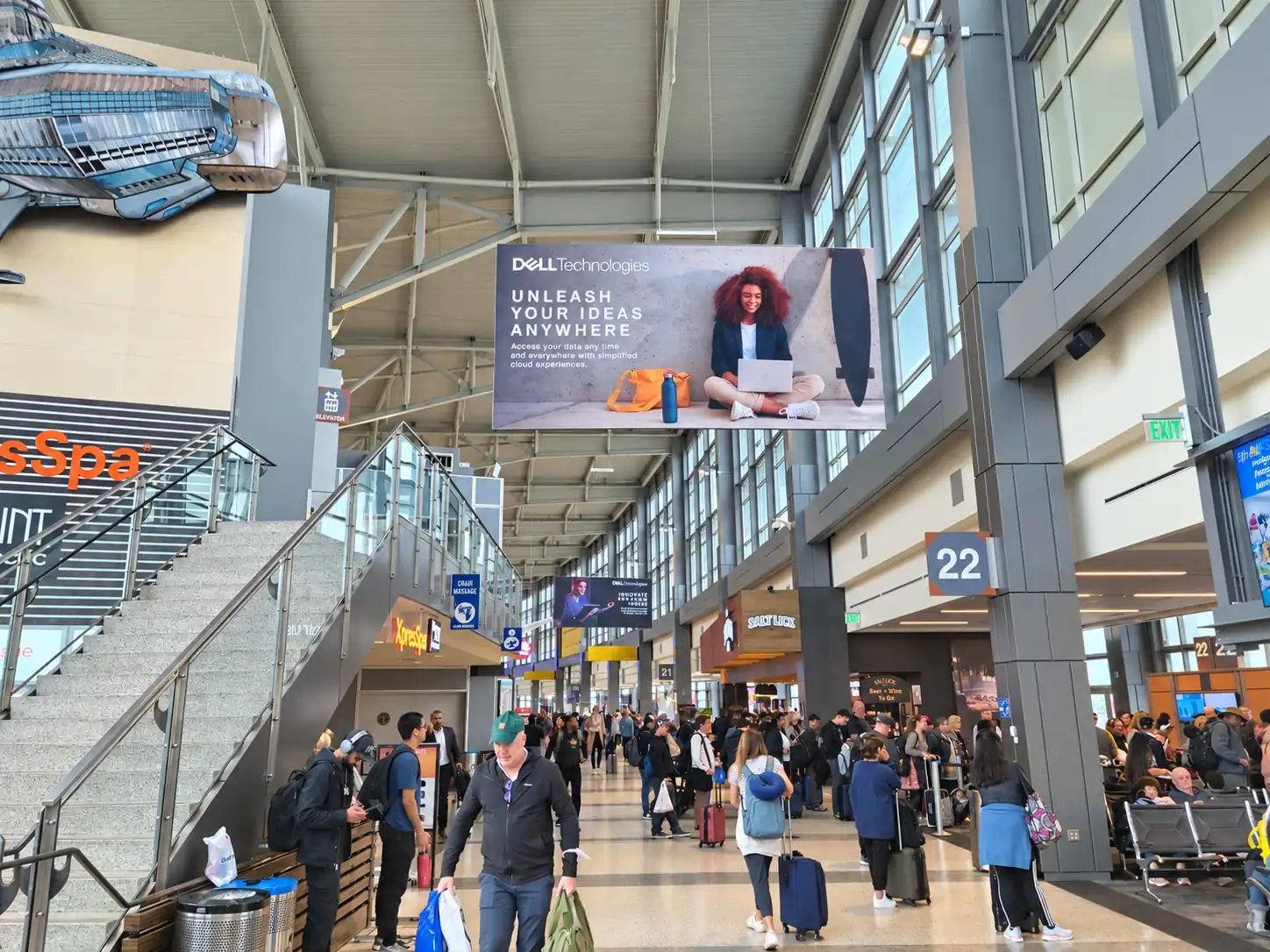
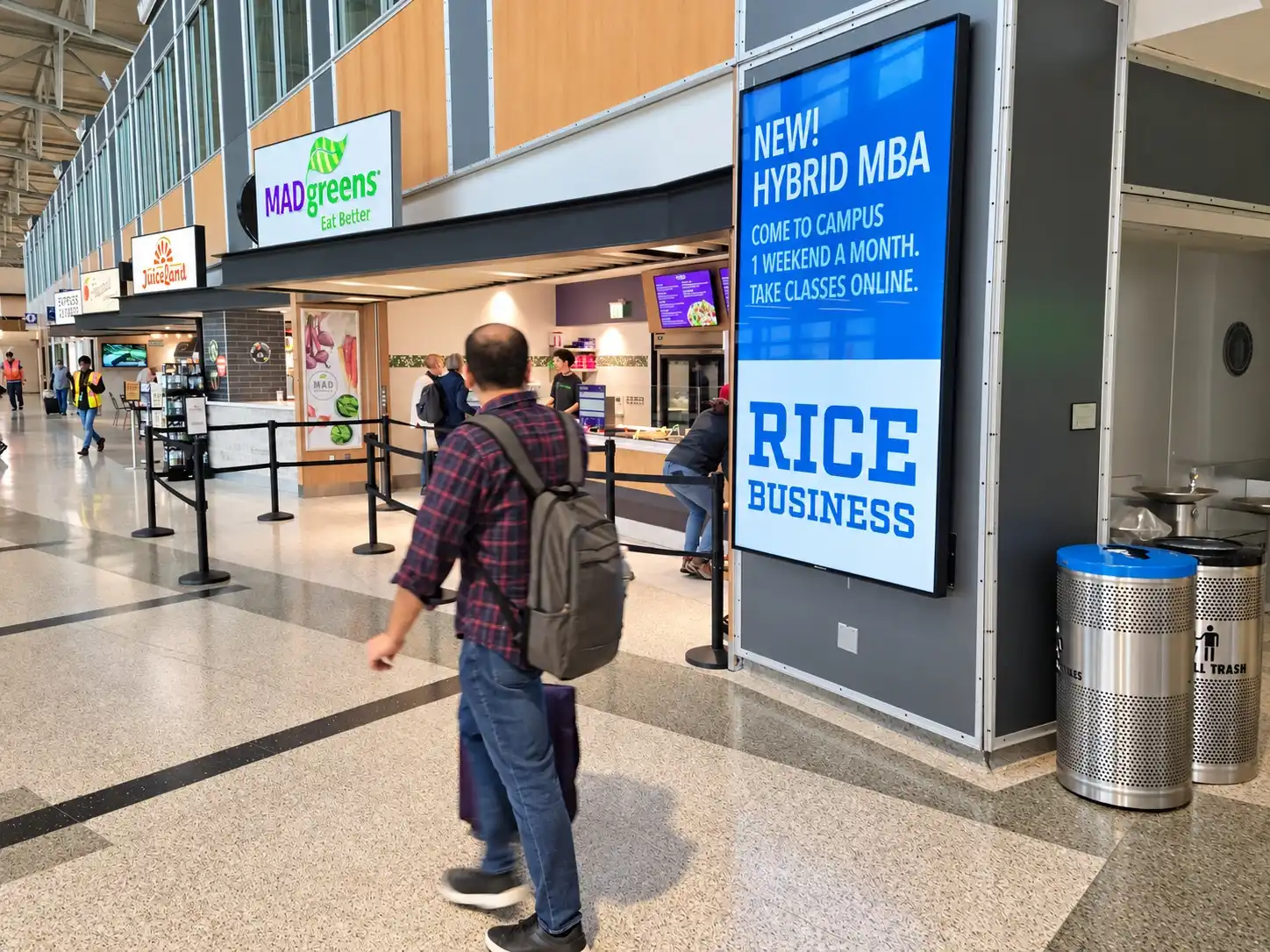
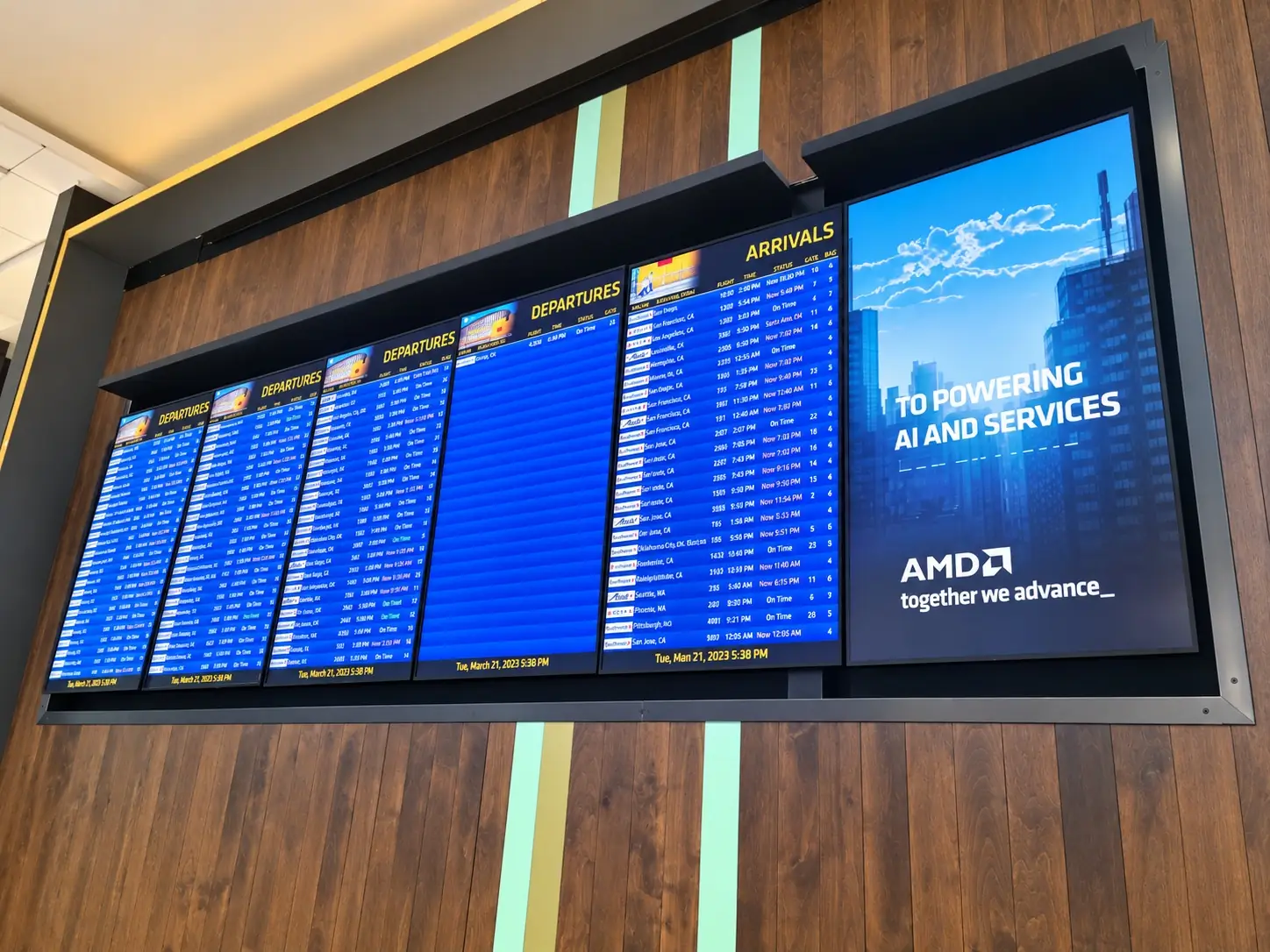
You’re in good company






The short answer
These ranges are for medium to large airports, from Phoenix (PHX) up to JFK, Las Vegas (LAS), and San Francisco (SFO); smaller airports such as San Antonio (SAT) run 25 to 40% less, depending on passenger traffic. As of October 2026, a single unit at one airport plans at about $7,000 to $50,000 for a four-week flight. Three airports run $75,000 to $100,000 at entry level and $100,000 and up when built for impact. Five major U.S. hubs run $150,000 to $250,000 at entry level and $250,000 and up for impact. Eight to ten airports, including two or three outside the U.S., start at $500,000. Media only, four-week flights, planning ranges rather than a rate card.
One airport
One spot in a screen network, one banner, or one spectacular for one flight. A two- or three-network package at one airport runs $15,000 to $110,000; owning the airport for a flight starts north of $150,000.
Three to five airports
Entry level: static and digital unit options across three to five airports for four weeks. Built for impact, with larger creative and more frequency: $100,000 and up for three, $250,000 and up for five.
Eight to ten airports
A national program with two or three international airports, four to eight weeks, every format possible. This is where one plan and one contract across several media owners earns its keep.
Smaller airports cost less
The ranges above are for medium to large airports, from Phoenix (PHX) up to JFK, Las Vegas (LAS), and San Francisco (SFO). At smaller airports such as San Antonio (SAT), the same campaign typically runs 25 to 40% less, depending on passenger traffic. Unit rates, loop-position premiums, and airport-specific quotes are not published here; they move with availability and the calendar, and come back as a quote.
Start your plan
Pick the one that matches where you are. Every path ends with current availability and a recommended mix.
By campaign shape
These ranges are for medium to large airports, from Phoenix (PHX) up to JFK, Las Vegas (LAS), and San Francisco (SFO); smaller airports such as San Antonio (SAT) run 25 to 40% less, depending on passenger traffic. Airport advertising is priced by the unit and the flight, not by the impression, so the shape of the campaign sets the number before any format does. The table gives planning ranges for the six shapes EAM Advertising quotes most often, media only, for a standard four-week flight.
| Campaign shape | Airports | Planning range, four weeks | What it typically includes | Who buys it this way |
|---|---|---|---|---|
| One unit | 1 | $7,000–$50,000 | One spot in a digital network loop, one banner, or one spectacular | A home-market brand, a first test, an event week at one airport |
| One-airport package | 1 | $15,000–$110,000 | Two or three networks, or a mix of digital and static along the arrival path | Conference exhibitors, universities, regional brands |
| One-airport domination | 1 | $150,000+ | The airport's digital networks and static units, and at some airports trays or lounges, for one flight | Launches, category leaders, the one conference week that matters most |
| Three airports | 3 | $75,000–$100,000 entry · $100,000+ built for impact | Static and digital units at each airport; larger creative and more frequency at the impact level | Regional programs, account-based plans against a few headquarters cities |
| Five major U.S. hubs | 5 | $150,000–$250,000 entry · $250,000+ built for impact | Digital networks, static units, lounges, and more at each hub | National B2B awareness, product launches |
| Eight to ten airports | 8–10, U.S. plus 2–3 international | $500,000+ | Every format possible, four to eight weeks, one plan and one contract across several media owners | Global brand programs, IPO and rebrand campaigns, conference circuits |
Ranges are for medium to large airports, from Phoenix (PHX) up to JFK, Las Vegas (LAS), and San Francisco (SFO); smaller airports such as San Antonio (SAT) run 25 to 40% less, depending on passenger traffic. Media only; production and installation are quoted separately (see below). Ranges are planning figures from EAM Advertising's buying across 125+ airports, not a rate card. Plans beyond ten airports scale the same way; a 20-airport program is quoted airport by airport against current availability. Event weeks are sold by the week; most other flights sell in four-week or 28-day periods.
Most airport inventory sells in four-week flights or 28-day periods, and the ranges on this page assume one of those. Some airports also sell two-week periods. Event weeks are the exception: at Las Vegas, conference weeks sell by the week with a one-week minimum, and the strongest units commit four to six months out.
A hold on inventory usually expires in five business days, contracts are non-cancellable once signed, and at most airports a contracted spot carries a single creative unless more are bought. Digital creative is due 14 to 18 business days before start; static units need 21 to 28 days for production and installation. Those terms move the timing of the decision as much as the price.
What moves the number
Six things set the number: the airport's size and traffic, the format and its size, where the unit sits and how much of the loop you own, how long the flight runs, what else is on the calendar, and how many airports and media owners the plan touches. Change one and the quote moves; change two and it moves a lot.
Airport size and traffic
Rates track passengers, not square footage. The campaign ranges on this page are for medium to large airports, from Phoenix (PHX) up to JFK, Las Vegas (LAS), and San Francisco (SFO); smaller airports such as San Antonio (SAT) run 25 to 40% less, depending on passenger traffic. In the format table, the low end is a smaller airport and the high end a major hub.
Format and size
A small-format sign sells for a few thousand dollars a flight; a spectacular sells for ten times that. Digital networks are priced per spot in the loop, static units per face. Size and visibility set the base rate before anything else.
Position and share of voice
A spot in a crowded loop costs less than the same spot with more of the loop to itself. Arrival-path positions and the first units after security carry a premium. This is the part of the price a rate card rarely shows.
Flight length
Four weeks is the standard flight and the basis for every range here. Longer campaigns earn better per-week pricing; one-week flights pay more per week, and event weeks pay the most.
Event weeks and seasonality
CES, SXSW, RSA, Money20/20, re:Invent, and F1 weeks book months out and price above the same unit in a quiet week. Off-season flights at the same airport cost less for the same units.
Airports and media owners in the plan
One airport can involve several vendors: terminal media, lounges, Wi-Fi, security trays. A ten-airport plan can touch fifteen or more contracts. EAM Advertising plans and buys all of it as one plan, one contract, and one invoice.
By format
Per four-week flight, media only: digital terminal networks $5,000 to $100,000 per network, baggage claim networks $5,000 to $75,000, spectaculars $15,000 to $100,000 per unit, banners $5,000 to $35,000, wall wraps $5,000 to $75,000, airline lounges $10,000 to $45,000 per lounge, security trays $30,000 to $100,000 and up per airport, Wi-Fi sponsorship $25,000 to $100,000 and up per airport, small-format signs $2,500 to $12,000. The low end is a smaller airport; the high end is a major hub.
| Format | Unit | Planning range, four weeks | What to know |
|---|---|---|---|
| Digital terminal networks | Per network, one spot in the loop | $5,000–$100,000 | The most common buy; the price moves with screen count, loop length, and share of voice |
| Digital baggage claim networks | Per network, one spot in the loop | $5,000–$75,000 | Reaches every arriving passenger on that carousel set; strong for tourism boards and B2B arrivals |
| Spectaculars | Per unit, digital or static | $15,000–$100,000 | The largest single units in the terminal and the first to sell out in event weeks |
| Banners | Per unit | $5,000–$35,000 | Static, high-dwell positions along the arrival path and at gates |
| Wall wraps | Per wrap | $5,000–$75,000 | Large static coverage; production and installation quoted separately |
| Airline lounge digital media | Per lounge | $10,000–$45,000 | Business and first-class travelers; sold by lounge, not by terminal |
| Security trays | Per airport, all checkpoints in the buy | $30,000–$100,000+ | Every departing passenger handles the message; sold by airport |
| Wi-Fi sponsorship | Per airport | $25,000–$100,000+ | Sold by the airport's Wi-Fi provider, a separate vendor from terminal media |
| Exteriors | Per unit: banner, wrap, or billboard | $5,000–$50,000 | Curbside and roadway units, sold apart from terminal programs |
| Small-format signs | Per unit, usually sold in sets | $2,500–$12,000 | Dioramas and mini-spectaculars: the way to run for less, at a lower level of impact |
Media only. Ranges are EAM Advertising planning figures as of October 2026. Availability by format varies by airport.
See what each format looks like on the airport advertising hub.
By budget
Campaigns built for impact start at about $100,000 for three airports, $250,000 for five, and $500,000 for eight to ten. Under $100,000 buys one airport done properly: a network, a package of two or three, or the smaller units at a lower level of impact. These are planning ranges, not a rate card.
Built for impact
What a budget can buy (four-week flights)
These levels are for a campaign that makes a real impact, with creative large enough and frequent enough to get noticed. You can run for less with smaller units such as dioramas and mini-spectaculars, at a lower level of impact. Each level shows what is possible, not a fixed package; the mix is built around your airports, audience, and dates.
1 airport, for example AUS, SAN, or MCO
3 airports, for example SFO, ORD, and BOS
5 airports, for example LAX, JFK, ORD, MIA, and DFW
8–10 airports, U.S. plus 2–3 international
How to read these levels
Each level shows what is possible, not a fixed package. The mix is built around your airports, audience, and dates, and the quote comes back with current availability.
Real campaigns
Three campaigns EAM Advertising planned and bought, one at each scale on this page: one airport taken over, a national buy across several media owners, and a global program across five continents. Markets, formats, and scope are real; spend is not published.
 One airport, dominatedFabricSan Jose (SJC). A full airport takeover for one flight: 82 digital faces covering 5,252 square feet, plus all 760 security trays.The shape in the table above: one-airport dominationSee the campaign
  National, several media ownersFortinetU.S. and Canada. Las Vegas, New York, Chicago, San Francisco, Toronto, Washington, D.C., Dallas, and more, bought from multiple media owners as one coordinated buy. 40 million impressions.The shape: five-plus hubs, built for impactSee the campaign
  Global, five continentsDynatraceParis, London, São Paulo, Tokyo, and more. Digital large format and screen networks across five continents, including Kuala Lumpur and Mexico City, under one contract. 60 million people reached.The shape: eight to ten airports, U.S. plus internationalSee the campaign
 The full cost
The media price covers the space and the time. What buyers ask about as hidden costs comes down to two items. Production and installation of static units run about $1,000 to $15,000 per install depending on the size and the airport, creative adaptation across different screen specs is a separate cost, and both are quoted alongside the media so the total is on the table before anything is signed. Posting, proof of posting, and play logs are part of the buy.
Static units
Banners, wraps, spectaculars, and small-format signs are printed and installed by the media owner's crew; some airports charge both install and removal. Digital units carry no installation cost.
Digital creative
Each airport's network has its own pixel sizes, spot lengths, and file rules. One campaign across eight airports can mean a dozen versions of the same creative. The adaptation is a production line item, not a media one.
Included in the buy
Confirmation of posting before the first arrival wave, photos of installed static units, and play logs for digital networks come with the campaign. They are not add-ons.
A hold on airport inventory usually expires in five business days. When the decision slips past it, the unit goes back on the market and comes back, if it comes back, at the price of the week it is re-quoted in, which during a conference run-up is higher. A contract signed before the creative has cleared airport approval is non-cancellable, so a rejected ad does not pause the media; it runs late or runs blank while a new version is produced. And a static unit printed to the wrong spec is printed twice, with the second install charged like the first.
None of these appear on a rate card, and all three are avoidable: a decision date set before the hold is placed, creative submitted for approval before contracts are signed, and one spec check per airport before anything is printed. That is a large part of what EAM Advertising does between the quote and the first arrival wave.
How to budget for it
Hold back production money for each static unit on top of the media range, plan one creative adaptation round per airport in the plan, and ask for the total before signing. EAM Advertising quotes media and production together, so the number you approve is the number on the contract.
Event weeks
Yes. The same unit costs more in a marquee week than in a quiet one, the strongest units sell out four to six months ahead, and event weeks are sold by the week rather than in four-week flights. At Las Vegas that means CES, NAB, Black Hat, Money20/20, re:Invent, SEMA, and F1; at Austin, SXSW and F1; at San Francisco, RSA and Dreamforce.
Timing
The strongest units in a marquee week commit four to six months out; mid-tier weeks eight to twelve weeks out. Contracts are non-cancellable once signed, and a contracted spot usually carries one creative. The decision date matters more than the discount.
Buying unit
Event weeks sell by the week with a one-week minimum at airports such as Las Vegas, at a higher per-week price than a four-week flight. For a standard multi-airport flight outside event weeks, plan twelve to sixteen weeks ahead.
Each airport page carries its own premium-week calendar and booking windows: Las Vegas airport advertising Austin airport advertising
Outside the U.S.
The ranges work the same way, but the quote is built differently: media at Barcelona, Madrid, Heathrow, Dubai, or Singapore is priced in local currency and excluding VAT, lead times run longer for approvals and production, and each airport can involve several media owners and contracts, one for the terminal screens, another for the lounges, another for trays or Wi-Fi. EAM Advertising plans international airports in the same plan as the U.S. ones, quotes in dollars, and handles the currency, tax treatment, and approvals behind one contract.
In Europe, terminal programs typically sell in 28-day, one-week, or two-week periods, priced in euros or pounds excluding VAT, with digital creative due 14 to 18 business days before start and static 21 to 28 days. In the Middle East, content approval is stricter and availability tighter, so decisions need to land earlier. In Asia-Pacific and Latin America, currency and lead time are the main variables, and local approvals add a step.
None of this changes what the campaign costs in principle; it changes when it has to be decided and how the invoice is built. One plan, one contract, and one invoice in dollars is the point of running the international airports through the same relationship as the U.S. ones.
CPM
Mostly no. Airport media is sold by the unit and the flight: a spot in a network loop, a banner, a spectacular, a lounge, for a week or for four weeks. Impressions are reported, and a CPM can be worked out from them to compare with other channels, but the price is set by the unit, its position, and the airport, not by an impression count. Compare airports by what the unit covers and how many passengers walk past it, not by a CPM that each media owner calculates its own way.
Why EAM
Because the number is built the same way every time. Availability is checked at every airport before anything is quoted, media and production come back as one total, the contract and the invoice are one document across every media owner in the plan, and EAM Advertising owns no inventory, so the mix is built for the brief rather than for what is unsold.
Checked before quoted
What is open for your dates at each airport, which loops are crowded, and which units will sell out first, checked before the range turns into a number.
One total
Static production and installation and digital creative adaptation are quoted with the media, so the figure you approve is the figure on the contract.
One contract, one invoice
Terminal media, lounges, trays, and Wi-Fi at one airport can be four vendors; ten airports can be fifteen contracts. You sign one and receive one invoice in dollars.
No inventory to fill
EAM Advertising does not own media at any airport. The recommendation is the mix that fits the objective and the budget, not the units a media owner needs to move this quarter.
Tell us the airports, the dates, and the range. We come back with current availability and a recommended mix.
Ready to plan?
Tell us the airports, the dates, and the budget range. We come back with current availability at every airport in the plan and a recommended mix.
125+ airports · 40+ media vendors · Since 2015
How EAM works
One call, one plan, one contract. We follow up to learn who you need to reach and when, then come back with current availability and a recommended mix across every airport that fits. Once approved, EAM Advertising secures the units, traffics the creative through airport approval, confirms posting before the first arrival wave, and delivers proof of posting and play logs after the flight.
For agencies and consultants
Agencies and consultants bring EAM Advertising in as the airport specialist behind a client’s plan. The client relationship stays with you. We plan, buy, and report under NDA, and can work white-label.
Get our media kitAirports
EAM Advertising plans and buys at 125+ airports across North America, Europe, Latin America, Asia-Pacific, the Middle East, India, and Africa, and any combination runs under one contract. The most-requested airports are below; every airport, with search by city or code, is on the airport advertising hub.
Questions
$150,000 to $250,000 for four weeks across five major U.S. hubs at entry level, with static and digital unit options, and $250,000 and up for a campaign built for impact. Those figures are for medium to large airports, from Phoenix (PHX) up to JFK, Las Vegas (LAS), and San Francisco (SFO); smaller airports such as San Antonio (SAT) run 25 to 40% less, depending on passenger traffic, and event weeks push the range up.
Five major hubs for four weeks with digital networks, static units, and lounges in the mix, built for impact; or two or three airports with more of the loop and larger units; or one major airport dominated for a flight. The mix depends on the airports and the dates.
About $7,000 for one unit at a medium-size airport such as Phoenix (PHX) for one flight, and 25 to 40% less at a smaller airport such as San Antonio (SAT), depending on passenger traffic. A campaign that reaches a meaningful share of one airport's passengers starts around $15,000 to $25,000. Under $100,000 buys one airport done properly.
Event weeks are sold by the week with a one-week minimum at airports such as Las Vegas, at a higher per-week price than a four-week flight. Most other inventory sells in four-week or 28-day flights, and the per-week cost falls as the flight gets longer.
Per unit, usually yes: a terminal spectacular costs more than a roadside bulletin for the same four weeks. Per audience, the comparison changes. An airport unit sits in front of a concentrated business and leisure travel audience with long dwell time and no drive-by, so a smaller number of units does the job a larger roadside buy would. Compare the two on who sees the unit and for how long, not on the unit price alone.
$15,000 to $100,000 per unit for four weeks, media only: the low end at a smaller airport, the high end at a major hub. Spectaculars are the first units to sell out in event weeks.
Media for the units and dates quoted, posting and proof of posting, and play logs for digital networks. Production and installation of static units ($1,000 to $15,000 per install) and creative adaptation are quoted alongside the media, so the total is known before signing.
Media owners publish rate cards for some airports. They show list prices for a unit and a flight, not loop position, share of voice, or event-week premiums, which is where the real number lives. The ranges are stable; the quote moves with availability and the calendar, and the same unit can be quoted differently in CES week and in a quiet February. EAM Advertising plans against current availability and quotes the mix, not the card.
Yes, at one airport. Small-format signs sell for $2,500 to $12,000 for four weeks, a banner for $5,000 to $35,000, and a spot in a digital network from about $5,000 at a smaller airport. The trade-off is impact: smaller units draw a lower level of attention.
Everything after the objective. We check what's open for the week, which loops are crowded and which units will sell out, and where on the arrival path your audience actually walks. We recommend the mix, secure the units, traffic the creative through airport approval, confirm posting on day one, and deliver proof of posting and play logs after. If the airport is one market in a larger plan, the same relationship covers the others.
Airport advertising media agency. 125+ airports. Est. 2015.
Send your work email for the media kit: formats, planning ranges, and booking windows. We’ll follow up to learn who you need to reach and when, then come back with current availability and a recommended mix.
125+ airports · 40+ media vendors · Since 2015
Sources
Updated October 5, 2026 · By EAM Advertising

EAM Advertising plans, secures, and buys airport and in-flight media across 125+ airports and 45+ airlines worldwide. Founded in 2015; collective operator experience in airport media buying spans two decades. Recommendations are based on what performs for the advertiser, not on inventory we have to sell. Clients include Dynatrace, Fortinet, Rubrik, McGraw-Hill, and Wharton.