What you buy
The unit, not a spot
One large screen or screen wall for a flight, with the screen to yourself or shared with a few advertisers. The message holds the wall.
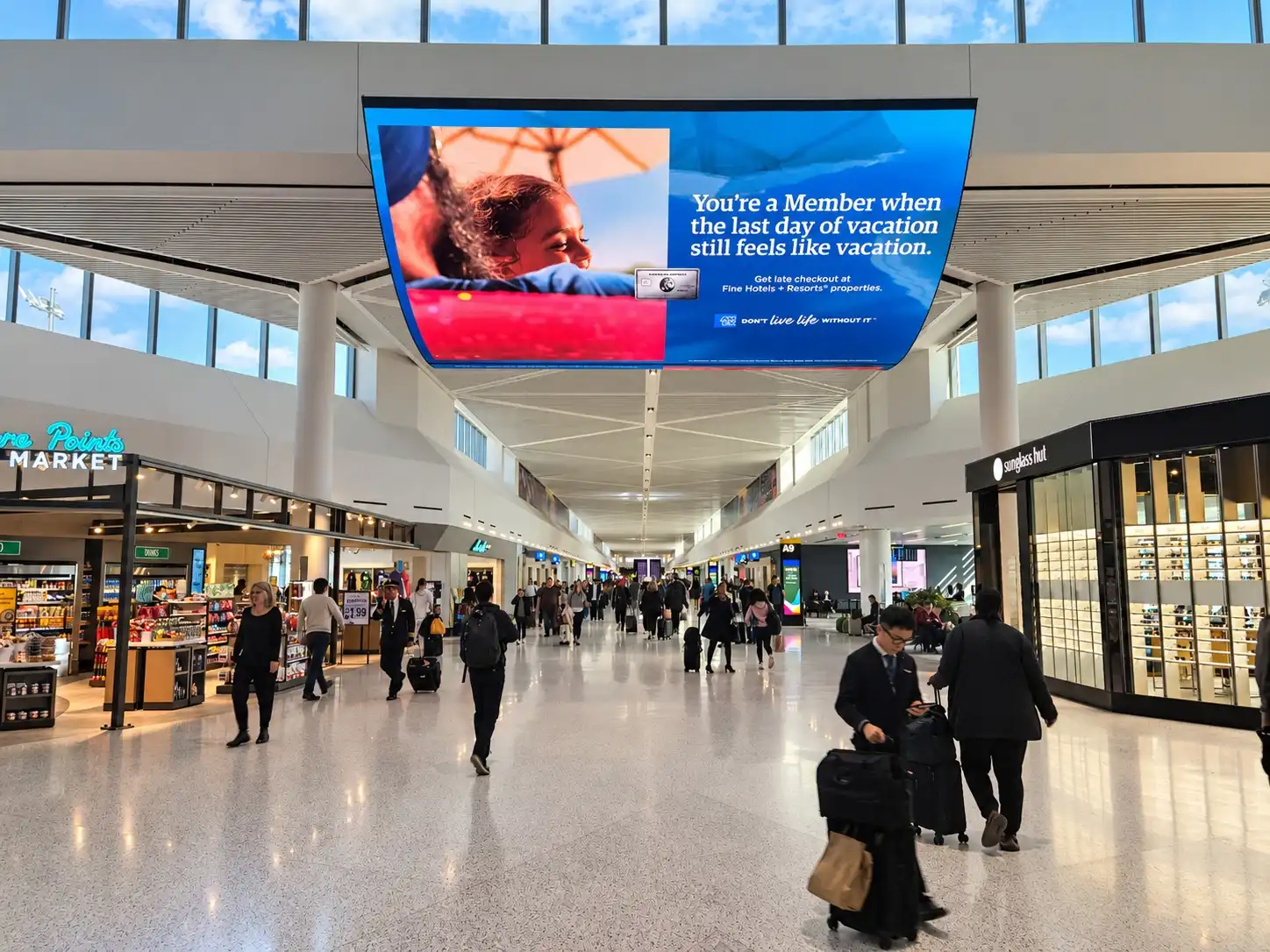
A digital spectacular is the largest screen in the terminal, in the place everyone passes: the wall over the escalators, the end of the arrivals corridor, the face of the baggage hall. It is sold one unit at a time, it is the first thing to sell out in an event week, and it is the format that makes a brand look like it owns the airport. This page covers what it costs, how it is bought, where it sits, what works on it, and when a smaller buy does the job, from EAM Advertising, an airport advertising media agency that plans and buys across 125+ airports and 40+ media vendors.


You’re in good company






The short answer
A single large-format digital screen, or a wall of screens sold as one unit, placed where the whole passenger flow converges: escalator walls, arrivals corridors, the entrance to baggage claim, the main concourse junction. Unlike a network spot, a spectacular is sold per unit, usually with the screen to yourself or shared with very few others, so the message holds the wall rather than rotating through a loop. Planning range: $15,000 to $100,000 per unit for four weeks at medium to large airports, with the strongest units at the major hubs at the top of that range and above it in event weeks.
What you buy
One large screen or screen wall for a flight, with the screen to yourself or shared with a few advertisers. The message holds the wall.
Where it sits
Escalator walls, arrivals corridors, baggage-hall entrances, concourse junctions. Chosen for the sightline, not the square footage.
What it does
The unit people remember and photograph. In a conference week it is the difference between being present and being the brand of the show.
The one thing to know
Spectaculars sell out first. In a marquee week the strongest units commit four to six months ahead, and there is usually one of each. The decision date matters more than the price.
Start your plan
Pick the path that matches where you are. Every path ends with current availability and a recommended mix.
The facts
Eight facts, in the table a planner would use.
| What to know | Airport digital spectaculars |
|---|---|
| Buying unit | Per unit, per flight (four weeks; by the week in event weeks) |
| Planning range, four weeks, media only | $15,000–$100,000 per unit, higher for the strongest units in event weeks |
| Smallest practical buy | One unit for one flight |
| Book ahead | 12–16 weeks ahead; 4–6 months for marquee event weeks |
| Creative or artwork due | Digital files 14–18 business days before start; some units take a mid-flight swap |
| Production and installation | None for digital; a static spectacular needs 21–28 days for printing and installation |
| Proof delivered | Posting confirmation, photos of the unit live, play logs where the unit runs a loop |
| Best for | Conference weeks, launches, category-leader programs, and any campaign where one message has to dominate |
Planning figures for medium to large airports, from Phoenix (PHX) up to JFK, Las Vegas (LAS), and San Francisco (SFO); smaller airports such as San Antonio (SAT) run 25 to 40% less. Media only. Ranges from the airport advertising cost page; timing from the lead-times page.
How it's bought
One unit at a time, by the flight, from the media owner that holds the airport's contract. The media owner names the unit, its position, whether it is exclusive or shared, and the price for your dates; in event weeks the price rises and the unit sells by the week. Because there is usually one unit per position, availability is the whole question: either it is open for your week or it is not.
Per unit
The arrivals-corridor wall at one airport is one unit with one price for your week. There is no 'a spectacular'; there is that spectacular.
Exclusive or shared
Some units run one advertiser; some rotate a handful. Exclusive holds the wall; shared costs less and still dominates the space.
Event weeks
At Las Vegas the strongest spectaculars for CES commit four to six months ahead and sell by the week. Decide early or buy what is left.
Where it works
Every major hub has several and most medium hubs have one or two: the escalator wall at LAX, the arrivals corridors at JFK and SFO, the baggage-hall faces at LAS, the concourse junctions at ORD and ATL. They work wherever the whole passenger flow passes one point, and the airport pages name each airport's units and where they sit.
Major hubs
LAX, JFK, SFO, ORD, ATL, and DFW each have multiple spectaculars by terminal, often from more than one media owner. The plan names the one on your audience's path.
Medium hubs
AUS, PHX, SAN, and SJC each have a signature unit or two at the main junction or arrivals, at rates well below the major hubs.
Conference airports
LAS in CES week, SFO in RSA week, AUS in SXSW week: the spectacular on the arrivals path is the unit the whole show walks past.
Airport pages with placements for this format: Las Vegas (LAS) Austin (AUS) All airports on the hub
What it costs
$15,000 to $100,000 per unit for a four-week flight at medium to large airports, media only. The low end is a smaller airport's signature unit; the high end is a major hub's arrivals wall; the strongest units in marquee weeks price above the range and by the week. Smaller airports such as San Antonio (SAT) run 25 to 40% less. Digital units carry no production cost beyond the file; static spectaculars add printing and installation at $1,000 to $15,000 per install.
A medium hub's signature unit
The main junction or arrivals wall at a medium airport for four weeks.
A major hub's arrivals wall
JFK, LAX, or SFO, four weeks, the unit everyone walks past.
The conference week
The strongest units in CES or RSA week price above a quiet-week flight and sell by the week. Budget for the week, not the month.
The full ranges by format and campaign shape, on the cost page.
Creative
Scale and restraint. The unit is enormous; the message should be one line and the brand, sized to read from the far end of the corridor. Motion that uses the whole wall draws the eye; a television ad scaled up does not. Most spectaculars run silent, and the best ones are designed for a passenger walking toward them for twenty seconds.
One line, enormous
The headline should read from the far end of the corridor; the brand mark should be the largest element.
Motion that uses the wall
Slow, full-frame movement that rewards the twenty-second walk toward the unit.
Designed for silence
Most units run without sound. If the message needs a voice, it is the wrong message for the wall.
When it's the wrong format
When reach matters more than dominance (a network puts you on screens across the terminal for less), when the budget would buy one spectacular and nothing else (one unit at one airport is a presence, not a campaign), and when the week you need is already sold. A spectacular is the impact layer; it works best on top of a network that carries the reach.
You need reach
Reach across the concourses for four weeks is a network's job; a spectacular reaches everyone who passes one point.
It would be the only unit
One spectacular with nothing around it is a photo, not a campaign. Add a network, or buy the spectacular at the airport that matters most and networks elsewhere.
The week is sold
If the arrivals wall is gone for CES week, a strong concourse unit in the same week beats the arrivals wall in a quiet week.
Why EAM
We know which spectaculars exist at each airport, where each one sits on the passenger path, whether it runs exclusive or shared, and how far ahead it commits for the week you want. We check availability for your dates, recommend the unit and the network to pair it with, secure it under one contract, adapt the creative to the wall, confirm posting with a photo of the unit live, and deliver the proof. Dynatrace's five-continent campaign ran digital large format alongside screen networks under one contract.
 Global, five continentsDynatraceParis, London, São Paulo, Tokyo, Kuala Lumpur, Mexico City, and more. Digital large format and screen networks across five continents, under one contract.60 million people reachedSee the campaign
  One airport, dominatedFabricSan Jose (SJC). A full airport takeover for one flight: 82 digital faces covering 5,252 square feet, plus all 760 security trays.Every network and checkpoint at one airportSee the campaign
  National, several media ownersFortinetU.S. and Canada: Las Vegas, New York, Chicago, San Francisco, Toronto, Washington, D.C., Dallas, and more. Bought from multiple media owners as one coordinated buy, under one plan and one contract.40 million impressionsSee the campaign
 See every campaign on the case studies page.
Tell us the airports, the dates, and the range. We come back with availability for this format at each airport and a recommended mix.
Ready to plan?
Tell us the airports, the dates, who you need to reach, and the budget range. We come back with availability for this format at every airport in the plan and a recommended mix.
125+ airports · 40+ media vendors · Since 2015
“EAM made a nationwide airport campaign feel much easier to manage. The team was responsive, organized, and always on top of the details. They helped us make smart decisions with the budget, kept everything moving, and ultimately delivered exactly what we were looking for.”
 Chief Marketing OfficerFortinet · nationwide airport campaign
For agencies and consultants
Agencies and consultants bring EAM Advertising in as the airport specialist behind a client’s plan. The client relationship stays with you. We plan, buy, and report under NDA, and can work white-label.
Get our media kitAirports
EAM Advertising plans and buys at 125+ airports across North America, Europe, Latin America, Asia-Pacific, the Middle East, India, and Africa, and any combination runs under one contract. The most-requested airports are below; every airport, with search by city or code, is on the airport advertising hub.
Questions
$15,000 to $100,000 per unit for four weeks at medium to large airports, media only; the strongest units at major hubs in marquee weeks price above that and sell by the week. Smaller airports run 25 to 40% less. Digital units have no production cost beyond the file.
A network is a spot in a loop that rotates across many screens; a spectacular is one large unit, sold per unit, usually exclusive or shared with a few, where the message holds the wall. Networks carry reach; spectaculars carry impact.
Twelve to sixteen weeks for a standard flight and four to six months for marquee event weeks, because there is usually one unit per position and the strongest commit first. Files are due 14 to 18 business days before start.
Every major hub has several (LAX, JFK, SFO, ORD, ATL, DFW, by terminal) and most medium hubs have one or two at the main junction or arrivals. The airport pages name each airport's units and where they sit.
Some run one advertiser for the flight; some rotate a handful. Exclusive holds the wall and costs more; shared still dominates the space. The media owner states which for each unit.
Usually the spectacular on the arrivals path or the escalator wall at the main junction: the one unit the entire passenger flow passes. In a conference week it is the unit the whole show walks past.
In event weeks, yes: at airports such as Las Vegas the strongest units sell by the week with a one-week minimum. Outside event weeks most spectaculars sell in four-week flights.
Digital allows motion and mid-flight swaps with no production; static holds one image with no rotation and needs 21 to 28 days for printing and installation. Position matters more than either; buy the unit on your audience's path.
Rarely. One unit at one airport is a presence; paired with a network that reaches across the terminal it is a campaign. The spectacular is the impact layer on top of the reach.
Everything after the objective. We check what's open for the week, which loops are crowded and which units will sell out, and where on the arrival path your audience actually walks. We recommend the mix, secure the units, traffic the creative through airport approval, confirm posting on day one, and deliver proof of posting and play logs after. If the airport is one market in a larger plan, the same relationship covers the others.
Airport advertising media agency. 125+ airports. Est. 2015.
Send your work email for the media kit: formats, planning ranges, and booking windows across 125+ airports. We’ll follow up to learn who you need to reach and when, then come back with current availability and a recommended mix.
125+ airports · 40+ media vendors · Since 2015
Sources
Updated October 5, 2026 · By EAM Advertising

EAM Advertising plans, secures, and buys airport and in-flight media across 125+ airports and 45+ airlines worldwide. Founded in 2015; collective operator experience in airport media buying spans two decades. Recommendations are based on what performs for the advertiser, not on inventory we have to sell. Clients include Dynatrace, Fortinet, Rubrik, McGraw-Hill, and Wharton.