What you buy
A unit on the way in or out
A roadway billboard, a curbside banner, a parking-structure wrap, or a pickup-zone package, for a flight.
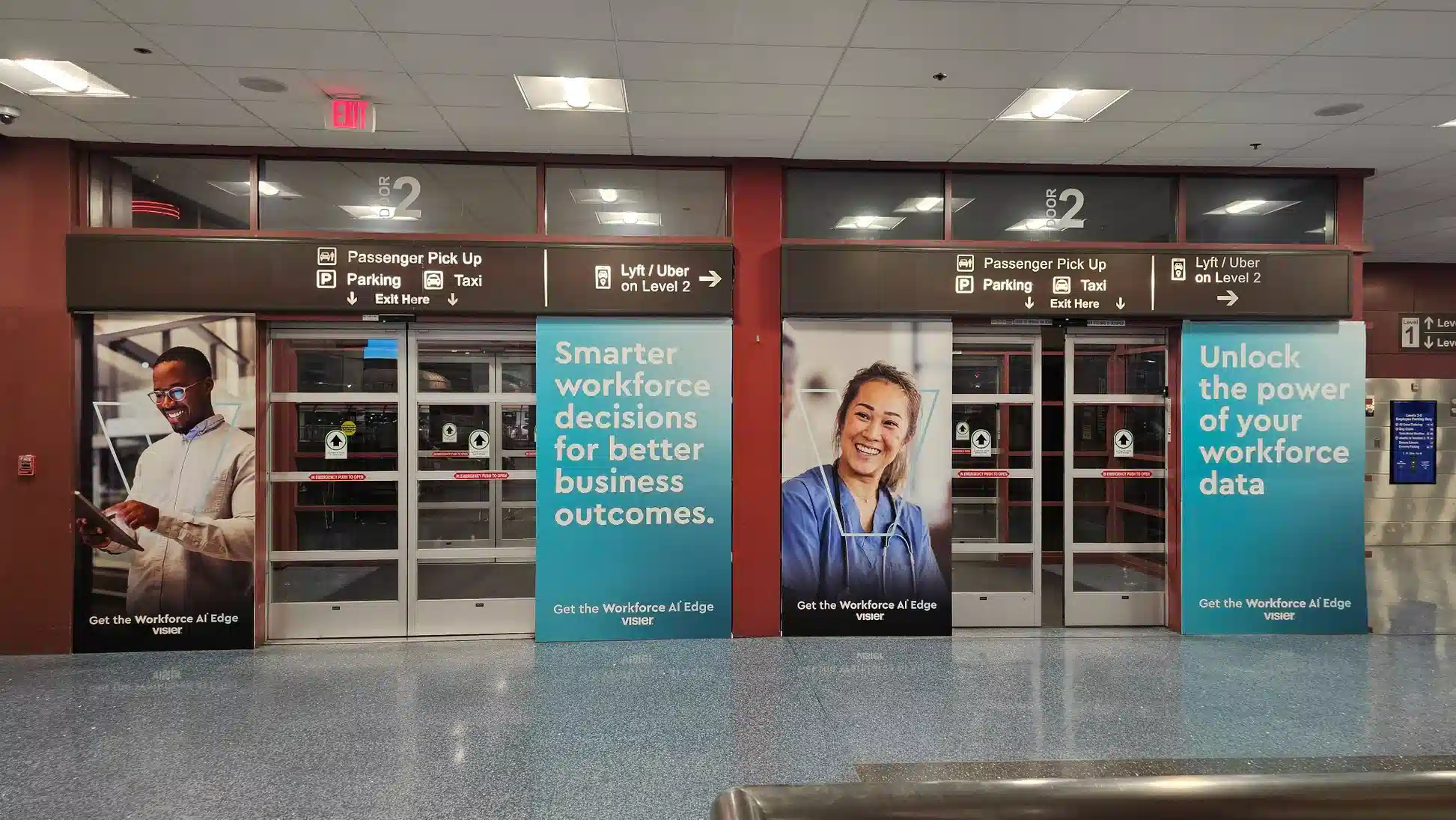
Exterior units reach the passenger outside the terminal: the roadway in, the curb at departures, the pickup zone at arrivals, and the walk to parking and ride-share. They are sold apart from the terminal programs, often by a different media owner, and they reach everyone who comes to the airport, including the people meeting and dropping off passengers who never go inside. This page covers what exteriors cost, how they are bought, who they reach, what works on them, and when the terminal is the better buy, from EAM Advertising, an airport advertising media agency that plans and buys across 125+ airports and 40+ media vendors.


You’re in good company






The short answer
Banners, wraps, and billboards on the airport's roadways, curbs, parking structures, and pickup and ride-share zones, sold per unit per flight by the media owner that holds the airport's exterior contract, which is often separate from the terminal media owner. They reach every vehicle and every passenger entering or leaving, plus the drivers and greeters who never pass security. Planning range: $20,000 to $100,000 and up per unit for four weeks at medium to large airports, media only, plus production and installation for printed units.
What you buy
A roadway billboard, a curbside banner, a parking-structure wrap, or a pickup-zone package, for a flight.
Who it reaches
Passengers in both directions, plus the drivers, greeters, and ride-share traffic that never enter the terminal.
Why it works
The roadway in is the first impression of the airport; the pickup zone is the last thing the arriving passenger sees before the city.
The number that matters
Vehicle and passenger flow at the specific position. A roadway billboard sees every car; a curbside banner at one terminal's departures door sees that terminal's passengers. Ask whose traffic passes the unit.
Start your plan
Pick the path that matches where you are. Every path ends with current availability and a recommended mix.
The facts
Eight facts, in the table a planner would use.
| What to know | Airport exterior advertising |
|---|---|
| Buying unit | Per unit (billboard, banner, wrap, or pickup package), per flight |
| Planning range, four weeks, media only | $20,000–$100,000+ per unit |
| Smallest practical buy | One unit for one flight |
| Book ahead | 12–16 weeks ahead |
| Creative or artwork due | Digital files 14–18 business days before start; printed units 21–28 days |
| Production and installation | $1,000–$15,000 per install for printed units; none for digital billboards |
| Proof delivered | Posting confirmation and photos; play logs for digital billboards |
| Best for | Local and regional brands, arrivals campaigns, ride-share and travel services, and takeovers that want the outside to match the inside |
Planning figures for medium to large airports, from Phoenix (PHX) up to JFK, Las Vegas (LAS), and San Francisco (SFO); smaller airports such as San Antonio (SAT) run 25 to 40% less. Media only. Ranges from the airport advertising cost page; timing from the lead-times page.
How it's bought
Per unit, per flight, by the media owner that holds the airport's exterior contract, which at many airports is a different company from the terminal media owner. Roadway billboards are sold like roadside out-of-home, digital or static; curbside banners and parking wraps are sold per position; pickup and exit zones are sold as packages along the route from the door to the car.
Roadway billboards
Sold per face per flight on the airport's access roads; digital faces run loops like roadside DOOH.
Curbside and parking
Banners at the departures doors and wraps on parking structures, held for the flight.
Pickup and exit packages
The walk from the arrivals door to ride-share and pickup, sold as a package of units so the passenger sees one brand to the car.
Where it works
At any airport with its own access roads and curbs, which is all of them; the inventory for sale differs by airport and the exterior contract is often separate. They work best where the audience arrives by car and where the brand has a reason to be outside: local and regional brands, travel and ride-share services, destination campaigns meeting arrivals at the curb, and takeovers that want the outside to match the inside. The airport pages carry each airport's exterior units.
Drive-to airports
At airports where most passengers drive or are driven, the roadway in is seen by the whole audience.
Arrivals campaigns
A destination or a city greets arrivals on the walk to the car, after baggage claim.
Takeovers
A takeover that includes the roadway and the curb reads as the whole airport, not the terminal.
Airport pages with placements for this format: Las Vegas (LAS) Austin (AUS) All airports on the hub
What it costs
$20,000 to $100,000 and up per unit for a four-week flight at medium to large airports, media only; the low end a curbside banner at a medium airport, the high end a roadway billboard or a parking-structure wrap at a major hub. Printed units add production and installation at $1,000 to $15,000 per install; digital billboards carry no production. Smaller airports such as San Antonio (SAT) run 25 to 40% less.
A curbside banner
One position at a terminal's departures door for four weeks, plus production.
A roadway billboard
A digital or static face on the access road at a major hub for four weeks.
The pickup package
The route from the door to the car at one terminal, sold as a set.
The full ranges by format and campaign shape, on the cost page.
Creative
Roadside rules apply: a few words, a large mark, and contrast that reads from a moving car or a crowded curb. Exteriors are seen at speed or at a distance, so the creative that works is the simplest version of the campaign, with the brand doing most of the work and the message fitting in a glance.
Roadside rules
Seen from a car or across a curb. Six words or fewer, and the brand reads first.
Contrast outdoors
Bold color against the sky and the structure; thin type disappears outside.
Match the inside
The exterior is the simplest version of the terminal creative, so the brand reads as one from the road to the gate.
When it's the wrong format
When the audience is the passenger inside the terminal with time to read (the concourse, the gates, the lounges, and the baggage hall do that job), when the airport's traffic arrives mostly by rail or transit and skips the roadway, and when the budget is small enough that one terminal unit would reach more of the right people than one exterior. Exteriors are the bookends of a plan, not usually its center.
Inside is where they read
Dwell and attention are inside; the roadway is a glance.
Rail and transit airports
Where most passengers arrive by train, the roadway sees fewer of them.
Small budgets
A spot in the concourse network reaches more of the right people than one roadway face.
Why EAM
We know which media owner sells each airport's exterior inventory, which units see the passenger flow rather than the service road, and how to run the roadway and the curb alongside the terminal under one agreement. We check availability for your dates, recommend the units, quote media and production together, secure them, confirm posting, and deliver photos and play logs.
 One airport, dominatedFabricSan Jose (SJC). A full airport takeover for one flight: 82 digital faces covering 5,252 square feet, plus all 760 security trays.Every network and checkpoint at one airportSee the campaign
  National, several media ownersFortinetU.S. and Canada: Las Vegas, New York, Chicago, San Francisco, Toronto, Washington, D.C., Dallas, and more. Bought from multiple media owners as one coordinated buy, under one plan and one contract.40 million impressionsSee the campaign
  Regional, four countriesRadissonBuenos Aires, Santiago, Bogotá, Mexico City. Digital and physical branding across four Latin American airports as one regional campaign.30 million-plus impressionsSee the campaign
 See every campaign on the case studies page.
Tell us the airports, the dates, and the range. We come back with availability for this format at each airport and a recommended mix.
Ready to plan?
Tell us the airports, the dates, who you need to reach, and the budget range. We come back with availability for this format at every airport in the plan and a recommended mix.
125+ airports · 40+ media vendors · Since 2015
“We ran a security tray advertising program across several key airports, and EAM was a tremendous partner throughout the process. Their team helped secure the space, manage renewals, and coordinate the campaign seamlessly from start to finish.”
 Chief Executive OfficerFlexispot · security tray program across five U.S. airports
For agencies and consultants
Agencies and consultants bring EAM Advertising in as the airport specialist behind a client’s plan. The client relationship stays with you. We plan, buy, and report under NDA, and can work white-label.
Get our media kitAirports
EAM Advertising plans and buys at 125+ airports across North America, Europe, Latin America, Asia-Pacific, the Middle East, India, and Africa, and any combination runs under one contract. The most-requested airports are below; every airport, with search by city or code, is on the airport advertising hub.
Questions
$20,000 to $100,000 and up per unit for a four-week flight at medium to large airports, media only; a curbside banner at the low end, a roadway billboard or parking wrap at a major hub at the high end. Printed units add production; smaller airports run 25 to 40% less.
The media owner that holds the airport's exterior contract, which at many airports is a different company from the terminal media owner. An airport advertising media agency buys both under one agreement.
Everyone who comes to the airport by road: passengers in both directions, plus drivers, greeters, and ride-share traffic that never enter the terminal.
Roadway billboards (digital or static), curbside banners at the departures doors, parking-structure wraps, and pickup and exit packages along the route from the arrivals door to the car.
Twelve to sixteen weeks, with printed units' artwork due 21 to 28 days before start and digital files 14 to 18 business days before.
They are sold similarly, per face per flight, but they sit on the airport's own roads, so every car passing them is going to or from the airport. Digital faces run loops like roadside DOOH.
A package of units along the route from the arrivals door to ride-share and pickup, so the arriving passenger sees one brand from the terminal to the car. Sold per terminal per flight.
Yes; local and regional brands, travel services, and destination campaigns use the roadway and the curb to reach everyone who comes to the airport, including the people who never go inside.
Often; a takeover that includes the roadway and the curb reads as the whole airport rather than the terminal. Outside units are bought from the exterior media owner alongside the terminal units.
Everything after the objective. We check what's open for the week, which loops are crowded and which units will sell out, and where on the arrival path your audience actually walks. We recommend the mix, secure the units, traffic the creative through airport approval, confirm posting on day one, and deliver proof of posting and play logs after. If the airport is one market in a larger plan, the same relationship covers the others.
Airport advertising media agency. 125+ airports. Est. 2015.
Send your work email for the media kit: formats, planning ranges, and booking windows across 125+ airports. We’ll follow up to learn who you need to reach and when, then come back with current availability and a recommended mix.
125+ airports · 40+ media vendors · Since 2015
Sources
Updated October 5, 2026 · By EAM Advertising

EAM Advertising plans, secures, and buys airport and in-flight media across 125+ airports and 45+ airlines worldwide. Founded in 2015; collective operator experience in airport media buying spans two decades. Recommendations are based on what performs for the advertiser, not on inventory we have to sell. Clients include Dynatrace, Fortinet, Rubrik, McGraw-Hill, and Wharton.