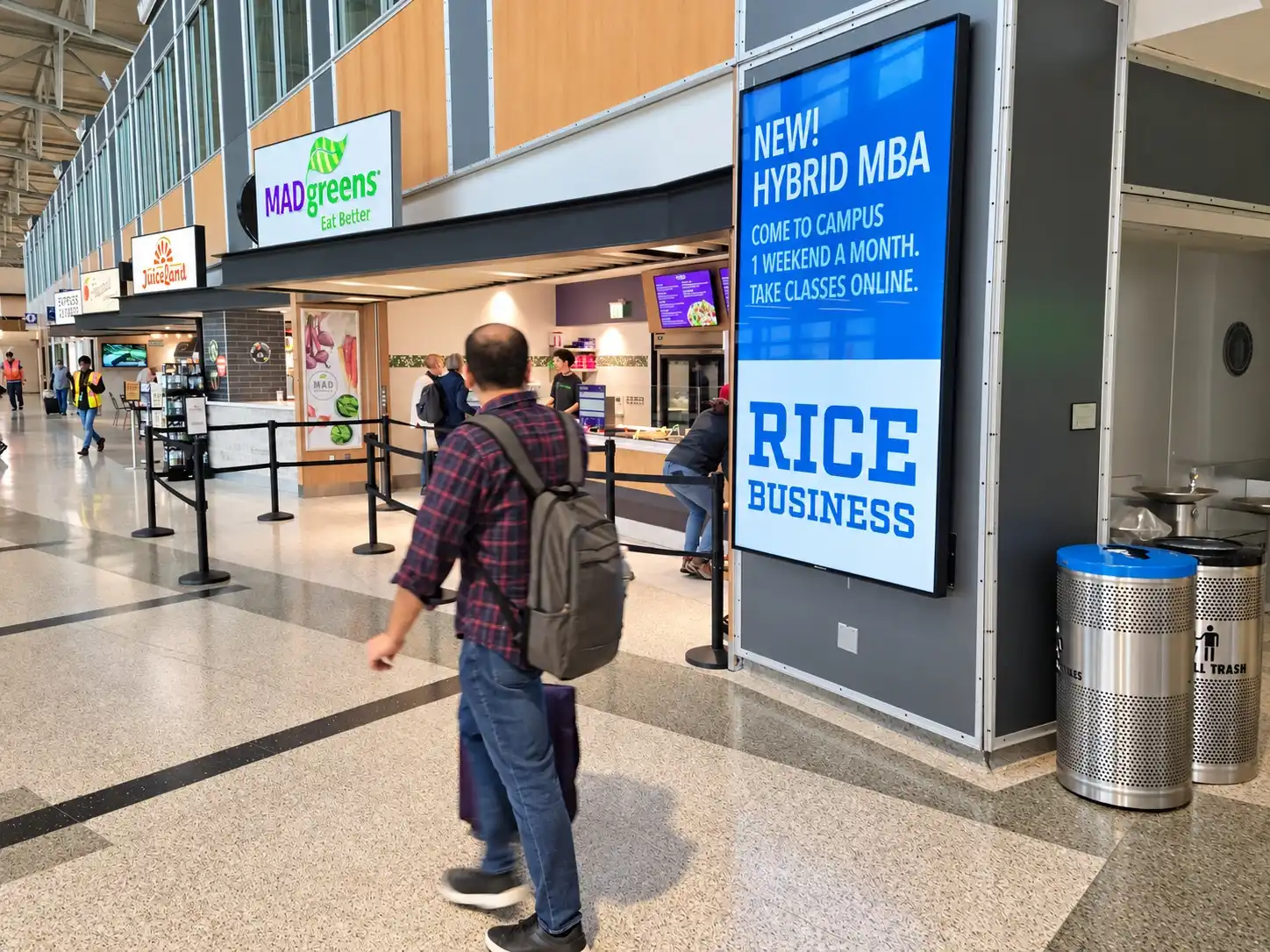
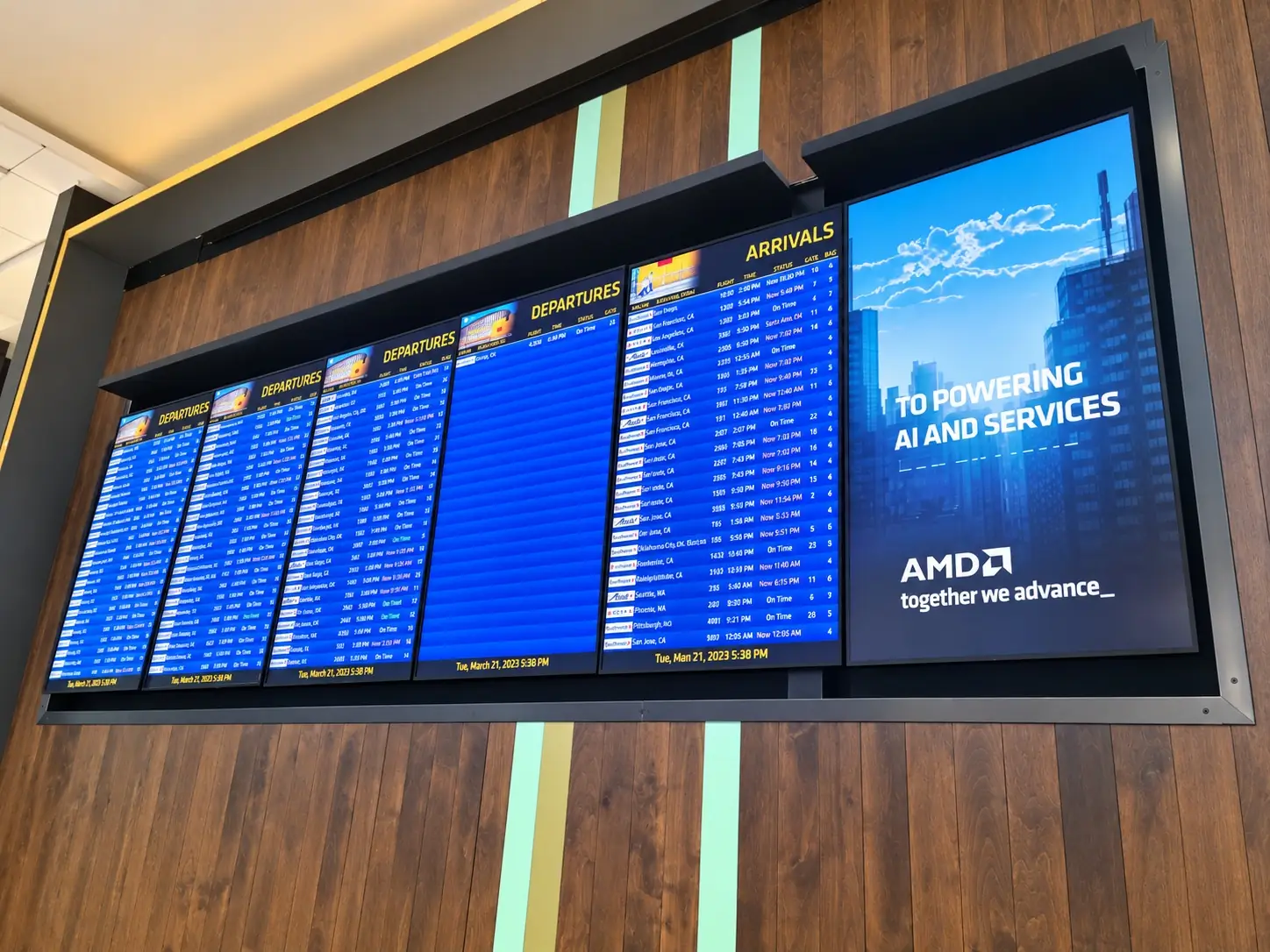
Start here How to plan airport
advertising. The first
hour, step by step.

The CEO wants it, the client asked for it, or the conference is four months out, and now airport advertising is yours to plan. This page is the first hour of that work: the five questions to answer before you talk to anyone, who you will deal with, what it costs, how long it takes, and what to send to get a real quote. From EAM Advertising, an airport advertising media agency that plans and buys across 125+ airports and 40+ media vendors. Get our media kit for formats, planning ranges, and booking windows.

We’ll follow up with the kit and next steps for your campaign.

  • 125+Airports worldwide
  • 40+Media vendors
  • 5Continents served

You’re in good company

  • Thomson Reuters
  • AMD
  • Dynatrace
  • Fortinet
  • Motorola
  • BYU

The first hour

What do you need to answer
before you talk to anyone?

Five things, and a range is fine for each: who you need to reach, which airports, when and for how long, how much, and what success looks like. With those five answered, any airport media agency can come back with current availability and a recommended mix. Without them, you get a rate card and a menu.

  1. Question 01

    Who do you need to reach?

    Not 'business travelers'. The buyer, the attendee, the candidate, the investor, the visitor. The audience decides the airports, the terminals, and whether arrivals or departures matter more.

    Write downThe one audience the campaign is for, in a sentence

  2. Question 02

    Which airports?

    You usually know this already: the conference city, the headquarters cities of the accounts you want, the hubs your buyers fly through, the feeder markets for your destination. One airport is a real campaign; so is ten.

    Write downThe airports, or the cities, in priority order

  3. Question 03

    When, and for how long?

    The event week, the launch month, the quarter the budget belongs to. Airport media sells in four-week flights or 28-day periods, and event weeks by the week, so the dates set the buying unit.

    Write downStart date, end date, and any week that cannot move

  4. Question 04

    How much?

    A range is enough. One unit at one airport plans at about $7,000 to $50,000 for four weeks; five major hubs at $150,000 to $250,000; eight to ten airports from $500,000. Smaller airports run 25 to 40% less.

    Write downA budget range, media and production together

  5. Question 05

    What does success look like?

    Being seen by the right people in the right week, photographed, and reported: proof of posting, play logs, and an audience you can describe. Airport advertising builds perception; it does not deliver click-through attribution, and the plan should say so up front.

    Write downThe result you will show leadership, in their words

What you do not need yet

Creative, specs, vendor names, or a list of formats. The formats come out of the audience and the budget, the specs come after the units are chosen, and the vendors are the agency's problem, not yours.

The sixty-second version

How does airport advertising
actually work?

Each airport's advertising is sold by one or more media owners under contract to that airport: terminal screens and signs by one company, airline lounges by another, security trays and Wi-Fi by others. You buy units, a spot in a screen loop, a banner, a spectacular, a lounge, for a flight of four weeks or 28 days, or by the week in event weeks. The airport approves the creative. An airport advertising media agency, independent of any media owner, plans the mix, buys from every media owner involved, and runs it under one contract.

Who sells it

Media owners, airport by airport

JCDecaux, Clear Channel Airports, oOh!media, Times OOH, Boingo, and others hold the contracts to sell advertising inside specific airports. They are not agencies; they sell their own inventory, at their own airports.

How it is bought

By the unit and the flight

A spot in a digital network loop, a banner, a spectacular, a lounge. Four-week flights or 28-day periods are standard; conference weeks sell by the week. Holds expire in days; contracts are non-cancellable once signed.

Who runs it

One plan across every media owner

An airport advertising media agency such as EAM Advertising plans the mix, checks availability everywhere, buys from each media owner, traffics the creative through airport approval, and reports back, under one contract and one invoice.

Who sells airport advertising, and who is on your side: the full comparison on the hub.

The first call

Who do you
actually call?

If you want one unit at one airport you already know, the media owner's sales office at that airport will quote it. For anything else, more than one airport, more than one media owner, no prior experience, or a deadline, call an airport advertising media agency: it checks availability everywhere at once, builds the mix around your five answers, and handles the contracts, approvals, and proof. Self-serve platforms exist for some digital screens; they cover a slice of the inventory, with less control over position.

One known unit

The media owner at that airport

You know the airport, the unit, and the dates. The media owner sells it to you from its rate card. You handle creative specs, approvals, and proof yourself.

Anything else

An airport advertising media agency

Several airports, several media owners, a first campaign, a conference deadline, or a budget you want planned rather than spent. One contact, one plan, one contract.

Digital screens only

A self-serve platform

Some airport screens can be bought programmatically. Useful for a quick digital test; it does not reach static units, spectaculars, trays, or lounges, and position in the loop is not yours to choose.

Your first move

What is your first move,
depending on who you are?

The same five answers, a different first step. A coordinator gathers them; a director decides them; an agency gets them from the client before the client gets them from someone else; a consultant turns them into a recommendation the CEO can approve.

Marketing coordinator or manager

Gather the five answers, then get the kit

You were asked to 'look into airport ads.' Come back with the five answers and planning ranges rather than quotes. The media kit gives you the ranges and the vocabulary; the quote comes once the five answers are set.

Marketing director or VP

Decide the shape, then send a brief

You own the budget and the dates. Decide the shape (one airport, a few hubs, national, global) and send the brief. Availability and a recommended mix come back; you decide, the agency executes.

Agency account director or planner

Ask the client five questions, then bring in a specialist

Your client asked for airports. Get the five answers from them before anyone else does, then bring in an airport specialist behind your team: planning, buying, and reporting under NDA, white-label if you want it.

Consultant or fractional CMO

Benchmarks first, then the brief

Your client's CEO has already decided. You need ranges, lead times, and precedents that defend the number, then a brief that gets a real quote. The cost page and the case studies are the two documents to read first.

What it costs

What does airport advertising
cost, roughly?

At medium to large airports, from Phoenix (PHX) up to JFK, Las Vegas (LAS), and San Francisco (SFO): one unit at one airport plans at about $7,000 to $50,000 for a four-week flight, three airports at $75,000 to $100,000 at entry level, five major U.S. hubs at $150,000 to $250,000, and eight to ten airports from $500,000. Smaller airports such as San Antonio (SAT) run 25 to 40% less, depending on passenger traffic. Media only; production and installation of static units add about $1,000 to $15,000 per install.

One airport

$7,000 to $50,000 per unit

One screen-network spot, one banner, or one spectacular for one flight. A two- or three-network package runs $15,000 to $110,000; owning the airport for a flight starts north of $150,000.

Three to five airports

$75,000 to $250,000

Entry level across three to five airports for four weeks. Built for impact, with larger creative and more frequency: $100,000 and up for three, $250,000 and up for five.

Eight to ten airports

$500,000 and up

A national program with two or three international airports, four to eight weeks, every format possible.

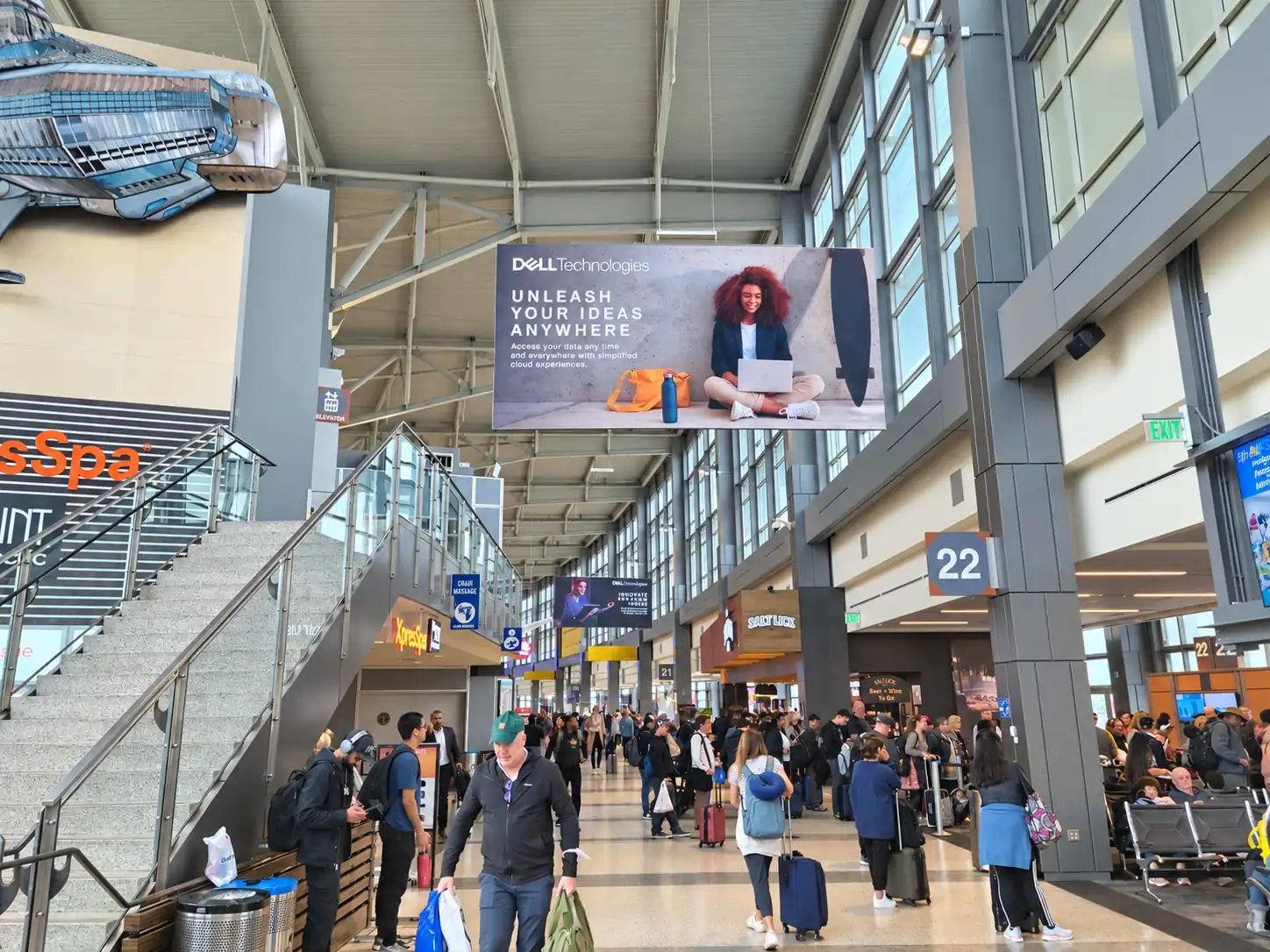
The full ranges by campaign shape, format, and budget are on the airport advertising cost page.

How long it takes

How far ahead do you
need to start?

Plan a standard multi-airport flight twelve to sixteen weeks ahead, and four to six months for marquee event weeks such as CES, SXSW, or RSA, when the strongest units sell out first. One airport outside an event week can move faster, but the creative deadlines do not: digital creative is due 14 to 18 business days before start, static units 21 to 28 days, and holds on inventory expire in about five business days.

A backward timeline for a standard airport advertising campaign
Weeks before launchWhat happensWhat you do
16 to 12 weeks outBrief sent; availability checked at every airport; mix and range quotedDecide the shape and the budget range; set the decision date before any hold is placed
12 to 8 weeks outUnits held (holds expire in about five business days); creative submitted for airport approvalApprove the plan; start creative; do not sign until the creative direction is approved
8 to 4 weeks outContracts signed; creative adapted to each airport's specsDeliver final creative: digital 14 to 18 business days before start, static 21 to 28 days
4 weeks to launchStatic units printed and installed; digital loaded and testedConfirm posting before the first arrival wave
During and afterProof of posting, photos, play logs; make-goods if anything failsCollect the report; it is the asset you show leadership

Lead times vary by airport and format; event weeks compress the decision, not the production. Each airport page carries its own booking windows.

Lead times by campaign, format, and event week are on the airport advertising lead times page.

Getting a real quote

What do you send
to get a real quote?

Six lines, and a range is fine for each: the airports or cities, the dates and the flight length, who you need to reach, the objective, a budget range, and where the creative stands. That is enough for current availability and a recommended mix to come back. A rate card is what you get when you send less.

Airports and dates

The shape of the buy

'LAX, ORD, and JFK, four weeks starting the first week of March' is a brief. 'Some airports in the spring' is a conversation that has to happen first.

Audience and objective

What the campaign is for

'Enterprise security buyers flying to RSA; we want to be the name they see before the show floor' tells the planner which terminals, which direction, and which formats.

Budget range and creative status

What can be quoted against

A range sets the mix; the creative status sets the timeline. 'Budget $200,000 to $250,000; creative ready in four weeks' is all a planner needs to come back with a real number.

The six lines, line by line, with three sample briefs you can copy.

The first-timer traps

What goes wrong
the first time?

Six things, and all of them are avoidable: starting with formats instead of the audience, letting a hold expire, signing before the creative is approved, asking for a CPM, sending one creative for every spec, and treating the airport as one vendor.

Formats first

Choosing the unit before the audience

A spectacular is not a strategy. Decide who you need to reach and which direction they walk; the unit follows. Buyers who start with the menu end up with the unit that was available, not the one that works.

The expired hold

Losing the unit to the calendar

A hold lasts about five business days. When the approval meeting slips past it, the unit goes back on the market and comes back, if it comes back, at the price of the week it is re-quoted in.

Signing too early

A non-cancellable contract and unapproved creative

Contracts are non-cancellable once signed. If the airport rejects the creative afterward, the media runs late or runs blank while a new version is produced. Submit for approval first.

The CPM question

Comparing airports by a number no two media owners calculate the same way

Airport media is sold by the unit and the flight. Compare airports by what the unit covers and who walks past it, not by a CPM that each media owner reports differently.

One creative for every spec

Pixel sizes, spot lengths, and file rules differ by airport

One campaign across eight airports can mean a dozen versions. Plan one adaptation round per airport in the budget and the timeline, or the static unit gets printed twice.

One airport, one vendor

Terminal, lounges, trays, and Wi-Fi are different companies

A single airport can involve four vendors and four contracts; ten airports can be fifteen. If you buy direct, you are the coordinator. If an agency plans it, you sign one contract.

Measurement

What does success look like,
and how is it measured?

Airport advertising is a perception channel: it makes a brand look established to the people who matter, in the week that matters. What you measure is delivery and audience, not clicks: proof of posting and photos of every unit, play logs for digital networks, the airport's passenger figures for the flight, and brand-lift or recall research when the budget justifies it. Set that expectation with leadership before the campaign, not after, and the campaign photos become the proof.

How EAM Advertising measures a multi-airport campaign, on the hub.

Why EAM

What does EAM Advertising do
with your five answers?

Everything after the objective. We check what's open for your dates at every airport in the plan, which loops are crowded and which units will sell out, and where on the arrival path your audience actually walks. We recommend the mix, secure the units, traffic the creative through airport approval, confirm posting on day one, and deliver proof of posting and play logs after. One contact, one plan, one contract, whether the campaign is one airport or twelve.

Send the five answers. We come back with current availability and a recommended mix.

Ready to plan?

Have the five answers?
Send them.

Airports, dates, who you need to reach, the objective, and a budget range. We come back with current availability at every airport in the plan and a recommended mix.

125+ airports · 40+ media vendors · Since 2015

“EAM made a nationwide airport campaign feel much easier to manage. The team was responsive, organized, and always on top of the details. They helped us make smart decisions with the budget, kept everything moving, and ultimately delivered exactly what we were looking for.”

Chief Marketing OfficerFortinet · nationwide airport campaign
Airports, start date and duration, campaign goal, budget range, and anything else you can share. A few lines is plenty.

We come back with current availability and a recommended mix.

For agencies and consultants

Your client. Your plan.
We handle the airports.

Agencies and consultants bring EAM Advertising in as the airport specialist behind a client’s plan. The client relationship stays with you. We plan, buy, and report under NDA, and can work white-label.

Get our media kit
  • Your client stays yours.We work behind your team, not around it.
  • White-label and NDA.Plans and reporting can go out under your name.
  • One contract, one invoice.Every airport and media owner in the plan, under one set of terms.
  • Numbers before the client commits.Current availability and planning ranges at the proposal stage.

Questions

Questions people ask
when the campaign is new to them

Where do I start with airport advertising?

Answer five questions before you talk to anyone: who you need to reach, which airports, when and for how long, how much, and what success looks like. A range is fine for each. Then get the media kit for planning ranges and booking windows, or send the five answers as a brief and get current availability and a recommended mix back.

What is the first step in an airport advertising campaign?

Deciding who the campaign is for. The audience decides the airports, the terminals, the direction (arrivals or departures), and the formats. Everything else, including the budget range, follows from it.

Who do I contact to advertise in an airport?

For one known unit at one airport, the media owner that holds that airport's advertising contract. For more than one airport or media owner, a first campaign, or a deadline, an airport advertising media agency such as EAM Advertising, which plans and buys across every media owner under one contract.

How much does airport advertising cost to start?

About $7,000 for one unit at a medium-size airport such as Phoenix (PHX) for a four-week flight, and 25 to 40% less at a smaller airport. Three airports start around $75,000 to $100,000; five major hubs $150,000 to $250,000; eight to ten airports from $500,000. Production and installation of static units add about $1,000 to $15,000 per install.

How far ahead do I need to plan airport advertising?

Twelve to sixteen weeks for a standard multi-airport flight, four to six months for marquee event weeks. Digital creative is due 14 to 18 business days before start, static units 21 to 28 days, and holds on inventory expire in about five business days.

Can we buy airport advertising ourselves?

For one unit at one airport, yes: the media owner's sales office will quote it, and you handle specs, approvals, and proof. Across several airports you become the coordinator of several vendors and contracts, which is the work an airport media agency exists to do.

What should an airport advertising brief include?

The airports or cities, the dates and flight length, who you need to reach, the objective, a budget range, and the creative status. Six lines are enough for a real quote; the brief form on this page takes exactly that.

Do airports have to approve the creative?

Yes. Every airport reviews creative before it runs, some stricter than others, and a rejection after contracts are signed does not pause the media. Submit creative for approval before signing, and plan one adaptation round per airport for pixel sizes, spot lengths, and file rules.

Is one airport enough to start?

Yes. A home-market airport, an event week, or a test at one airport is a real campaign, and it is how many national programs begin. Decide the shape by the audience, not by the number of airports.

What does EAM Advertising handle on an airport campaign?

Everything after the objective. We check what's open for the week, which loops are crowded and which units will sell out, and where on the arrival path your audience actually walks. We recommend the mix, secure the units, traffic the creative through airport approval, confirm posting on day one, and deliver proof of posting and play logs after. If the airport is one market in a larger plan, the same relationship covers the others.

Airport advertising media agency. 125+ airports. Est. 2015.

New to airport advertising?
Start with the media kit.

Send your work email for the media kit: formats, planning ranges, and booking windows. We’ll follow up to learn who you need to reach and when, then come back with current availability and a recommended mix.

We’ll follow up to learn who you need to reach and when.

125+ airports · 40+ media vendors · Since 2015

Sources

Sources
and methodology

  1. Planning ranges: the airport advertising cost page, drawn from EAM Advertising planning and buying data across 125+ airports, 2015–2026. Ranges are planning figures, media only, not rate cards.
  2. Lead times, holds, creative deadlines, and contract terms: current media kits at Las Vegas, Austin, San Francisco, and Barcelona, 2025–2026. Media owners are described, not named.
  3. How airport advertising is sold: each media owner's own published description of its airport advertising business (JCDecaux, Clear Channel Airports, oOh!media, Times OOH, Boingo).
  4. Measurement: proof of posting, play logs, and passenger figures as reported by the media owners and airports on EAM Advertising campaigns, 2015–2026.

Updated October 3, 2026 · By EAM Advertising