Large and affluent
Millions a day, skewed upward
Travelers over-index on income, education, and budget authority compared with the general population.
Every airport advertising plan starts with one question: who is actually in the terminal, where, and when? The honest answer has two parts. The airport audience as a whole is large, affluent, and traveling for a reason; and it is not one audience but several, sorted by side of the terminal, by hour, by airport, and by week. This page explains who is where, how to get the figures for a specific airport, and what the data can and can't tell you, from EAM Advertising, an airport advertising media agency that plans and buys across 125+ airports and 40+ media vendors.

You’re in good company






The short answer
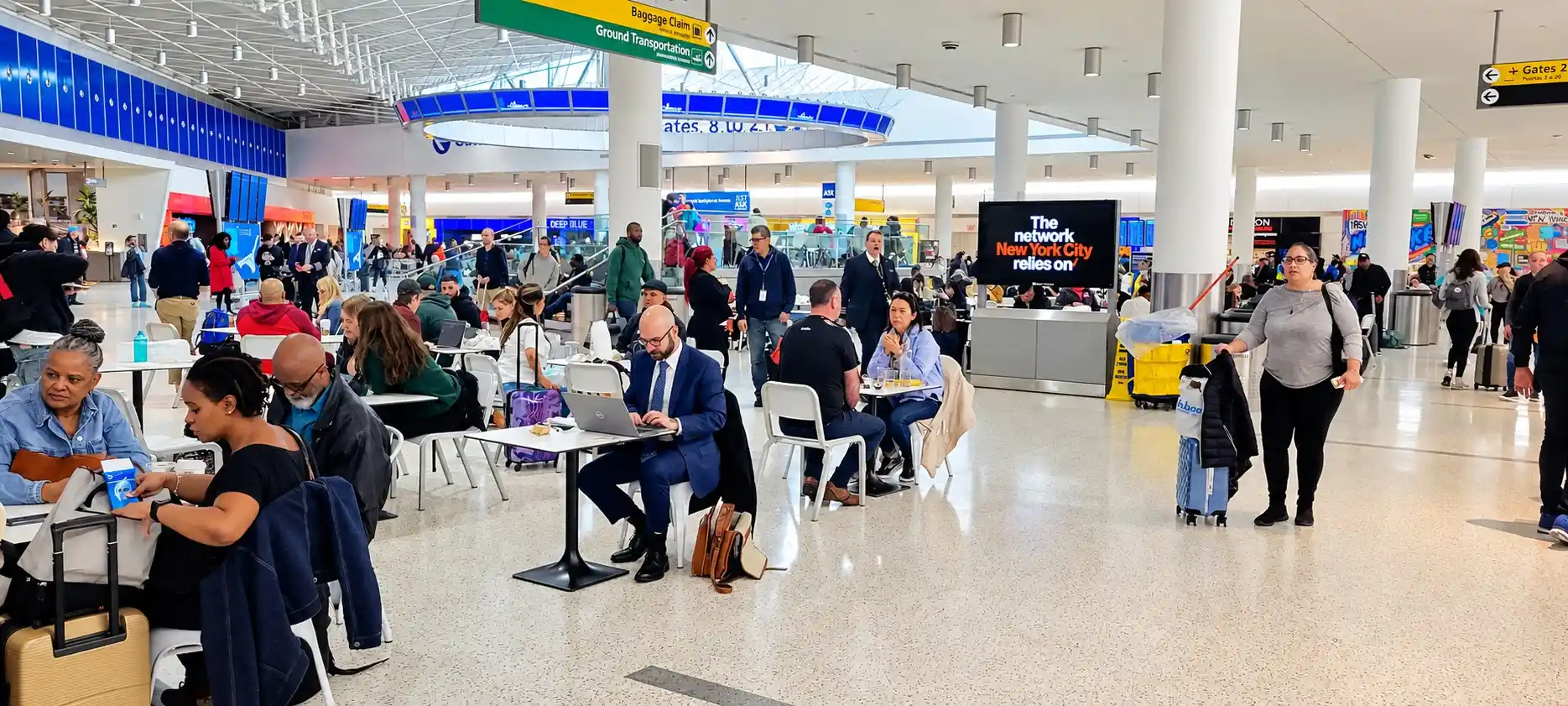
On a typical day TSA screens around two to three million passengers at U.S. airports, and they skew toward the people advertisers pay most to reach: business travelers with budget authority, affluent leisure travelers, students and families on the move, and the executives and investors who fly up front. More useful than the total is the sorting: residents depart and visitors arrive, business flyers cluster on weekday mornings and evenings, executives sit in the lounges, and in a conference week an entire market lands at one airport. The airport is not a mass audience; it is many specific audiences in predictable places.
Large and affluent
Travelers over-index on income, education, and budget authority compared with the general population.
Sorted, not mixed
Residents on departures, visitors on arrivals, executives in lounges, the market in show week.
Measured, not tracked
Passenger traffic is public; impressions are estimates; nobody is tracked individually.
The one thing to get right
Ask for the figures for the specific airport, terminal, and weeks in your plan. National averages describe nobody; the enplanements for Terminal 4 in March describe your audience.
Start your plan
Pick the path that matches where you are. Every path ends with current availability and a recommended mix.
The argument
Because it combines three things other channels deliver separately: affluence, intent to travel, and attention. Air travelers spend more than the general population, they are by definition going somewhere for a reason (a meeting, a conference, a trip they paid for), and in the terminal they wait, with nothing to scroll past on the wall in front of them. Business travelers add budget authority; conference weeks add concentration; lounges add seniority.
Affluence
Flying itself selects for income and employment.
Intent
Meetings, conferences, trips planned and paid for.
Attention
Dwell at gates, lounges, and carousels that no feed offers.
Who is where
The terminal sorts its audience for you. Read the table from the curb to the gate.
| Place | Who is there | When they're most present | What reaches them |
|---|---|---|---|
| Roadway, curb, parking | Everyone arriving by car, plus drivers and greeters who never go inside | All day; peaks with departures and arrivals banks | Exteriors, billboards, curbside banners |
| Check-in and security | Departing residents and connecting passengers | Weekday mornings for business; weekends and holidays for leisure | Security trays, check-in area units |
| Concourses and gates | Departing and connecting passengers, waiting | Business banks morning and evening; leisure midday and weekends | Digital networks, holdroom banners, dioramas, spectaculars |
| Airline club lounges | Premium-cabin and elite-status travelers: executives, frequent business flyers, investors | Weekday business hours; heaviest around morning and evening banks | Lounge screens and static units |
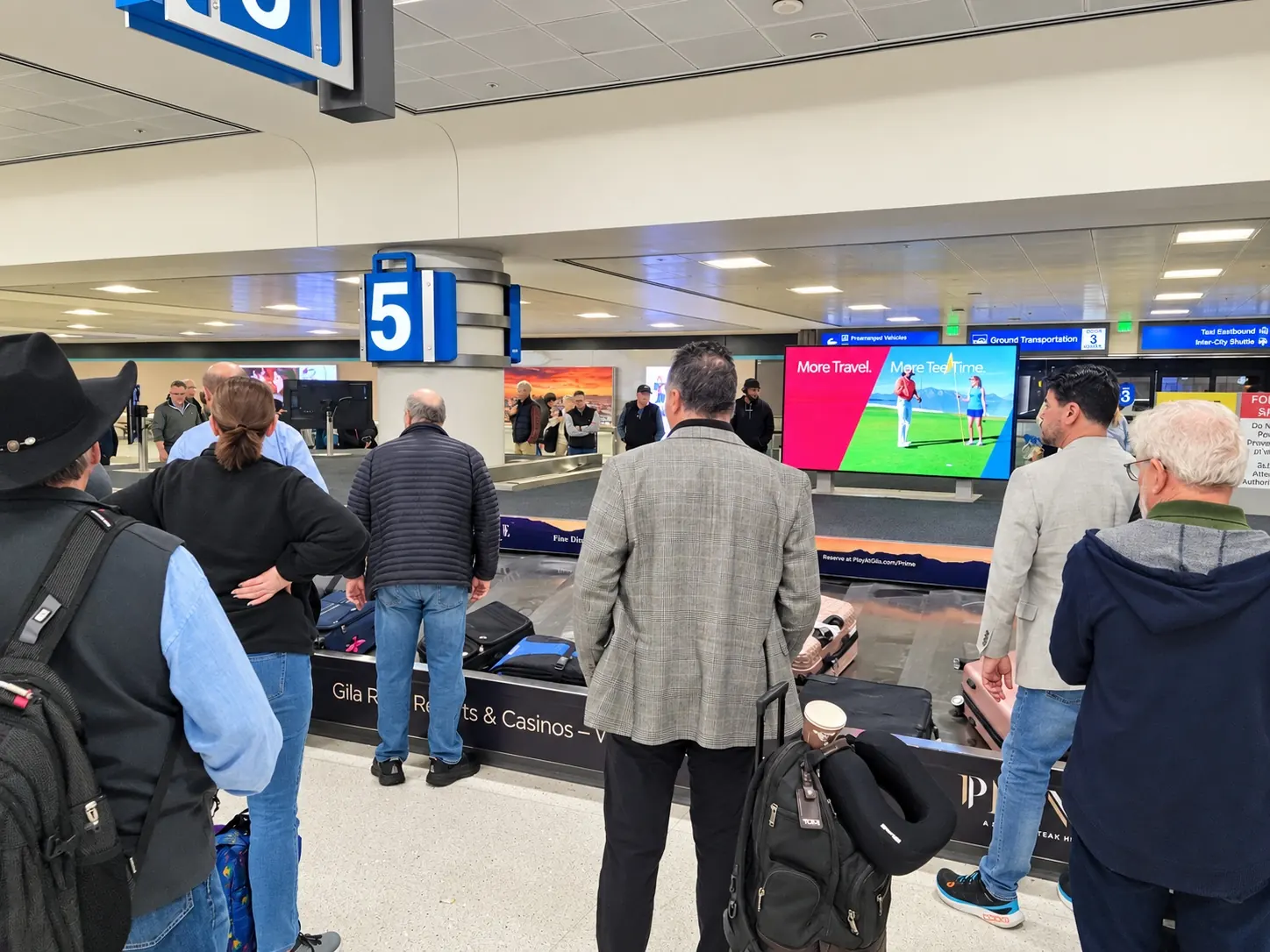
| Arrivals corridors and baggage claim | Arriving visitors: attendees, tourists, inbound buyers | Arrivals banks; whole-market peaks in conference weeks | Baggage-claim networks, arrival-path spectaculars, exit sponsorships |
| Connecting hubs | Passengers between flights, often with hours to spend | All day at ATL, ORD, DFW, DEN, CLT | Networks, lounges, Wi-Fi sponsorship |
Patterns, not figures; the airport's enplanements by month and terminal and the media owner's dwell and impression estimates carry the numbers for a specific plan.
Getting the numbers
Three sources, each for a different number. The airport publishes enplanements by month and often by terminal and airline, which is the count of who was there. The media owner estimates impressions and dwell per unit from that traffic and the placement's share of it, with methods that differ by media owner. Passenger surveys and research panels describe who the travelers are, by income, purpose, and frequency, and should be read with their sample and date in mind.
Airport enplanements
Public data, the base of every estimate.
Media-owner estimates
Traffic times placement share; ask whose method.
Surveys and panels
Income, purpose, frequency; check the sample and the date.
Limits of the data
It can say how many people passed the airport and the terminal, roughly how many passed a unit, and what the traveling population looks like. It cannot say which individuals saw your ad, how many of them were your buyers, or what they did afterward. A plan is honest when it uses the counts for what they are and the brand and business signals for the rest.
| The data can say | The data can't say |
|---|---|
| How many passengers used the airport and terminal in your weeks | Which individuals saw the unit |
| Roughly how many passed a placement, by the media owner's method | How many of them were your buyers, except by inference from routes and weeks |
| What the traveling population looks like, from surveys | What any one traveler did after seeing the ad |
| Where business, leisure, and premium travelers concentrate | A per-person reach or frequency figure with survey-grade precision |
Use counts for delivery and audience; use brand and business signals for effect.
What goes wrong
Audience numbers mislead when they're asked to do a job they can't.
National averages
There is no single airport audience; the terminal, hour, and week decide who is there. Plan from the specific figures.
Impressions as reach
Media-owner impressions are traffic times share; two owners can report the same unit differently. Name the method.
Counting everyone
A huge total of the wrong travelers is worth less than a medium hub full of the right ones.
Measurement
To choose and to prove. Choose the airport, the side, and the week from who is there (your buyers' hubs, the departures side for residents, the show week for the market), then prove delivery with the counts: enplanements for the weeks, the media owner's impression and dwell estimates with their method named, and the posting confirmation and photos that show the units ran.
Why EAM
We plan from the airport's own figures and the media owner's estimates, by terminal and week, and we say which is which in every report. We know where business, leisure, and premium travelers concentrate at each of the 125+ airports we buy, which side of the terminal reaches residents and which reaches visitors, and which weeks put a whole market through one airport. The audience figures for your airports come back with the plan.
 National, several media ownersFortinetU.S. and Canada: Las Vegas, New York, Chicago, San Francisco, Toronto, Washington, D.C., Dallas, and more. Bought from multiple media owners as one coordinated buy, under one plan and one contract.40 million impressionsSee the campaign
  Global, five continentsDynatraceParis, London, São Paulo, Tokyo, Kuala Lumpur, Mexico City, and more. Digital large format and screen networks across five continents, under one contract.60 million people reachedSee the campaign
  Executive audiences, seven citiesWhartonPhiladelphia, New York, Dallas, Atlanta, Denver, Minneapolis, San Diego. United, Delta, and American business club lounges, for Wharton Executive Education awareness.Seven U.S. citiesSee the campaign
 See every campaign on the case studies page.
Send the airports and weeks. We come back with the enplanements, the estimates by unit, and a recommended mix built from who is actually there.
Ready to plan?
Tell us the audience, the airports or the event, the dates, and the budget range. We come back with current availability at every airport in the plan and a recommended mix.
125+ airports · 40+ media vendors · Since 2015
“EAM made a nationwide airport campaign feel much easier to manage. The team was responsive, organized, and always on top of the details. They helped us make smart decisions with the budget, kept everything moving, and ultimately delivered exactly what we were looking for.”
 Chief Marketing OfficerFortinet · nationwide airport campaign
For agencies and consultants
Agencies and consultants bring EAM Advertising in as the airport specialist behind a client’s plan. The client relationship stays with you. We plan, buy, and report under NDA, and can work white-label.
Get our media kitAirports
EAM Advertising plans and buys at 125+ airports across North America, Europe, Latin America, Asia-Pacific, the Middle East, India, and Africa, and any combination runs under one contract. The most-requested airports are below; every airport, with search by city or code, is on the airport advertising hub.
Questions
TSA screens around two to three million passengers on a typical day across U.S. airports, with the busiest days higher; the figure for a specific airport and terminal comes from its published enplanements.
Travelers who skew toward higher income and budget authority: business travelers, affluent leisure travelers, students and families, and the executives and investors in the lounges, sorted by side of the terminal, hour, airport, and week.
On the departures side on weekday mornings and evenings, in the concourses and gates, in the airline club lounges, and connecting through hubs such as ATL, ORD, DFW, DEN, and CLT.
On the arrivals side: arrival corridors, baggage claim, and the walk to ground transport, with whole-market peaks in conference weeks at the host airport.
By the media owner, from passenger traffic for the airport or terminal and the placement's share of that flow; methods differ by media owner and should be named in the report.
By place and time rather than by individual: lounges for executives, departures for residents, arrivals for visitors, show weeks for a market, and specific airports for specific buyers.
From the airport's published enplanement reports by month and terminal, and from the media owner's estimates for specific units; both come with the plan.
Air travelers over-index on income and employment compared with the general population; passenger surveys by airport and research panels carry the specifics, with their samples and dates.
Which individuals saw the ad, how many of them were your buyers, or what they did afterward; those come from brand and business signals around the flight.
Everything after the objective. We check what's open for the week, which loops are crowded and which units will sell out, and where on the arrival path your audience actually walks. We recommend the mix, secure the units, traffic the creative through airport approval, confirm posting on day one, and deliver proof of posting and play logs after. If the airport is one market in a larger plan, the same relationship covers the others.
Airport advertising media agency. 125+ airports. Est. 2015.
Send your work email for the media kit: formats, planning ranges, and booking windows across 125+ airports. We’ll follow up to learn who you need to reach and when, then come back with current availability and a recommended mix.
125+ airports · 40+ media vendors · Since 2015
Sources
Updated October 5, 2026 · By EAM Advertising

EAM Advertising plans, secures, and buys airport and in-flight media across 125+ airports and 45+ airlines worldwide. Founded in 2015; collective operator experience in airport media buying spans two decades. Recommendations are based on what performs for the advertiser, not on inventory we have to sell. Clients include Dynatrace, Fortinet, Rubrik, McGraw-Hill, and Wharton.