National reach
The major hubs
Hundreds of thousands of travelers a day across LAX, JFK, ORD, ATL, DFW, and the rest.
E-commerce brands live on social and search, where the cost of attention keeps rising and the audience scrolls past. Airports offer the same consumers, with money and time, in a setting where they look up: hundreds of thousands a day at the national hubs, a captive wait at baggage claim, and a security tray in every traveler's hands. Airport advertising gives an online brand physical presence and the credibility that comes with it. This page covers which airports, formats, and program shapes work, what they cost, and the consumer campaigns EAM Advertising has run, from EAM Advertising, an airport advertising media agency that plans and buys across 125+ airports and 40+ media vendors.

You’re in good company






The short answer
Yes, as the physical layer an online brand usually lacks. Air travelers skew toward higher income and frequent purchase, they wait with time and a phone in hand, and a brand they see in the terminal looks bigger and more trustworthy than one they only see in a feed. Flexispot ran year-long security-tray takeovers across five major U.S. airports with more than 100 million impressions; for launches, a four-week flight across the national hubs makes an online brand look like a national one.
National reach
Hundreds of thousands of travelers a day across LAX, JFK, ORD, ATL, DFW, and the rest.
Always-on frequency
Every departing passenger handles the brand, trip after trip; Flexispot ran it for a year.
Credibility
A brand in the terminal looks established, which lifts every other channel.
The one thing to get right
Give it a way to act. Pair the terminal with a code, a vanity URL, or a Wi-Fi sponsorship, so the airport's presence has a measurable path back to the site.
Start your plan
Pick the path that matches where you are. Every path ends with current availability and a recommended mix.
Why airports
Because attention online keeps getting more expensive and less reliable, and airports deliver a large, affluent, captive audience at a predictable cost. Travelers in the terminal have time, a phone in hand, and nothing to scroll past on the wall in front of them. For a brand built on digital, physical presence also signals scale, and that credibility tends to lift the performance of the brand's other channels.
Affluent and captive
Travelers wait at gates, carousels, and checkpoints with attention to spare.
Predictable cost
Media priced per flight, not bid up by the next advertiser.
Credibility
A brand in the terminal reads as bigger than its ad account.
Airports and weeks
The national hubs for reach, the brand's strongest markets for efficiency, CES week at LAS for consumer electronics, and the holiday and summer travel peaks when traffic is highest.
| Airport or week | Why | What to buy |
|---|---|---|
| LAX, JFK, ORD, ATL, DFW, MIA, SFO | The largest consumer traffic | Networks, baggage claim, spectaculars |
| Your strongest markets | Where customers already buy | Networks and static units |
| LAS in CES week | Consumer electronics buyers, press, and retailers | Arrival path and baggage claim; sold by the week |
| Holiday and summer peaks | The highest passenger volumes of the year | Networks and baggage claim |
| Five-hub tray programs | Every departing passenger, all year | Security trays, as Flexispot ran |
Examples, not a complete list. Peak-season inventory commits early; book eight to twelve weeks ahead, longer for CES week.
Formats
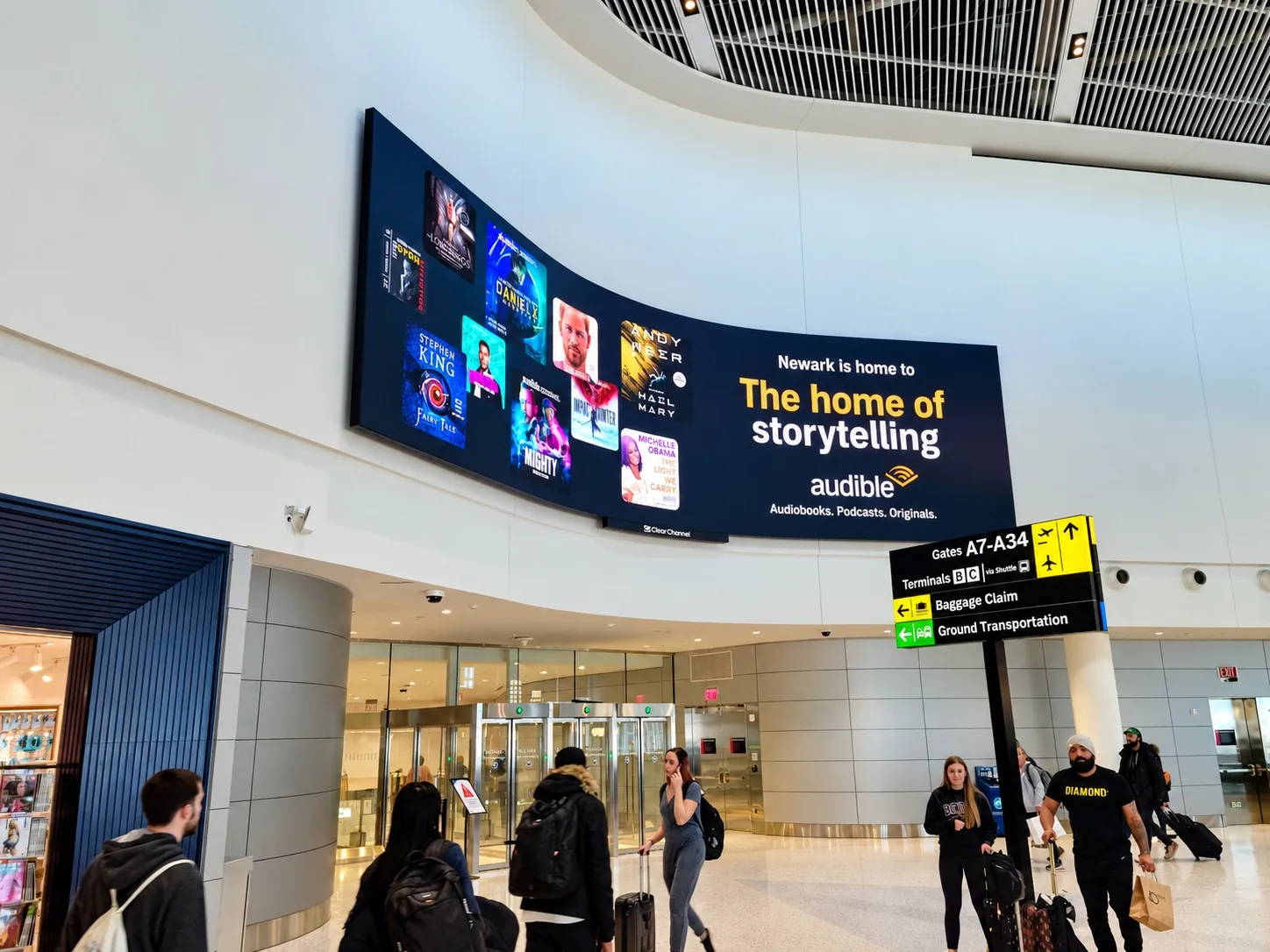
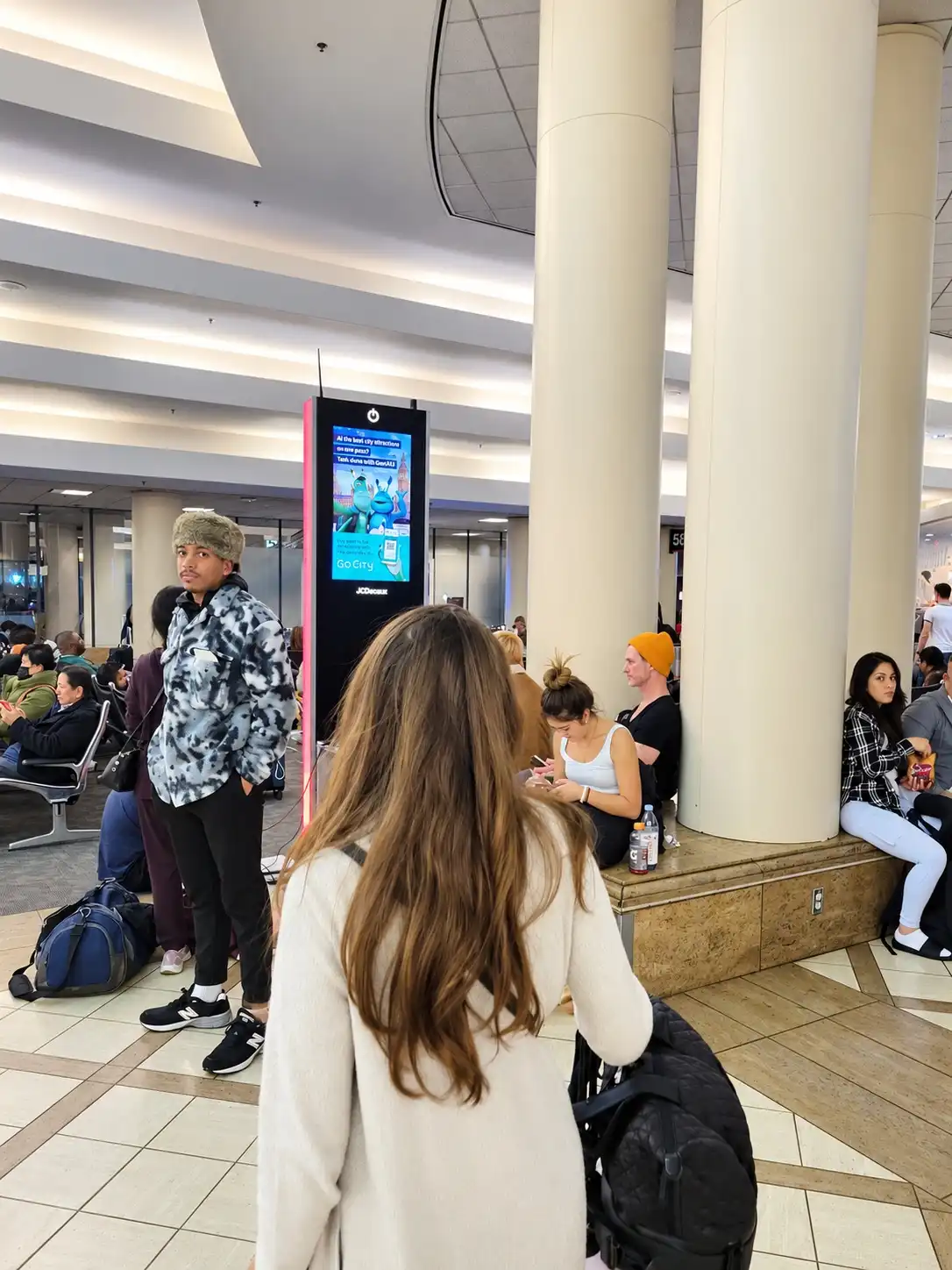
Security trays for always-on frequency, digital networks and baggage claim for reach, spectaculars for a launch, and Wi-Fi sponsorship to turn presence into a visit to the site.
Always-on frequency
Every departing passenger handles the brand, trip after trip.
Reach at the hubs
A spot in the loop across the concourses your audience connects through.
Arrivals, waiting
Every arriving passenger with a bag, facing the screens.
For the week that matters
The arrival-path unit the whole show walks past; the first to sell out in a conference week.
A way to act
A trial, a sign-up, or a meeting request on the phone in their hand.
One message, held
A single image held for the whole flight, with 100% share of voice.
Budget
A strongest-market test at one airport starts around $50,000 for four weeks; a national launch across five major hubs built for impact starts around $250,000; a security-tray program runs $30,000 to $100,000 and up per airport for four weeks, with longer runs priced per period. Media only, for medium to large airports.
| Plan | Airports | Formats | Planning range, media only |
|---|---|---|---|
| One-market test | 1 airport | Networks, baggage claim | From about $50,000 for four weeks |
| National launch | 5 major hubs built for impact | Spectaculars, networks, baggage claim | From about $250,000 for four weeks |
| Always-on trays | 3–5 airports, repeated flights | Security trays | $30,000–$100,000+ per airport per four weeks |
| Peak-season push | 8–10 airports | Networks and baggage claim | From about $500,000 |
Planning figures for medium to large airports, from Phoenix (PHX) up to JFK, Las Vegas (LAS), and San Francisco (SFO); smaller airports such as San Antonio (SAT) run 25 to 40% less. Ranges from the cost and budget pages.
A sample plan
An online brand's national launch: four weeks across five major hubs with baggage claim and networks for reach, plus a security-tray program at two hubs that runs on after the launch. Media only.
| Airport | Units | Weeks | Planning range, media only |
|---|---|---|---|
| LAX | Baggage-claim network plus the terminal network | 4 weeks | $30,000–$150,000 |
| JFK | Baggage-claim network plus the terminal network | 4 weeks | $30,000–$150,000 |
| ORD | Terminal network plus a security tray program | 4 weeks, trays continuing | $55,000–$200,000 |
| ATL | Terminal network | 4 weeks | $25,000–$100,000 |
| DFW | Terminal network plus a security tray program | 4 weeks, trays continuing | $55,000–$200,000 |
A worked example, not a quote. Ranges from the format and cost pages for medium to large airports, from Phoenix (PHX) up to JFK, Las Vegas (LAS), and San Francisco (SFO); production and installation are on top.
What goes wrong
Online brands know how to measure and often forget to give the airport anything to measure.
No way to act
Without a vanity URL, a code, or a Wi-Fi click, the airport's effect is invisible in your dashboards. Build the path in.
Lifestyle instead of product
Travelers glance; the product at scale registers, the lifestyle scene does not.
A short tray run
A four-week tray buy at one airport is a test; Flexispot's year across five hubs is why it worked.
Creative
The product, big, with one line and a way to act. Consumer creative in an airport works when the product is instantly recognizable, the line is short, and there's a code or URL the traveler can use on the phone already in their hand. In a security tray, a line that plays on the moment reads instantly.
Product first
The product at scale beats a lifestyle scene.
A way to act
Give the phone in their hand something to type.
The tray moment
A line that plays on the checkpoint makes the tray memorable.
Measurement
With more direct signals than most categories: vanity URL and code redemptions, direct and branded-search traffic by region during the flight, Wi-Fi sponsorship clicks, and new-customer volume in the targeted markets compared with the weeks before, alongside proof of posting and photos.
Why EAM
Flexispot's year-long security-tray takeovers across Chicago, Denver, Charlotte, Washington, D.C., and Los Angeles, with more than 100 million impressions; Rauw Alejandro's album and tour launch across Miami, New York, Chicago, Madrid, and Barcelona; and Fabric's full takeover of San Jose. We plan for reach and frequency, give every campaign a measurable path back to the site, and run every airport under one contract.
Always-on, five airportsFlexispotChicago, Denver, Charlotte, Washington, D.C., Los Angeles. Year-long security-tray takeovers across five major U.S. airports.100 million-plus impressionsSee the campaign  Launch, two countriesRauw AlejandroMiami, New York, Chicago, Madrid, Barcelona. Airport advertising for the Saturno album and tour launch in the U.S. and Spain at the same time.15 million people reachedSee the campaign
  One airport, dominatedFabricSan Jose (SJC). A full airport takeover for one flight: 82 digital faces covering 5,252 square feet, plus all 760 security trays.Every network and checkpoint at one airportSee the campaign
 See every campaign on the case studies page.
Send the markets, the season, and the range. We come back with availability and a recommended mix.
Ready to plan?
Tell us the audience, the airports or the event, the dates, and the budget range. We come back with current availability at every airport in the plan and a recommended mix.
125+ airports · 40+ media vendors · Since 2015
“We ran a security tray advertising program across several key airports, and EAM was a tremendous partner throughout the process. Their team helped secure the space, manage renewals, and coordinate the campaign seamlessly from start to finish.”
 Chief Executive OfficerFlexispot · security tray program across five U.S. airports
For agencies and consultants
Agencies and consultants bring EAM Advertising in as the airport specialist behind a client’s plan. The client relationship stays with you. We plan, buy, and report under NDA, and can work white-label.
Get our media kitAirports
EAM Advertising plans and buys at 125+ airports across North America, Europe, Latin America, Asia-Pacific, the Middle East, India, and Africa, and any combination runs under one contract. The most-requested airports are below; every airport, with search by city or code, is on the airport advertising hub.
Questions
Yes, as the physical presence online brands usually lack: an affluent, captive audience at the national hubs, frequency through security trays, and credibility that lifts other channels. Flexispot ran year-long tray takeovers across five U.S. airports with more than 100 million impressions.
The national hubs for reach (LAX, JFK, ORD, ATL, DFW, MIA, SFO), the brand's strongest customer markets for efficiency, and LAS in CES week for consumer electronics.
From about $50,000 for a four-week test at one airport, about $250,000 for a five-hub national launch, and $30,000 to $100,000 and up per airport for four weeks of security trays. Media only.
Yes; every departing passenger handles the tray, and long runs build frequency. Flexispot ran year-long tray takeovers across five major U.S. airports.
Vanity URL and code redemptions, direct and branded-search traffic by region during the flight, Wi-Fi sponsorship clicks, and new-customer volume in the targeted markets compared with the weeks before.
Yes; a four-week flight across the national hubs makes an online brand look national, and CES week at LAS reaches consumer electronics press and retailers.
The product at scale, one short line, and a code or URL the traveler can use on the phone in their hand.
The holiday and summer travel peaks carry the most passengers; book eight to twelve weeks ahead, since peak-season inventory commits early.
Consumer electronics, subscription services, travel brands, and online retailers. EAM Advertising's consumer campaigns include Flexispot and Rauw Alejandro's album launch.
Everything after the objective. We check what's open for the week, which loops are crowded and which units will sell out, and where on the arrival path your audience actually walks. We recommend the mix, secure the units, traffic the creative through airport approval, confirm posting on day one, and deliver proof of posting and play logs after. If the airport is one market in a larger plan, the same relationship covers the others.
Airport advertising media agency. 125+ airports. Est. 2015.
Send your work email for the media kit: formats, planning ranges, and booking windows across 125+ airports. We’ll follow up to learn who you need to reach and when, then come back with current availability and a recommended mix.
125+ airports · 40+ media vendors · Since 2015
Sources
Updated October 5, 2026 · By EAM Advertising

EAM Advertising plans, secures, and buys airport and in-flight media across 125+ airports and 45+ airlines worldwide. Founded in 2015; collective operator experience in airport media buying spans two decades. Recommendations are based on what performs for the advertiser, not on inventory we have to sell. Clients include Dynatrace, Fortinet, Rubrik, McGraw-Hill, and Wharton.