Where candidates live
Their home airports, departures side
Residents are reached at the gates, the trays, and the lounges, not at baggage claim.
Recruiting campaigns have a geography: the candidates a company wants live in a few cities, and they fly out of those cities' airports on every trip. Airport advertising reaches them on the departures side of their own airport, at the gates, in the trays, in the lounges, where a company that looks established in the terminal looks like a place worth working. This page covers which markets, which formats, what a program costs, and the recruiting and enrollment campaigns EAM Advertising has run, from EAM Advertising, an airport advertising media agency that plans and buys across 125+ airports and 40+ media vendors.

You’re in good company






The short answer
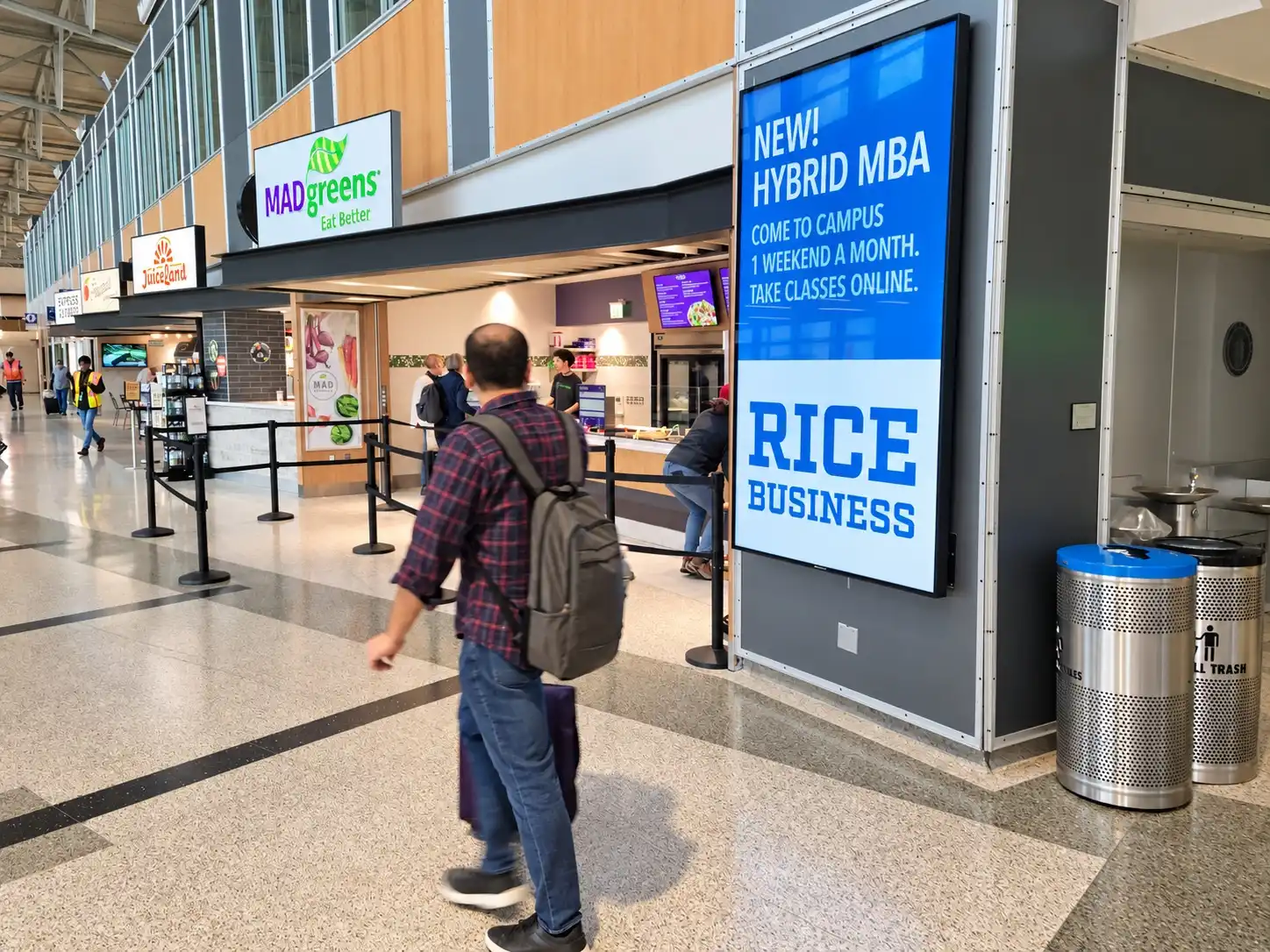
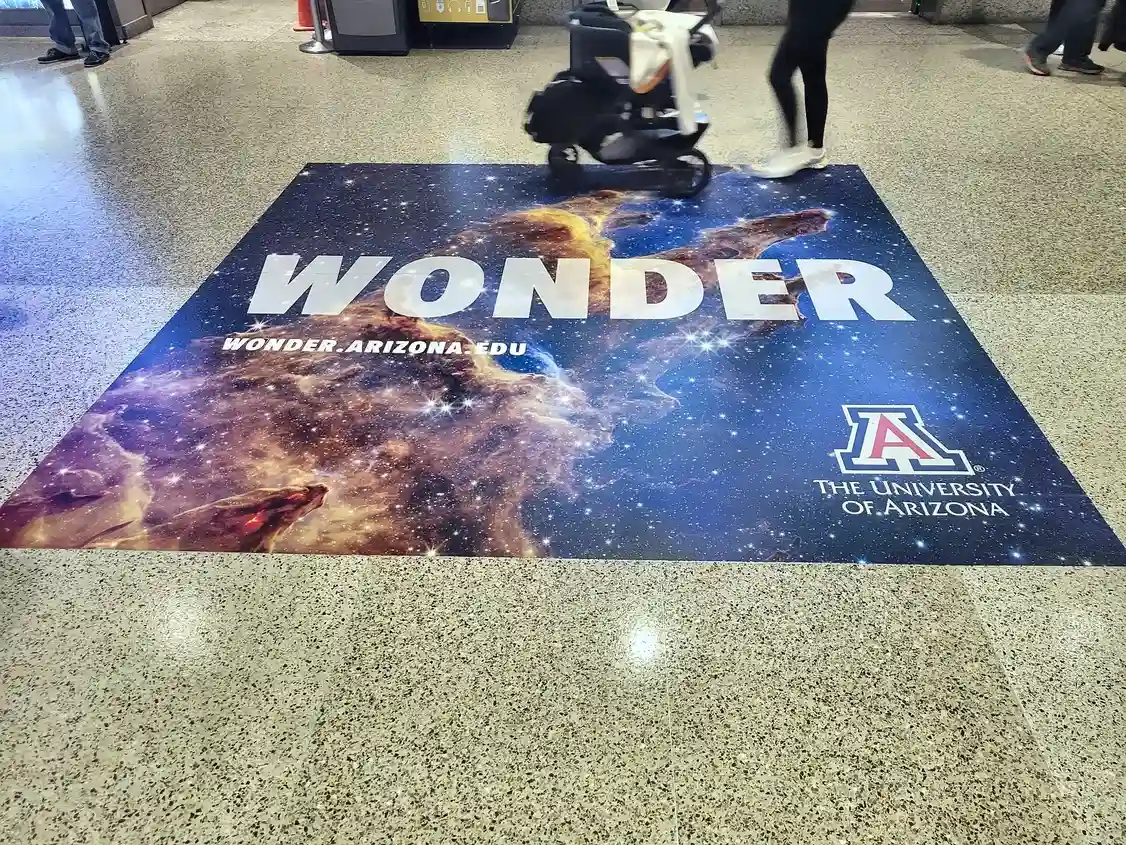
Yes, when it is aimed at the departures side of the airports where candidates live. Residents, not visitors, are the audience: the engineers in Seattle and Austin, the finance talent in New York and Charlotte, the healthcare workforce in a hospital city. They pass security trays, concourses, gates, and lounges on every trip, and a brand with a presence there reads as a serious employer. Rice Business used airport networks for enrollment; BYU ran a year-round enrollment campaign on airport video, always on in Salt Lake City.
Where candidates live
Residents are reached at the gates, the trays, and the lounges, not at baggage claim.
Employer brand at scale
A company in the terminal reads as established to the people it wants to hire.
Year-round or in season
Hiring cycles are long; a steady presence in the home market suits them.
The one thing to get right
Departures, not arrivals. Candidates are residents heading out, so the units that work are the ones they pass on the way to the gate: trays, concourse networks, holdroom banners, lounges. Baggage claim reaches the people arriving, who are someone else's audience.
Start your plan
Pick the path that matches where you are. Every path ends with current availability and a recommended mix.
Why it works
Because the people a company wants to hire are frequent flyers in a few cities, and they see employer brands the way they see any brand: by whether it shows up where they are. A candidate who sees a company at their home airport every trip assumes it is large, stable, and hiring; the same candidate rarely clicks a job ad. Airports also reach the passive candidate, the one not looking, which is where most senior hires come from.
Frequent flyers
Engineers, finance, sales, and healthcare talent fly for work and leisure.
Passive candidates
The best hires aren't on job boards; they're at the gate.
Stability signal
Looks established, funded, and worth a call back.
Airports and timing
The home airports of the cities where the talent lives: technology talent around SEA, SFO, SJC, AUS, and DEN; finance around JFK, CLT, and BOS; healthcare around the hospital hubs; and your own headquarters city for local hiring and the company's own people.
| Talent | Home airports | What to buy |
|---|---|---|
| Engineering and technology | SEA, SFO, SJC, AUS, DEN | Security trays, concourse networks, holdroom banners |
| Finance and professional services | JFK, EWR, CLT, BOS, ORD | Club lounges and networks |
| Healthcare and clinical | MSP, CLE, BNA, BOS, the hospital hubs | Networks and static units |
| Your headquarters city | Your home airport | Arrival-path units for visitors, trays and networks for residents |
| Campus and early-career | The home airport and feeder markets | Digital video, as BYU ran |
Examples. The markets come from where your candidates live, which your recruiting team already knows.
Formats
Security trays, which every departing resident handles; digital networks and holdroom banners on the concourses; club lounges for senior and executive hires; and Wi-Fi sponsorship for a careers-page click.
Always-on frequency
Every departing passenger handles the brand, trip after trip.
Reach at the hubs
A spot in the loop across the concourses your audience connects through.
One message, held
A single image held for the whole flight, with 100% share of voice.
The executives
Seated for an hour, the most senior audience in the terminal.
A way to act
A trial, a sign-up, or a meeting request on the phone in their hand.
For the week that matters
The arrival-path unit the whole show walks past; the first to sell out in a conference week.
Budget
A home-market employer-brand presence starts around $50,000 for four weeks at a medium to large airport; a three-city talent-market program starts around $100,000 for four weeks; a tray program across the hiring markets runs $30,000 to $100,000 and up per airport per four weeks, with longer runs priced per period. Media only.
| Plan | Airports | Formats | Planning range, media only |
|---|---|---|---|
| Home market | 1 airport | Trays, networks, holdroom banners | From about $50,000 for four weeks |
| Three talent markets | 3 airports at entry level | Networks and static units | From about $100,000 for four weeks |
| Tray program | 2–4 hiring markets, longer runs | Security trays | $30,000–$100,000+ per airport per four weeks |
| Executive hiring | Club lounges in 3–5 cities | Lounge screens | $10,000–$45,000 per lounge for four weeks |
Planning figures for medium to large airports, from Phoenix (PHX) up to JFK, Las Vegas (LAS), and San Francisco (SFO); smaller airports such as San Antonio (SAT) run 25 to 40% less. Ranges from the cost and budget pages.
A sample plan
A technology company hiring engineers in three cities: a departures-side presence at each home airport for a quarter, trays where the program runs, with a careers link on Wi-Fi. Media only.
| Airport | Units | Weeks | Planning range, media only |
|---|---|---|---|
| SEA | Security tray program plus the concourse network | 4 weeks, repeated through the quarter | $55,000–$200,000 per flight |
| AUS | Concourse network plus holdroom banners | 4 weeks, repeated | $40,000–$160,000 per flight plus production |
| DEN | Concourse network | 4 weeks | $25,000–$100,000 |
| All three | Wi-Fi sponsorship with a careers call to action | 4 weeks | $25,000–$100,000+ per airport |
A worked example, not a quote. Ranges from the format and cost pages for medium to large airports, from Phoenix (PHX) up to JFK, Las Vegas (LAS), and San Francisco (SFO); production and installation are on top.
What goes wrong
Recruiting campaigns fail by facing the wrong direction, saying the wrong thing, or stopping too soon.
Arrivals units for residents
Candidates are departing; buy the trays, the concourse, the holdrooms, the lounges.
A job ad on a spectacular
The unit builds the employer brand; the careers page does the hiring. One line about the company, one link.
One flight in a long hiring cycle
A single four-week burst is forgotten by the time the candidate looks; run the home market steadily.
Creative
The company as a place, not a posting. Employer-brand creative that works in a terminal says who the company is and what it's like to work there, in one line, with the brand at scale; the role list and the apply button live on the careers page the Wi-Fi sponsorship or vanity URL points to. Humor and self-awareness work in the tray, where the candidate is looking straight at it.
Who you are
Not a job title; a reason to look you up.
A careers link
Where the interested candidate goes from the gate.
The tray moment
A line that plays on the checkpoint lands with engineers.
Measurement
Applications and careers-page traffic from the targeted metros across the flight versus the weeks before, careers-link clicks from Wi-Fi sponsorship or a vanity URL, candidate-source answers that mention the airport, offer-acceptance rates in those markets, and the delivery proof: posting confirmation, photos, play logs.
Why EAM
BYU's year-round enrollment campaign on airport video, always on in Salt Lake City and rotating through Dallas, Chicago, and Washington, D.C.; Wharton Executive Education's lounge program across seven cities; and Flexispot's year-long tray program across five hubs, the shape a multi-market employer-brand program takes. We plan from where your candidates live, buy the departures side, and run every airport under one contract.
Year-round, four marketsBYUSalt Lake City year-round; Dallas, Chicago, and Washington, D.C. in rotation. A year-round enrollment campaign on airport digital video, always on at home and rotating through three markets.12 months on airSee the campaign  Executive audiences, seven citiesWhartonPhiladelphia, New York, Dallas, Atlanta, Denver, Minneapolis, San Diego. United, Delta, and American business club lounges, for Wharton Executive Education awareness.Seven U.S. citiesSee the campaign
  Always-on, five airportsFlexispotChicago, Denver, Charlotte, Washington, D.C., Los Angeles. Year-long security-tray takeovers across five major U.S. airports.100 million-plus impressionsSee the campaign
 See every campaign on the case studies page.
Send the roles and the cities you're hiring in. We come back with the departures-side units that fit and current availability.
Ready to plan?
Tell us the audience, the airports or the event, the dates, and the budget range. We come back with current availability at every airport in the plan and a recommended mix.
125+ airports · 40+ media vendors · Since 2015
“EAM made a nationwide airport campaign feel much easier to manage. The team was responsive, organized, and always on top of the details. They helped us make smart decisions with the budget, kept everything moving, and ultimately delivered exactly what we were looking for.”
 Chief Marketing OfficerFortinet · nationwide airport campaign
For agencies and consultants
Agencies and consultants bring EAM Advertising in as the airport specialist behind a client’s plan. The client relationship stays with you. We plan, buy, and report under NDA, and can work white-label.
Get our media kitAirports
EAM Advertising plans and buys at 125+ airports across North America, Europe, Latin America, Asia-Pacific, the Middle East, India, and Africa, and any combination runs under one contract. The most-requested airports are below; every airport, with search by city or code, is on the airport advertising hub.
Questions
Yes, aimed at the departures side of the airports where candidates live: trays, concourse networks, holdroom banners, and lounges reach residents on every trip, and a company in the terminal reads as a serious employer.
The home airports of the cities where the talent lives: technology around SEA, SFO, SJC, AUS, and DEN; finance around JFK, CLT, and BOS; healthcare around the hospital hubs; plus your own headquarters airport.
From about $50,000 for four weeks in the home market, about $100,000 for three talent markets, $30,000 to $100,000 and up per airport for trays, and $10,000 to $45,000 per lounge for executive hiring. Media only.
Security trays, digital networks and holdroom banners on the concourses, club lounges for senior hires, and Wi-Fi sponsorship for a careers-page click.
Departures; candidates are residents heading out. Baggage claim reaches visitors, who are someone else's audience.
Indirectly: the unit builds the employer brand and the careers link on Wi-Fi or a vanity URL carries the click; applications from the targeted metros are the measure.
Steadily in the home market, since senior hiring takes months, with flights timed to hiring pushes in the other markets.
Technology companies hiring engineers, financial firms, health systems, and universities; EAM Advertising's enrollment campaigns include BYU and Wharton Executive Education.
One line about who the company is and what it's like to work there, with the brand at scale and a careers link; the role list lives on the careers page.
Everything after the objective. We check what's open for the week, which loops are crowded and which units will sell out, and where on the arrival path your audience actually walks. We recommend the mix, secure the units, traffic the creative through airport approval, confirm posting on day one, and deliver proof of posting and play logs after. If the airport is one market in a larger plan, the same relationship covers the others.
Airport advertising media agency. 125+ airports. Est. 2015.
Send your work email for the media kit: formats, planning ranges, and booking windows across 125+ airports. We’ll follow up to learn who you need to reach and when, then come back with current availability and a recommended mix.
125+ airports · 40+ media vendors · Since 2015
Sources
Updated October 5, 2026 · By EAM Advertising

EAM Advertising plans, secures, and buys airport and in-flight media across 125+ airports and 45+ airlines worldwide. Founded in 2015; collective operator experience in airport media buying spans two decades. Recommendations are based on what performs for the advertiser, not on inventory we have to sell. Clients include Dynatrace, Fortinet, Rubrik, McGraw-Hill, and Wharton.