One airport
Where your audience walks
The hub your buyers connect through, or your home market; not the biggest airport, the right one.
Most first airport campaigns are pilots whether they're called that or not: one airport, one flight, a budget the team can approve without a board meeting. The difference between a pilot that leads to a program and one that ends the conversation is design, not luck: the right airport, a unit big enough to be seen, a measurement plan set before launch, and an honest success criterion. This page covers how to design a pilot that tells you something, what it costs, and what goes wrong, from EAM Advertising, an airport advertising media agency that plans and buys across 125+ airports and 40+ media vendors.

You’re in good company






The short answer
Pick one airport where your audience actually walks, buy enough of it to be seen (a spot with real share of voice in the network your audience passes, or a well-placed static unit, not one small face), run a standard four-week flight, set the measurement plan and the success criterion before launch, and compare the flight to the weeks before it. A pilot built that way costs $25,000 to $50,000 at a medium airport, media only, and answers the question the board will ask.
One airport
The hub your buyers connect through, or your home market; not the biggest airport, the right one.
Enough to be seen
One spot in a crowded loop teaches you nothing; a meaningful share of the network does.
Measured before launch
Decide what 'worked' means before the first arrival wave, not after.
The one thing to get right
Size it to be visible. The most common pilot failure is a buy too small to be noticed, followed by the conclusion that airports don't work. A $25,000 to $50,000 four-week flight at a medium airport is the floor for a readable result.
Start your plan
Pick the path that matches where you are. Every path ends with current availability and a recommended mix.
Why it works
Because it converts an argument into evidence. A pilot proves to a skeptical CFO that the channel delivers presence to the right audience, shows the sales team what prospects say when they've seen the brand, and produces the photos and the search curve the board will want before approving a program. Done at one airport, it also teaches you the specs, approvals, and timelines before they matter at five.
Evidence, not argument
Photos, delivery proof, and a before-and-after curve.
Learn the mechanics cheaply
One airport's lessons before five airports' deadlines.
A basis for the program
Which unit, which audience, which week to repeat.
Airports and timing
The one where the audience is densest and the read will be cleanest: a medium hub your buyers connect through, your home market, or the host airport in a conference week if the campaign is really about the show. Run it in a normal four-week flight unless the question is about an event.
| Pilot type | Airport | Why |
|---|---|---|
| B2B awareness | A medium hub your buyers connect through (AUS, SJC, SEA, CLT) | Dense audience, rates below the mega-hubs, clean read |
| Home-market brand | Your own airport | The audience you know best; easy to compare with existing signals |
| Conference test | The host airport in show week | One week, one audience, booth traffic to compare |
| Consumer test | One major hub's baggage claim or trays | Reach with a clear path to a code or URL |
One airport, one standard flight, unless the pilot's question is about an event week.
Formats
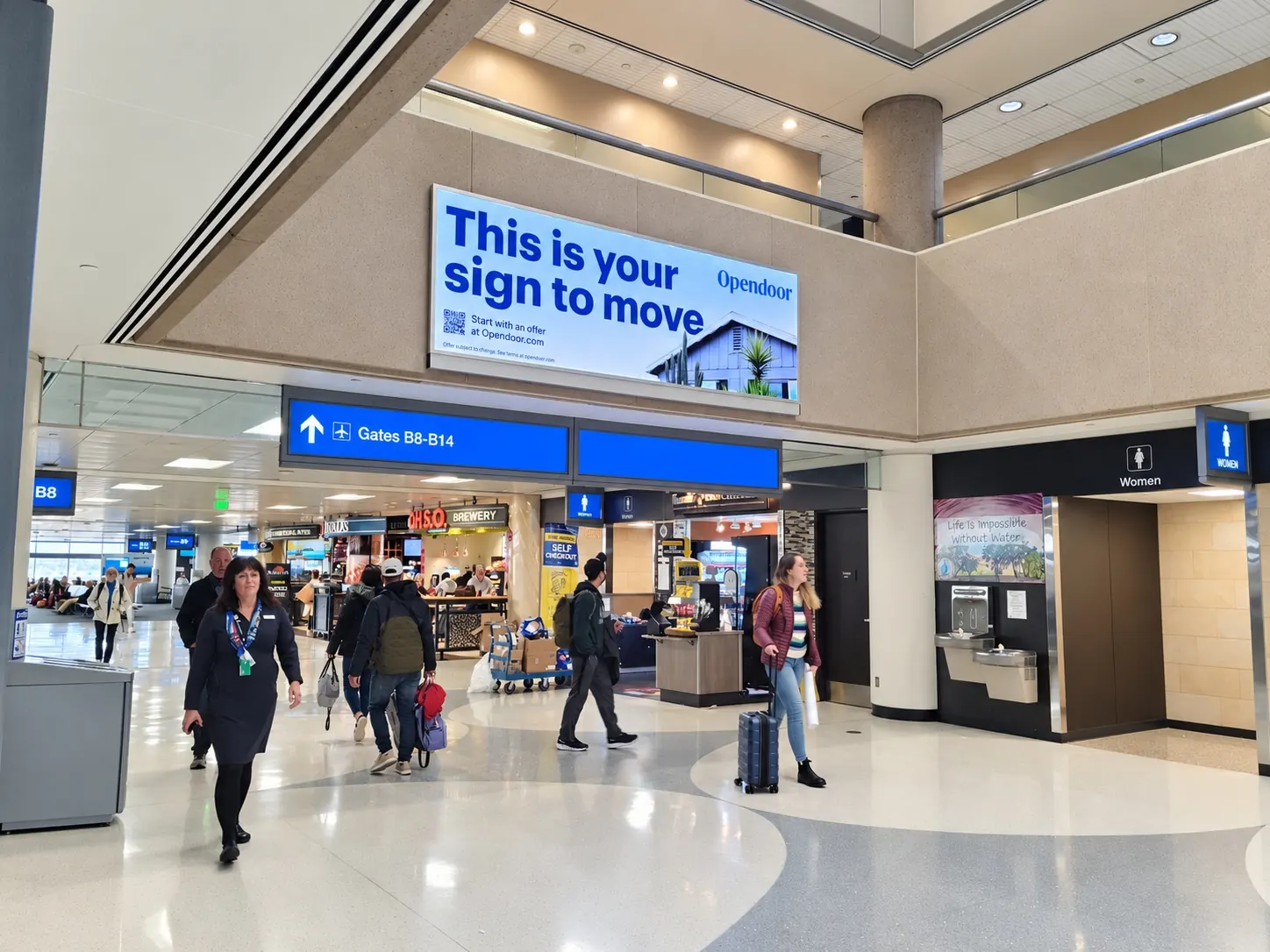
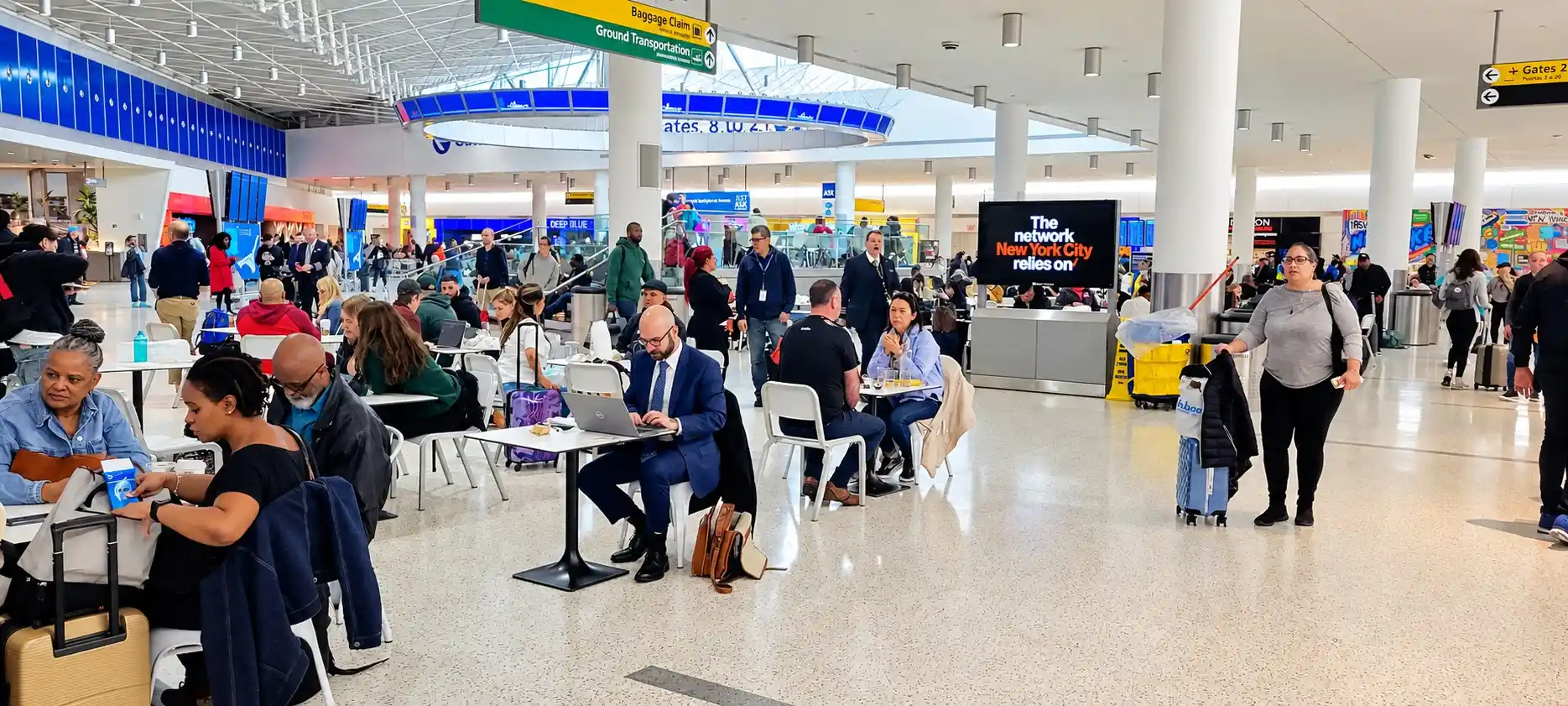
A digital network with real share of voice is the usual choice: no production, swappable creative, play logs as proof. A static unit at a high-dwell position works where the audience sits; trays suit a departures-side test; baggage claim suits an arrivals test.
Reach at the hubs
A spot in the loop across the concourses your audience connects through.
One message, held
A single image held for the whole flight, with 100% share of voice.
Always-on frequency
Every departing passenger handles the brand, trip after trip.
Arrivals, waiting
Every arriving passenger with a bag, facing the screens.
A way to act
A trial, a sign-up, or a meeting request on the phone in their hand.
For the week that matters
The arrival-path unit the whole show walks past; the first to sell out in a conference week.
Budget
$25,000 to $50,000 for a readable four-week pilot at a medium airport, media only: a meaningful share of a network, or a network plus a static unit. Smaller airports run 25 to 40% less; a major hub pilot runs $50,000 to $100,000. Add production for static units.
| Plan | Airports | Formats | Planning range, media only |
|---|---|---|---|
| Readable pilot | 1 medium airport | A network with real share of voice, or a network plus a static unit | $25,000–$50,000 for four weeks |
| Major-hub pilot | 1 major hub | Network plus one high-dwell static unit | $50,000–$100,000 for four weeks |
| Conference pilot | The host airport, show week | Arrival-path unit or baggage claim | From about $50,000 for the week |
| Below the floor | 1 airport, one small face | Not recommended as a test | Under $10,000; too small to read |
Planning figures for medium to large airports, from Phoenix (PHX) up to JFK, Las Vegas (LAS), and San Francisco (SFO); smaller airports such as San Antonio (SAT) run 25 to 40% less. Ranges from the cost and budget pages.
A sample plan
A B2B software company's first airport buy: one medium hub its buyers connect through, four weeks, a network with a strong share of the loop plus one static unit at the gates, with the measurement plan agreed before launch. Media only.
| Airport | Units | Weeks | Planning range, media only |
|---|---|---|---|
| AUS | Terminal digital network, two spots in the loop for share of voice | 4 weeks | $25,000–$50,000 |
| AUS | One static banner facing holdroom seating | 4 weeks | $15,000–$30,000 plus production |
| Measurement | Branded search and direct traffic by region, sales-call mentions, Wi-Fi or URL clicks if added | Flight vs. prior 8 weeks | Set before launch |
A worked example, not a quote. Ranges from the format and cost pages for medium to large airports, from Phoenix (PHX) up to JFK, Las Vegas (LAS), and San Francisco (SFO); production and installation are on top.
What goes wrong
Pilots fail for predictable reasons, and most are decided before the first unit is posted.
Too small to see
A buy below the visibility floor produces no signal and the wrong conclusion. Size it to be seen.
No baseline
Measure the eight weeks before the flight, or the lift is invisible.
The wrong airport
A mega-hub full of leisure travelers dilutes a B2B test; the medium hub your buyers use reads cleanly.
Creative
One line and the brand, with a way to act. Keep the pilot's creative simple so the read is about the channel, not the ad: a single message, the brand at scale, and a vanity URL, a code, or a Wi-Fi sponsorship so part of the response can be counted.
One message
A single line keeps the read clean.
A countable path
Some response you can count, alongside the brand signals.
Swappable
If the first two weeks teach something, change the file.
Measurement
Against a baseline set before launch: branded-search and direct-traffic curves for the targeted region across the flight versus the eight weeks before, vanity URL or code activity, Wi-Fi sponsorship clicks if included, and a log of prospects who mention the airport, plus proof of posting, photos, and play logs. Decide in advance what result would justify a program.
Why EAM
We help choose the airport where the read will be cleanest, size the buy to be seen, set the measurement plan and the baseline before launch, secure the units, confirm posting, and deliver play logs and photos, then show what the result would look like scaled to a program. BYU's year-round program started as an airport test in its home market; Fabric's one-airport takeover is what a pilot can grow into.
Year-round, four marketsBYUSalt Lake City year-round; Dallas, Chicago, and Washington, D.C. in rotation. A year-round enrollment campaign on airport digital video, always on at home and rotating through three markets.12 months on airSee the campaign  One airport, dominatedFabricSan Jose (SJC). A full airport takeover for one flight: 82 digital faces covering 5,252 square feet, plus all 760 security trays.Every network and checkpoint at one airportSee the campaign
  Always-on, five airportsFlexispotChicago, Denver, Charlotte, Washington, D.C., Los Angeles. Year-long security-tray takeovers across five major U.S. airports.100 million-plus impressionsSee the campaign
 See every campaign on the case studies page.
Send the audience and the airport you have in mind. We come back with a pilot sized to be seen and the measurement plan to go with it.
Ready to plan?
Tell us the audience, the airports or the event, the dates, and the budget range. We come back with current availability at every airport in the plan and a recommended mix.
125+ airports · 40+ media vendors · Since 2015
“EAM made a nationwide airport campaign feel much easier to manage. The team was responsive, organized, and always on top of the details. They helped us make smart decisions with the budget, kept everything moving, and ultimately delivered exactly what we were looking for.”
 Chief Marketing OfficerFortinet · nationwide airport campaign
For agencies and consultants
Agencies and consultants bring EAM Advertising in as the airport specialist behind a client’s plan. The client relationship stays with you. We plan, buy, and report under NDA, and can work white-label.
Get our media kitAirports
EAM Advertising plans and buys at 125+ airports across North America, Europe, Latin America, Asia-Pacific, the Middle East, India, and Africa, and any combination runs under one contract. The most-requested airports are below; every airport, with search by city or code, is on the airport advertising hub.
Questions
$25,000 to $50,000 for a readable four-week pilot at a medium airport, media only, with a meaningful share of a network or a network plus a static unit; $50,000 to $100,000 at a major hub. Below about $10,000, a buy is usually too small to read.
One standard four-week flight, unless the test is about an event week, in which case the show week itself.
The one where your audience is densest: a medium hub your buyers connect through, your home market, or the host airport in a conference week.
Branded search and direct traffic for the region versus the eight weeks before, vanity URL or code activity, Wi-Fi clicks if included, prospects who mention it, and proof of posting, photos, and play logs.
Yes, at one airport, as long as the buy is big enough to be seen; one small face for one week teaches nothing. Smaller airports run 25 to 40% less, which helps a modest budget reach the visibility floor.
A digital network with real share of voice: no production, swappable creative, and play logs as proof. Add one static unit at a high-dwell position if the budget allows.
Against the success criterion you set before launch: lift in regional branded search and direct traffic, countable responses, and sales conversations that mention it, with the delivery proof to show it ran.
Buys too small to see, no baseline to compare against, and the wrong airport. All three are decided before launch.
It becomes the first flight of a program: the same unit and audience repeated, then extended to the next airports the audience uses.
Everything after the objective. We check what's open for the week, which loops are crowded and which units will sell out, and where on the arrival path your audience actually walks. We recommend the mix, secure the units, traffic the creative through airport approval, confirm posting on day one, and deliver proof of posting and play logs after. If the airport is one market in a larger plan, the same relationship covers the others.
Airport advertising media agency. 125+ airports. Est. 2015.
Send your work email for the media kit: formats, planning ranges, and booking windows across 125+ airports. We’ll follow up to learn who you need to reach and when, then come back with current availability and a recommended mix.
125+ airports · 40+ media vendors · Since 2015
Sources
Updated October 5, 2026 · By EAM Advertising

EAM Advertising plans, secures, and buys airport and in-flight media across 125+ airports and 45+ airlines worldwide. Founded in 2015; collective operator experience in airport media buying spans two decades. Recommendations are based on what performs for the advertiser, not on inventory we have to sell. Clients include Dynatrace, Fortinet, Rubrik, McGraw-Hill, and Wharton.