Their home airport
Where their customers and people fly
The arrival path and the network at the competitor's headquarters airport.
A competitor just showed up at your home airport, or you want to be the brand at theirs: the airport where their customers, partners, and employees start every trip, and the show weeks where you both sell to the same buyers. Conquest in airports is about position and share of voice, not comparative claims, which most airports won't run anyway. This page covers which airports, what airports allow, which formats win the loop, what it costs, and the traps, from EAM Advertising, an airport advertising media agency that plans and buys across 125+ airports and 40+ media vendors.

You’re in good company






The short answer
You take the position your competitor's audience sees most: the arrival path and the concourse network at their headquarters airport, the strongest units at the host airport in the show weeks you share, and the home airports of the accounts you're trying to win from them. The lever is share of voice and position, not a comparison: most airports review creative and decline comparative or disparaging claims, so conquest creative is your own strongest line, placed where their customers walk. If a competitor has appeared at your airport, the same logic applies in reverse: hold the units they'd want before they do.
Their home airport
The arrival path and the network at the competitor's headquarters airport.
The shared show weeks
The strongest units at the host airport, committed before they commit.
Your own airport
If they've shown up at your hub, hold the units they'd want next.
The one thing to get right
Buy the position, not the argument. A spectacular on their arrival path says more than any comparison, and it clears airport review; a claim about them usually doesn't.
Start your plan
Pick the path that matches where you are. Every path ends with current availability and a recommended mix.
Why it works
Because the terminal is one place a competitor's customers, partners, employees, and executives are all gathered without the competitor controlling the channel. Their customers see your brand on the way to visit them; their recruits see it on the way to interview; their sales team sees it every Monday. In a shared show week, the arrival path belongs to whichever brand committed first, and the whole market notices who it was.
Their world, uncontrolled
Everyone around the competitor passes the same terminal.
First to commit wins
The arrival path goes to the brand that decided early.
Visible to the market
Buyers notice which brand is in the terminal and which isn't.
Airports and timing
The competitor's headquarters airport, the host airports of the show weeks you share, the home airports of the accounts you want to win, and your own airport if they've moved in.
| Target | Airport | What to buy |
|---|---|---|
| The competitor's headquarters | Its home airport, often a medium hub | Arrival-path spectacular, the concourse network with a strong share of the loop, security trays |
| Shared conference weeks | The host airport in show week | The arrival path and baggage claim, committed four to six months ahead |
| Accounts you want from them | The accounts' home airports | Networks and lounges, as in an account-based plan |
| Your own hub, defended | Your home airport | The units they would want next, held for the year |
Conquest creative is your own strongest message; comparative or disparaging claims are declined by most airports' creative review.
Formats
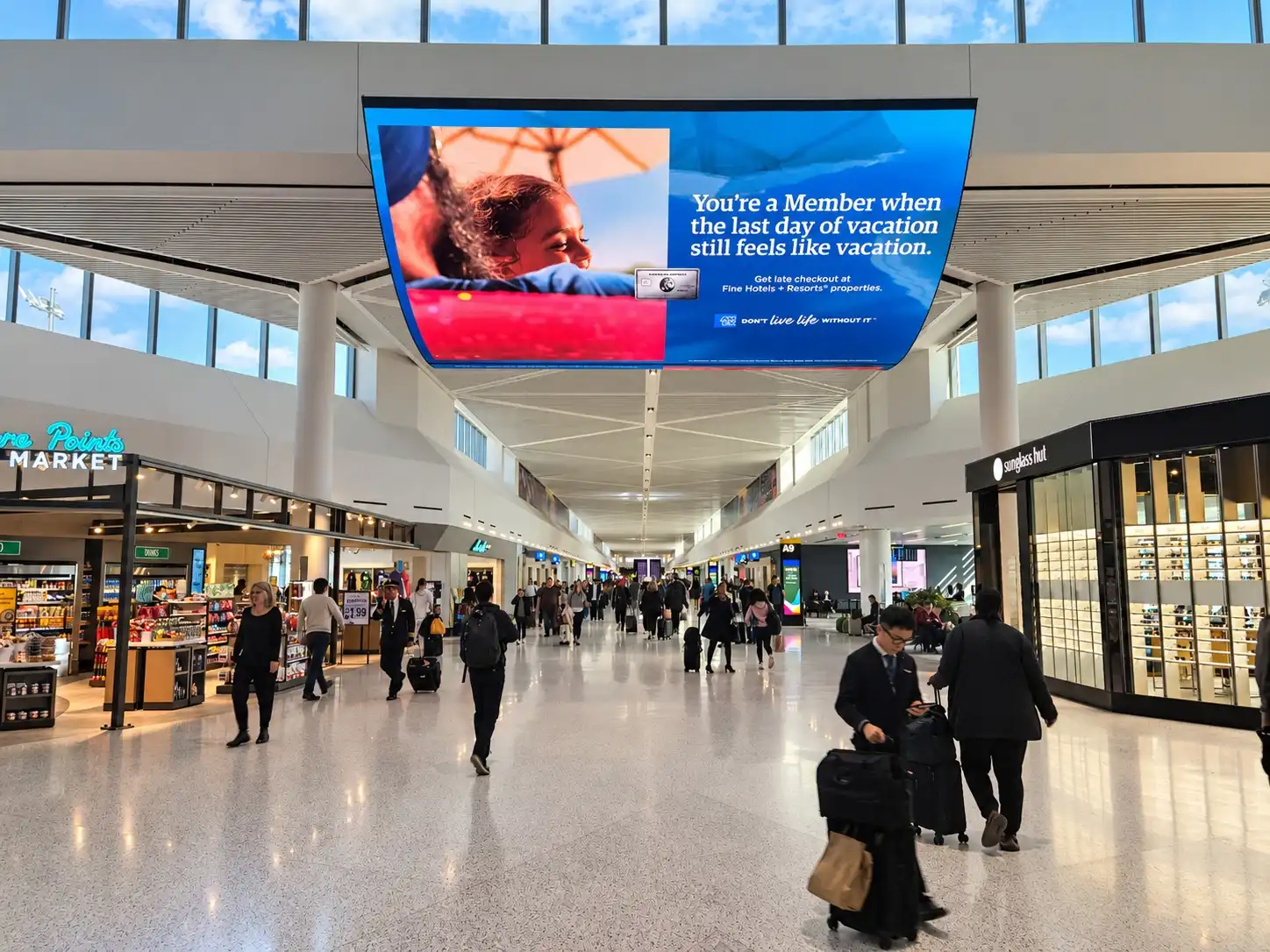
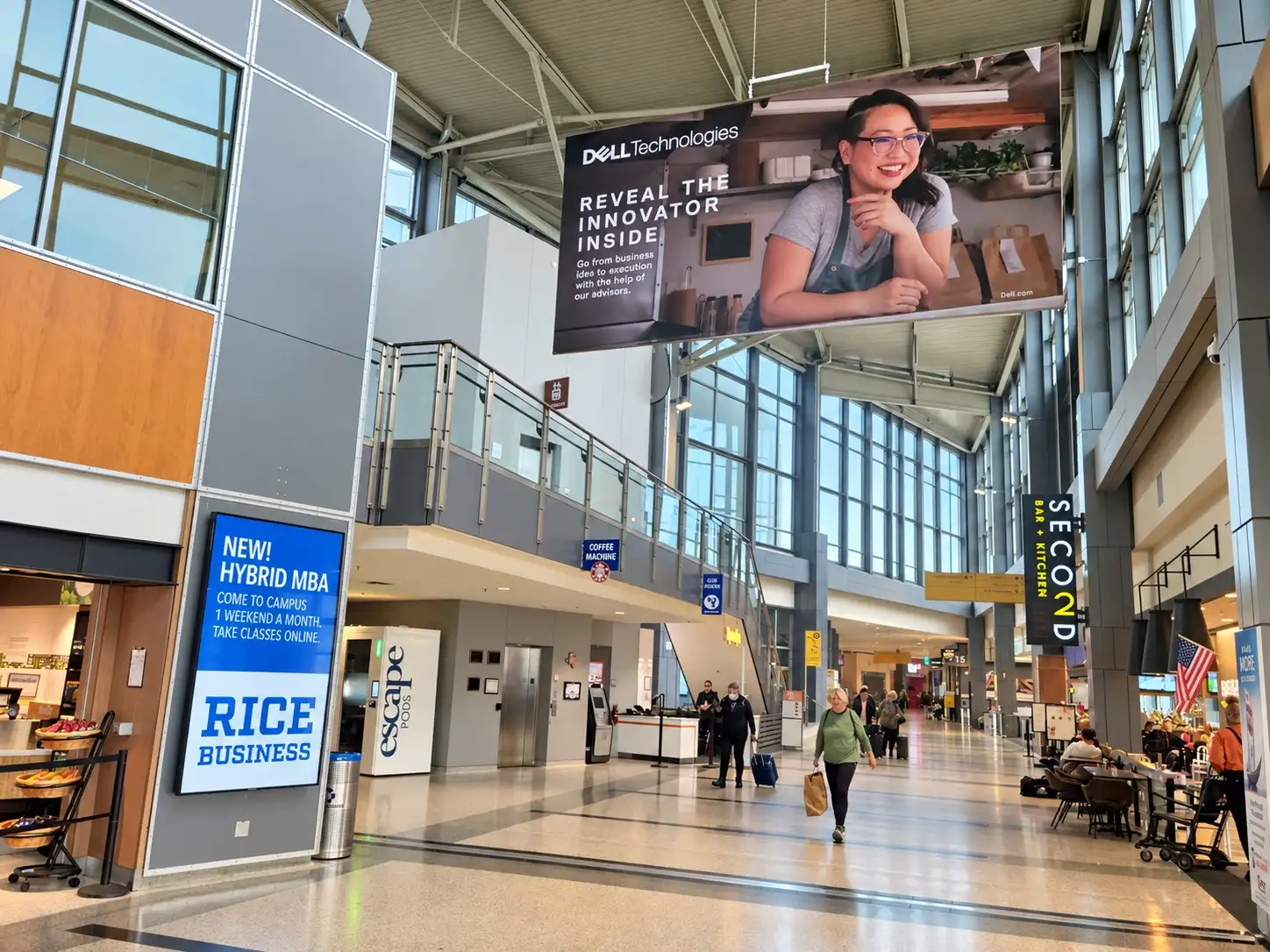
Spectaculars for position, digital networks with a large share of the loop so the competitor's spot is the one that disappears, security trays for the competitor's departing employees and customers, and lounges for their executives.
For the week that matters
The arrival-path unit the whole show walks past; the first to sell out in a conference week.
Reach at the hubs
A spot in the loop across the concourses your audience connects through.
Always-on frequency
Every departing passenger handles the brand, trip after trip.
The executives
Seated for an hour, the most senior audience in the terminal.
Arrivals, waiting
Every arriving passenger with a bag, facing the screens.
One message, held
A single image held for the whole flight, with 100% share of voice.
Budget
A presence at one competitor's home airport built for impact starts around $50,000 for four weeks; owning the arrival path in a shared show week starts around $50,000 for the week and rises fast for the strongest units; a conquest program across the competitor's hub, two shared show weeks, and your own airport runs $250,000 and up. Media only, for medium to large airports.
| Plan | Airports | Formats | Planning range, media only |
|---|---|---|---|
| Their home airport | 1 airport built for impact | Spectacular, network with share of voice, trays | From about $50,000 for four weeks |
| A shared show week | The host airport | Arrival path and baggage claim | From about $50,000 for the week |
| Full conquest program | Their hub, two show weeks, your hub | Spectaculars, networks, trays, lounges | $250,000 and up |
| Defense | Your own airport, held for the year | The units they'd want, as repeated flights | From about $50,000 per flight |
Planning figures for medium to large airports, from Phoenix (PHX) up to JFK, Las Vegas (LAS), and San Francisco (SFO); smaller airports such as San Antonio (SAT) run 25 to 40% less. Ranges from the cost and budget pages.
A sample plan
A software company whose main competitor is headquartered in Austin and sells into the same accounts at Dreamforce: a four-week flight at the competitor's home airport plus the show week at SFO. Media only.
| Airport | Units | Weeks | Planning range, media only |
|---|---|---|---|
| AUS (competitor's HQ) | Arrivals-path digital spectacular plus a large share of the concourse network | 4 weeks | $45,000–$200,000 |
| AUS | Security tray program | 4 weeks, or longer | $30,000–$100,000+ |
| SFO, Dreamforce week | Arrivals-path digital spectacular plus baggage-claim network | 1 week | $20,000–$150,000 |
| Three target accounts' home airports | Terminal networks | 4 weeks | $75,000–$300,000 |
A worked example, not a quote. Ranges from the format and cost pages for medium to large airports, from Phoenix (PHX) up to JFK, Las Vegas (LAS), and San Francisco (SFO); production and installation are on top.
What goes wrong
Conquest fails when it argues instead of positions, or arrives second.
Comparative creative
Claims about a competitor are declined in review at most airports and read as insecure where they run. Lead with your own line.
Arriving second
If the competitor committed four months out, the show-week wall is gone. Decide early or take a different week.
Too small a share
A single spot in a twenty-ad loop at their hub is a rumor; buy enough of the loop that their spot is the one that disappears.
Creative
Your strongest claim, stated as if the competitor didn't exist. Conquest creative that names, mocks, or compares reads as small and usually fails airport review; creative that owns the category's language at scale, in the competitor's terminal, makes the point without making it. Speak to their customers' problem, not to them.
Own the category's language
The line their customers recognize as the real thing.
Scale over snark
Clears review and reads as confident.
Their customers' problem
Speak to the audience, not the rival.
Measurement
Delivery and the competitor's-market signals: proof of posting and photos at their airport, branded search and direct traffic from their headquarters region across the flight, inbound inquiries and meetings from accounts in their base, sales-call mentions, and, in show week, booth traffic and the conversations that reference the terminal.
Why EAM
We map the competitor's airport and the show weeks you share, check which units are open and which they already hold, buy position and share of voice rather than a comparison, keep creative inside what airport review allows, secure every unit under one contract, and confirm posting before the first arrival wave. Fortinet's nationwide program across the hubs its competitors share is the closest precedent.
National, several media ownersFortinetU.S. and Canada: Las Vegas, New York, Chicago, San Francisco, Toronto, Washington, D.C., Dallas, and more. Bought from multiple media owners as one coordinated buy, under one plan and one contract.40 million impressionsSee the campaign  Global, five continentsDynatraceParis, London, São Paulo, Tokyo, Kuala Lumpur, Mexico City, and more. Digital large format and screen networks across five continents, under one contract.60 million people reachedSee the campaign
  One airport, dominatedFabricSan Jose (SJC). A full airport takeover for one flight: 82 digital faces covering 5,252 square feet, plus all 760 security trays.Every network and checkpoint at one airportSee the campaign
 See every campaign on the case studies page.
Send the competitor's city and the show weeks you share. We come back with what's open at their airport and what they already hold.
Ready to plan?
Tell us the audience, the airports or the event, the dates, and the budget range. We come back with current availability at every airport in the plan and a recommended mix.
125+ airports · 40+ media vendors · Since 2015
“EAM made a nationwide airport campaign feel much easier to manage. The team was responsive, organized, and always on top of the details. They helped us make smart decisions with the budget, kept everything moving, and ultimately delivered exactly what we were looking for.”
 Chief Marketing OfficerFortinet · nationwide airport campaign
For agencies and consultants
Agencies and consultants bring EAM Advertising in as the airport specialist behind a client’s plan. The client relationship stays with you. We plan, buy, and report under NDA, and can work white-label.
Get our media kitAirports
EAM Advertising plans and buys at 125+ airports across North America, Europe, Latin America, Asia-Pacific, the Middle East, India, and Africa, and any combination runs under one contract. The most-requested airports are below; every airport, with search by city or code, is on the airport advertising hub.
Questions
Yes; the airport's media owners sell to any advertiser the airport approves. Conquest is about buying the position and share of voice their customers see, with your own creative, not comparative claims.
Most airports' creative review declines comparative or disparaging claims; conquest creative that works owns the category's language at scale without naming anyone.
From about $50,000 for a four-week presence at a competitor's home airport built for impact, about $50,000 for a shared show week's arrival path, and $250,000 and up for a full program. Media only.
Hold the units they would want next: the arrival path, the strongest network share, trays, for the year as repeated flights. Position is held by whoever commits.
Spectaculars for position, networks with a large share of the loop, security trays for the competitor's employees and customers, and lounges for their executives.
Four to six months for the arrival path; the brand that commits first gets it.
Proof of posting at their airport, branded search and direct traffic from their region across the flight, inbound inquiries from their customer base, sales-call mentions, and show-week booth conversations.
Often; a challenger that owns the arrival path at the incumbent's hub in show week looks like a peer to the whole market for a four-week budget.
Your strongest category claim, stated as if the competitor didn't exist, aimed at their customers' problem, at scale in their terminal.
Everything after the objective. We check what's open for the week, which loops are crowded and which units will sell out, and where on the arrival path your audience actually walks. We recommend the mix, secure the units, traffic the creative through airport approval, confirm posting on day one, and deliver proof of posting and play logs after. If the airport is one market in a larger plan, the same relationship covers the others.
Airport advertising media agency. 125+ airports. Est. 2015.
Send your work email for the media kit: formats, planning ranges, and booking windows across 125+ airports. We’ll follow up to learn who you need to reach and when, then come back with current availability and a recommended mix.
125+ airports · 40+ media vendors · Since 2015
Sources
Updated October 5, 2026 · By EAM Advertising

EAM Advertising plans, secures, and buys airport and in-flight media across 125+ airports and 45+ airlines worldwide. Founded in 2015; collective operator experience in airport media buying spans two decades. Recommendations are based on what performs for the advertiser, not on inventory we have to sell. Clients include Dynatrace, Fortinet, Rubrik, McGraw-Hill, and Wharton.