The feeder markets
Where visitors depart
The origin airports your visitors fly from, before the booking season.
A destination's visitors are travelers by definition, and airports reach them twice: in the feeder markets they depart from, while they're deciding where to go next, and at your own airport when they arrive, when the welcome shapes the trip. Tourism boards, cities, hotels, and attractions use both. This page covers which airports and seasons, which formats, what a program costs, and the destination and hospitality campaigns EAM Advertising has run, from EAM Advertising, an airport advertising media agency that plans and buys across 125+ airports and 40+ media vendors.

You’re in good company






The short answer
Yes, and it is one of the oldest uses of the channel. A destination reaches future visitors at the departures airports of its feeder markets, in the weeks before the booking season, when travel is on their minds; and it reaches arriving visitors at its own airport, where the welcome and the things to do in town shape how they spend the trip. Radisson ran a regional campaign across Buenos Aires, Santiago, Bogotá, and Mexico City on the same logic.
The feeder markets
The origin airports your visitors fly from, before the booking season.
The welcome
Baggage claim and the arrival path, the first impression of the trip.
Every traveler
Everyone in an airport is already thinking about the next trip.
The one thing to get right
Advertise where visitors leave from, not only where they land. The arrivals side of your own airport welcomes people who already chose you; the feeder markets are where the next visitors decide.
Start your plan
Pick the path that matches where you are. Every path ends with current availability and a recommended mix.
Why airports
Because the audience is already traveling. A passenger at a departures gate is the one person guaranteed to take trips, and often already thinking about the next one. At your own airport, arriving visitors are deciding what to do and where to spend, and the welcome sets the tone. Few channels reach both the decision and the arrival.
Travel-minded
Every traveler in the terminal is a future visitor somewhere.
Before the booking
Reach visitors at their home airports before they choose.
On arrival
Arriving visitors decide what to do in town.
Airports and weeks
The feeder-market airports in the weeks before your booking season, and your own airport's arrivals side year-round or in peak seasons. International destinations add the major hubs of their source countries.
| Airport or season | Why | What to buy |
|---|---|---|
| Feeder-market airports, pre-season | Future visitors deciding where to go | Digital networks, spectaculars, departures side |
| Your own airport, arrivals | Visitors on arrival, deciding what to do | Baggage claim, arrival path, exit sponsorships |
| Source-country hubs | International visitors at home | Terminal programs at the hubs they depart from |
| Holiday and summer peaks | The highest volumes of the year | Networks and baggage claim |
Examples. Feeder markets come from your visitor data; booking seasons vary by destination.
Formats
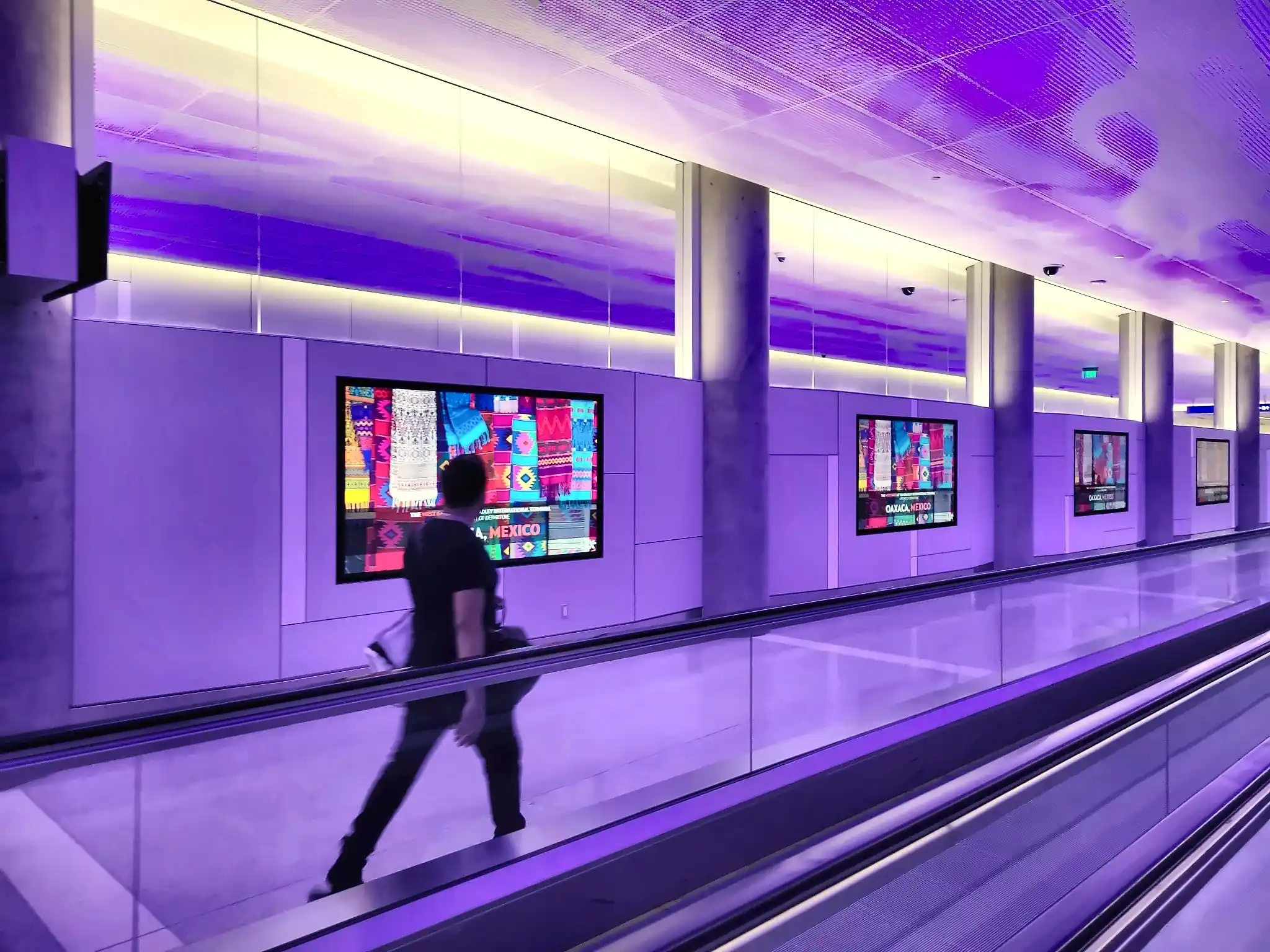
Digital networks and spectaculars in the feeder markets, where motion and imagery sell a place; baggage claim, the arrival path, and exit sponsorships at your own airport for the welcome; and walkway or network dominations for a destination that wants to own a stretch of a hub.
Reach at the hubs
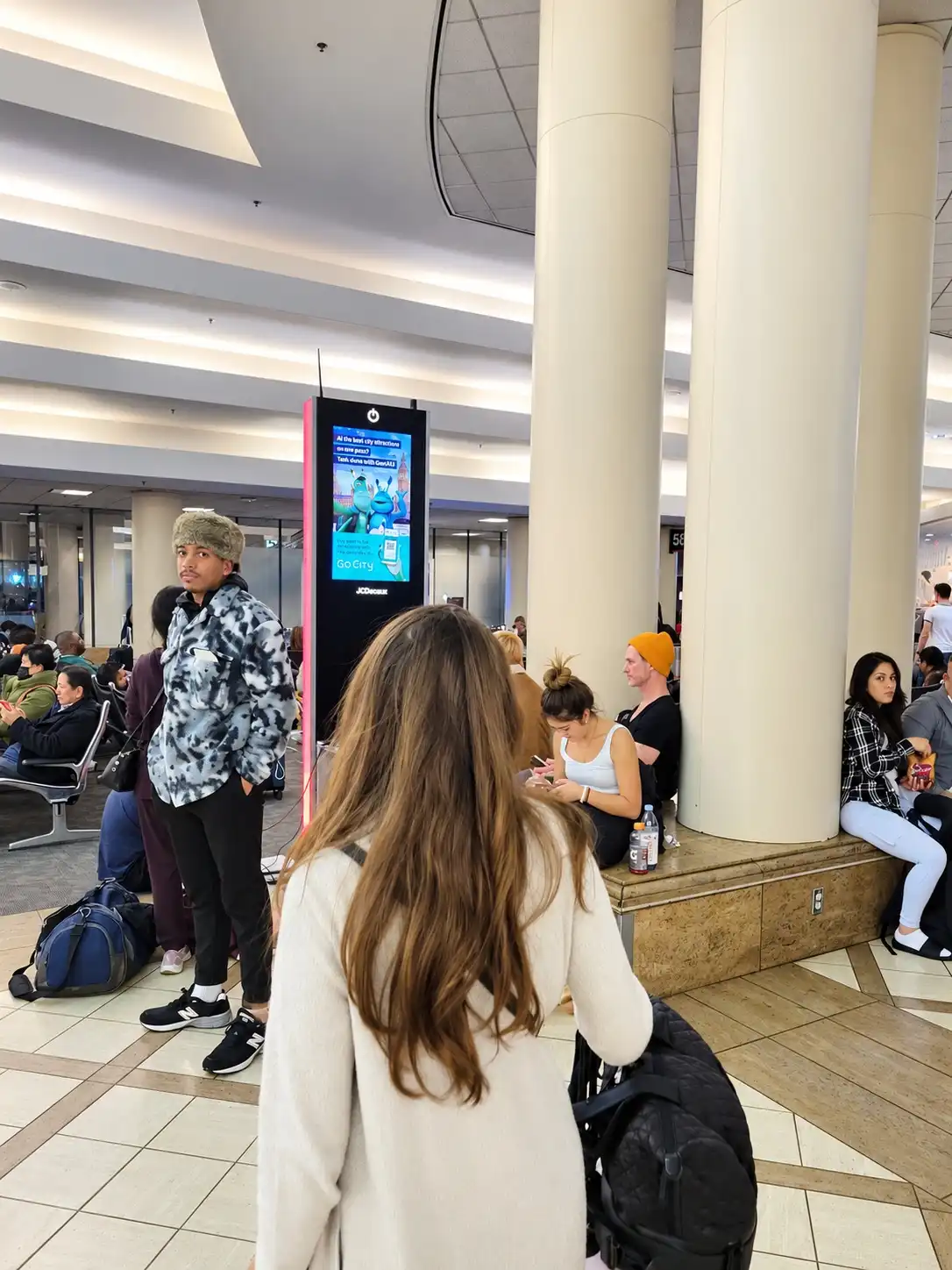
A spot in the loop across the concourses your audience connects through.
For the week that matters
The arrival-path unit the whole show walks past; the first to sell out in a conference week.
Arrivals, waiting
Every arriving passenger with a bag, facing the screens.
Own a stretch of a hub
Every screen along a walkway or every unit in a terminal, one destination.
A way to act
A trial, a sign-up, or a meeting request on the phone in their hand.
The executives
Seated for an hour, the most senior audience in the terminal.
Budget
A pre-season push in three feeder markets starts around $100,000 for four weeks; a welcome at your own airport's baggage claim runs $3,000 to $10,000 per network at small airports and $5,000 to $50,000 at medium and large ones; a national or international program across eight to ten airports starts around $500,000. Media only.
| Plan | Airports | Formats | Planning range, media only |
|---|---|---|---|
| Welcome at home | Your own airport | Baggage claim, arrival path, exit | Baggage claim $3,000–$50,000 per network for four weeks |
| Feeder-market push | 3 origin airports | Digital networks, spectaculars | From about $100,000 for four weeks |
| National campaign | 5 major hubs built for impact | Spectaculars, networks, dominations | From about $250,000 for four weeks |
| International | 8–10 airports, U.S. plus international | Every format | From about $500,000 |
Planning figures for medium to large airports, from Phoenix (PHX) up to JFK, Las Vegas (LAS), and San Francisco (SFO); smaller airports such as San Antonio (SAT) run 25 to 40% less. Ranges from the cost and budget pages.
A sample plan
A destination's pre-season push in three feeder markets, plus the welcome at its own airport through the peak season. Media only; feeder markets come from your visitor data.
| Airport | Units | Weeks | Planning range, media only |
|---|---|---|---|
| Feeder market 1 | Terminal digital network with destination video | 4 weeks, pre-season | $25,000–$100,000 |
| Feeder market 2 | Terminal digital network with destination video | 4 weeks, pre-season | $25,000–$100,000 |
| Feeder market 3 | Digital spectacular at the main junction | 4 weeks, pre-season | $15,000–$100,000 |
| Your own airport | Baggage-claim network plus an exit sponsorship package | Peak season, by period | $20,000–$150,000 |
A worked example, not a quote. Ranges from the format and cost pages for medium to large airports, from Phoenix (PHX) up to JFK, Las Vegas (LAS), and San Francisco (SFO); production and installation are on top.
What goes wrong
Destinations tend to advertise where it feels good rather than where the next visitor is.
Only at home
The arrivals side of your own airport is the welcome, not the sale. The sale happens in the feeder markets.
After the booking season
A feeder-market flight in the travel season reaches people who already booked. Run it before.
A still where motion sells
On a digital network, ten seconds of the place outperforms a poster of it.
Creative
The place, at its best, in motion. Destination creative works when the image does the selling: a view, a dish, a festival, shown big on a digital network with a short line and the name of the place. At your own airport, switch to the welcome: what to do, where to go, how to get there.
The image sells
Show the place; let one line name it.
Motion where it helps
Short, silent video of the place outperforms a still.
The welcome
What to do in town, for visitors who just arrived.
Measurement
Against visitation: bookings and site traffic from the targeted feeder markets compared with prior seasons, hotel and flight search data where the destination has it, branded search by region, and, at your own airport, visitor-center traffic or offer redemptions, alongside proof of posting and photos.
Why EAM
Radisson's regional campaign across Buenos Aires, Santiago, Bogotá, and Mexico City, with digital and physical branding in four countries; Invest in Canada's airports-and-lounges program across the U.S., Europe, and the Middle East; and campaigns across 125+ airports for brands reaching travelers. We plan the feeder markets from your visitor data, run international airports in dollars under one contract, and deliver proof of posting from every airport.
Regional, four countriesRadissonBuenos Aires, Santiago, Bogotá, Mexico City. Digital and physical branding across four Latin American airports as one regional campaign.30 million-plus impressionsSee the campaign  Airports and lounges, three regionsInvest in CanadaLondon, Dubai, New York, plus airline lounges across U.S. airports. Digital and print in airports and lounges, aimed at C-level executives, as one coordinated plan.49 million impressionsSee the campaign
  One airport, dominatedFabricSan Jose (SJC). A full airport takeover for one flight: 82 digital faces covering 5,252 square feet, plus all 760 security trays.Every network and checkpoint at one airportSee the campaign
 See every campaign on the case studies page.
Send the destination, the feeder markets, and the season. We come back with the airports and units that fit and current availability.
Ready to plan?
Tell us the audience, the airports or the event, the dates, and the budget range. We come back with current availability at every airport in the plan and a recommended mix.
125+ airports · 40+ media vendors · Since 2015
“EAM made a nationwide airport campaign feel much easier to manage. The team was responsive, organized, and always on top of the details. They helped us make smart decisions with the budget, kept everything moving, and ultimately delivered exactly what we were looking for.”
 Chief Marketing OfficerFortinet · nationwide airport campaign
For agencies and consultants
Agencies and consultants bring EAM Advertising in as the airport specialist behind a client’s plan. The client relationship stays with you. We plan, buy, and report under NDA, and can work white-label.
Get our media kitAirports
EAM Advertising plans and buys at 125+ airports across North America, Europe, Latin America, Asia-Pacific, the Middle East, India, and Africa, and any combination runs under one contract. The most-requested airports are below; every airport, with search by city or code, is on the airport advertising hub.
Questions
Yes; it reaches future visitors at the departures airports of your feeder markets before the booking season, and arriving visitors at your own airport where the welcome shapes the trip. Radisson ran a four-country campaign across Latin America on that logic.
Both, for different jobs: feeder markets to influence the next visitors' decision, and your own airport's arrivals side to welcome the visitors who already chose you.
From about $100,000 for a four-week push in three feeder markets, $3,000 to $50,000 per network for a baggage-claim welcome at your own airport, and from about $500,000 for an international program. Media only.
Digital networks and spectaculars in feeder markets, where imagery and motion sell the place; baggage claim, the arrival path, and exit sponsorships at your own airport; and dominations for owning a stretch of a hub.
Yes; source-country hubs reach international visitors at home. EAM Advertising runs international airports in the same plan, quoted in dollars under one contract.
In the feeder markets, in the weeks before your booking season; at your own airport, year-round or in the peak seasons when visitors arrive.
The place at its best (a view, a dish, a festival), big and often in motion, with one short line and the destination's name; at your own airport, the welcome and what to do.
Bookings and site traffic from targeted feeder markets versus prior seasons, search data, regional branded search, and visitor-center traffic or offer redemptions at your own airport.
Yes; hotels, resorts, and attractions use both the feeder markets and the arrivals side. Radisson's Latin American campaign is one example.
Everything after the objective. We check what's open for the week, which loops are crowded and which units will sell out, and where on the arrival path your audience actually walks. We recommend the mix, secure the units, traffic the creative through airport approval, confirm posting on day one, and deliver proof of posting and play logs after. If the airport is one market in a larger plan, the same relationship covers the others.
Airport advertising media agency. 125+ airports. Est. 2015.
Send your work email for the media kit: formats, planning ranges, and booking windows across 125+ airports. We’ll follow up to learn who you need to reach and when, then come back with current availability and a recommended mix.
125+ airports · 40+ media vendors · Since 2015
Sources
Updated October 5, 2026 · By EAM Advertising

EAM Advertising plans, secures, and buys airport and in-flight media across 125+ airports and 45+ airlines worldwide. Founded in 2015; collective operator experience in airport media buying spans two decades. Recommendations are based on what performs for the advertiser, not on inventory we have to sell. Clients include Dynatrace, Fortinet, Rubrik, McGraw-Hill, and Wharton.