Airport advertising creative best practices Airport ad creative,
built for the walk
and the wait.

Travelers either walk past an airport ad or wait beside it. This guide covers what to put on each placement, what the research supports, and how to carry one idea across airports where every media vendor has its own specs, approvals, and deadlines. From EAM Advertising, an airport advertising media agency.

We’ll follow up with the kit and next steps for your campaign.

  • 125+Airports worldwide
  • 40+Media vendors
  • 5Continents served

You’re in good company

  • Thomson Reuters
  • AMD
  • Dynatrace
  • Fortinet
  • Motorola
  • BYU

The short answer

What makes airport advertising
creative work?

1 message, 7 words or fewer, the brand at the top, and a design matched to whether the traveler is walking past the ad or waiting beside it. In out-of-home testing by System1 and JCDecaux, about a third of ads went unrecognized in a 2-second look, and the campaigns recognized fastest were recalled 54% more often. That research covers out-of-home in general, not airports alone, and comes from a media owner, so the airport-specific guidance on this page is EAM Advertising's own. In an airport the same idea then has to be rebuilt for every screen, wall, and tray, because each media vendor sets its own sizes, file rules, and approval steps.

  1. 1

    Sort every unit into walk or wait. A traveler walking past a concourse screen gives it a glance. A traveler at a gate, a carousel, or a security line is beside the ad for minutes. Those are 2 different design jobs.

  2. 2

    1 message per ad. In System1 and JCDecaux brand-lift data, campaigns carrying 1 message saw a 4.4% lift in the key brand association. Campaigns carrying 3 saw a slight decline.

  3. 3

    7 words or fewer. Ads with shorter copy were recognized by 70% of viewers inside 2 seconds, against 59% for ads with longer copy.

  4. 4

    Brand at the top, and big. Ads branded at the top were about 2.7 times more likely to beat average recognition, and ads whose logo covered at least 10% of the creative were viewed 28% longer.

  5. 5

    Waiting time is for depth, not more words. In the research, longer looks did not go with better basic recall. They went with higher preference, consideration, and action.

  6. 6

    Across airports, keep the idea and rebuild the file. Every media vendor sets its own sizes, file rules, approvals, and deadlines. Design to the art sizes in the proposal, then cut final files from each vendor's specs once the contract is signed.

  • 2 secAverage look at an out-of-home poster, not airport-specificLumen attention research for JCDecaux: 1.8 seconds static, 2.2 seconds digital
  • 54%More campaign recall when the brand is recognized inside 2 secondsSystem1 and JCDecaux, Double Take, 2025: top third against bottom third of 73 campaigns
  • 1 in 3Out-of-home exposures where viewers could not name the brandSystem1 and JCDecaux, Double Take, 2025: 1,220 campaigns tested

The buyer's side

What do media-owner creative guides
leave out?

They are written for 1 owner's screens. A real campaign crosses several media vendors, shares its screens with other advertisers, sits on a specific stretch of the arrival or departure path, and ends up in photos your team shares. Those 4 facts shape the creative brief before any design rule applies, and they are what EAM Advertising checks when it plans a campaign.

Vendors

Your plan crosses vendors

The same airport often has different media vendors for the terminal screens, the lounges, the Wi-Fi, and the security trays, each with its own contract, sizes, and approvals. A guide from one owner covers its own inventory. Your creative has to work on all of it.

Share of voice

You share the screen

A digital spot runs in a loop with other advertisers: 6 to 24 on a screen network, 4 to 10 on a large-format screen or video wall. How often yours comes around differs by network and by week. Before design, ask which loops are crowded: in a busy loop the brand has to land faster, and a static unit, which you hold alone, may carry the idea better.

Direction

Arrivals and departures are different audiences

Baggage claim reaches people landing. Ticketing, security, and gates reach people leaving. A welcome to conference attendees belongs on the arrival path; a message to residents who fly for work belongs on departures. The same file on both wastes one of them.

The photo

The ad gets photographed

An airport campaign runs twice: in the terminal, and in the photos your team, your executives, and your partners post from it. Design so the installed unit reads in a phone photo, with the brand in frame from the angle people shoot and the line legible at thumbnail size.

Airport advertising in practice, photographed across many airports

Dynatrace airport advertising campaign across five continents
Dynatrace
Fortinet airport advertising campaign across U.S. and Canadian airports
Fortinet
Fabric airport advertising at San Jose International Airport (SJC)
Fabric, San Jose (SJC)
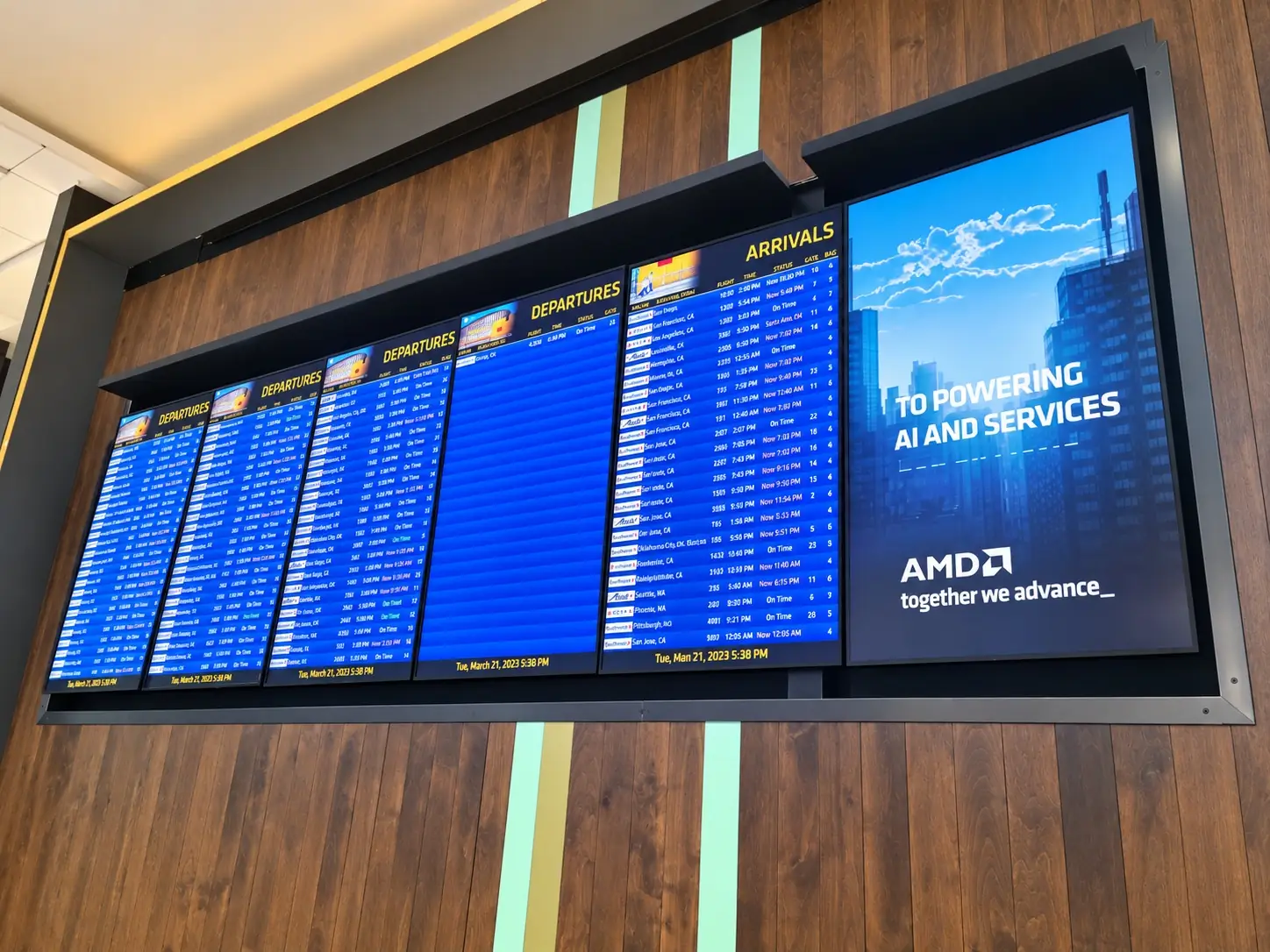
AMD advertising in Austin-Bergstrom International Airport (AUS).
AMD, Austin (AUS)
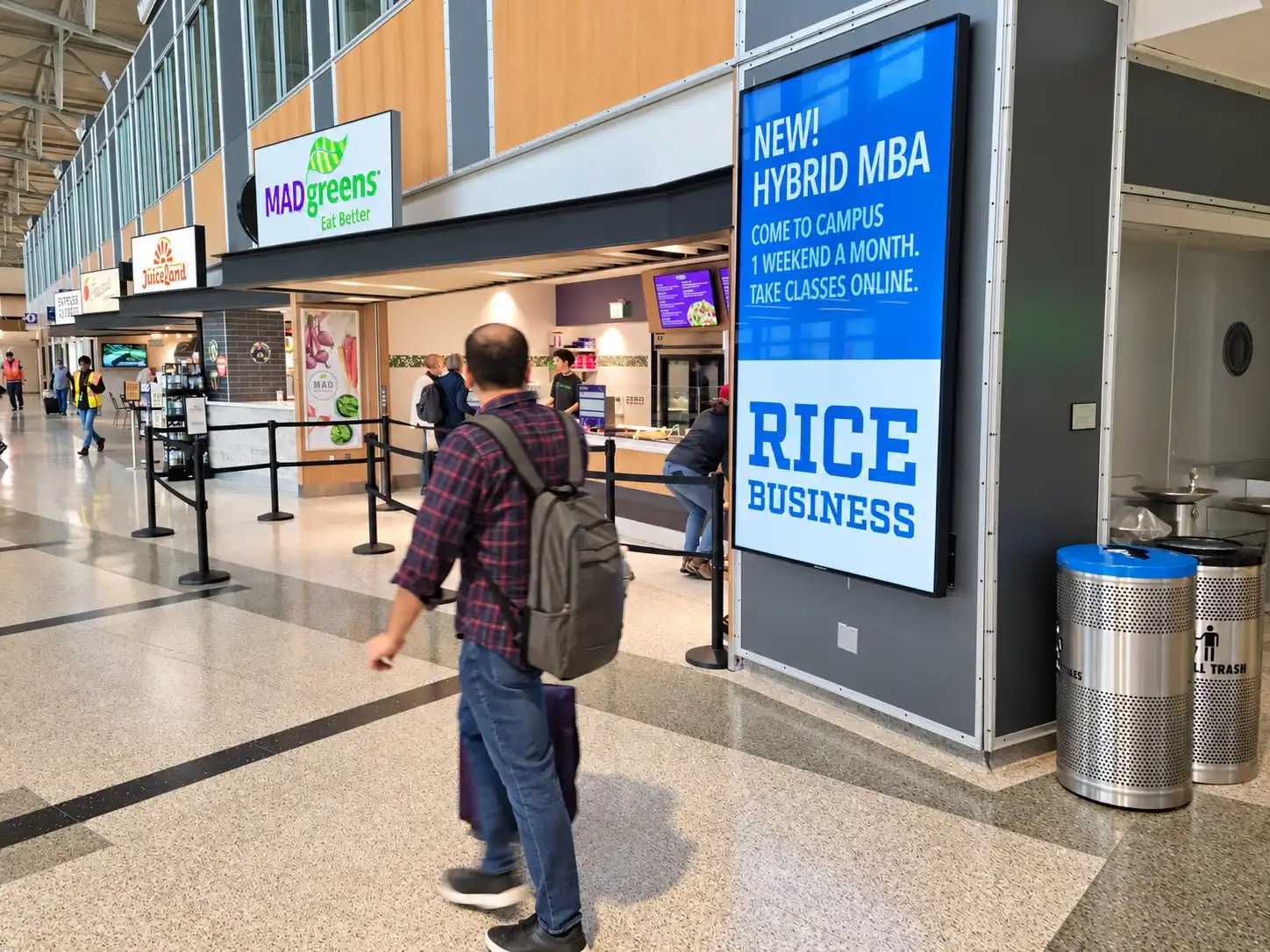
Rice University advertising in Austin-Bergstrom International Airport (AUS).
Rice University, Austin (AUS)
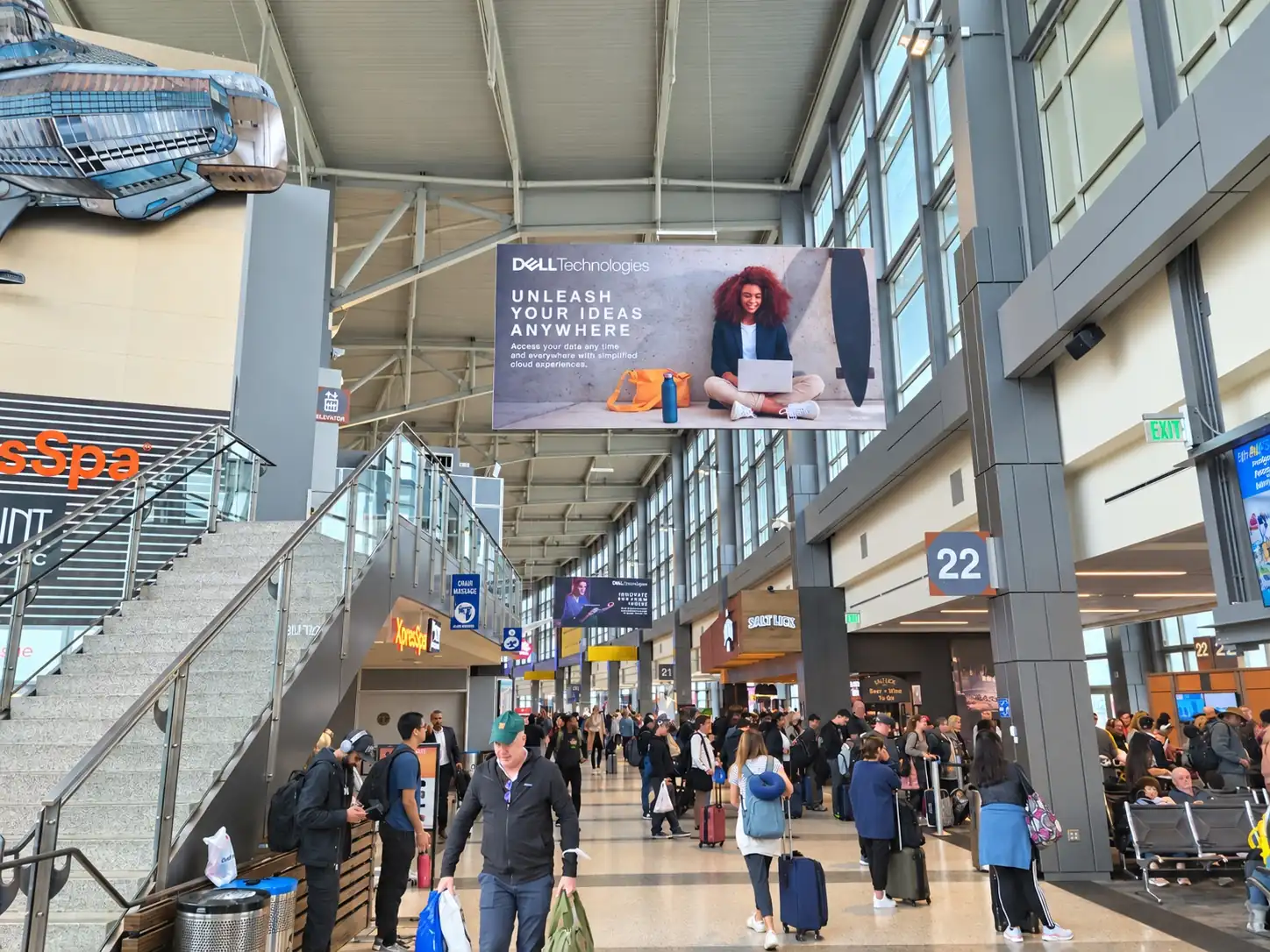
Dell advertising in Austin-Bergstrom International Airport (AUS).
Dell, Austin (AUS)

By placement

How should creative change by
where it runs in the airport?

Sort every unit in the plan into walk or wait before anyone opens a design file. Walk placements, such as concourse screens, corridor banners, and exterior boards, need the brand and 1 line that land in a glance. Wait placements, such as gates, baggage claim, security lines, and lounges, can carry 1 supporting proof point and a way to respond. More time is not permission for more messages.

Walk

The traveler is moving

Concourses, corridors, moving walkways, curbside. The ad is one of many things in view, and the traveler sees it once, briefly, often mid-loop on a digital screen.

  • Brand readable from the far end of the sightline
  • 1 line, 7 words or fewer
  • 1 image or product, as large as the layout allows
  • No QR code, no URL to memorize
Wait

The traveler is standing or seated

Gates, baggage claim, security lines and trays, lounges, charging stations. The traveler looks up more than once and has a phone in hand.

  • Still passes the 2-second test for the brand
  • 1 supporting line: a proof point, an offer, a location
  • A way to respond: QR code or short URL
  • Message tied to the moment, such as arriving or boarding
Airport creative by placement: what the traveler is doing and what the ad has to do
PlacementTravelerWhat the creative has to doCopy and responseWatch for
Curbside and exterior boardsWalkAnnounce the brand at distance, to people in vehicles and on the curbBrand plus 3 to 5 words. No response mechanism.Read across roadways and through glass. The smallest type has to hold at the longest distance.
Ticketing and check-inBothBrand and 1 line above head height, seen from the queueUp to 7 wordsThe lower third of the unit is often hidden by people, stanchions, and kiosks.
Security traysWaitBrand and 1 line read at arm's length, looking straight downBrand, 3 to 5 words, short URL or QR codeThe tray fills with belongings. The message has to register before it does, and again at pickup. Tray artwork is due 2 to 4 months ahead.
Concourse digital networksWalkBrand in every frame and 1 line, on a screen shared with other advertisers7 words or fewer. No QR code.Travelers pass mid-spot. No frame can depend on the frame before it.
Digital spectaculars and video wallsWalk1 large visual on a long sightline, brand on screen throughout3 to 7 wordsSeams and columns between panels. Motion slow enough to read from far back.
Wall wraps and bannersWalk1 image at scale. On long walls, repeat the brand so every stretch carries it.Up to 7 wordsDoors, outlets, signage, and seams interrupt the canvas. Design from the site template.
Gate hold roomsWaitBrand first, then 1 proof point for a seated audienceA second line and a QR code or short URL fit hereViewing angle from the seats. It still has to pass the glance for people walking by.
Jet bridgesWait1 idea carried across a run of panels in a slow single-file line1 short line per panelA passenger may notice only 2 or 3 panels. Each one has to stand alone.
Baggage claimWaitAn arrival message for people standing at the carousel, phones outA second line and a way to respond fit hereArrivals only. Departing travelers never see it, so the message should be about landing, not leaving.
Airline loungesWaitA closer, quieter read for a seated audience that stays a whileLounge screens run 30-second spots in a loop of 5 to 6 minutes, so more detail is tolerable. Keep 1 message.Smaller formats viewed up close. Fine print is legible here and nowhere else in the airport.

The 7-word line comes from the System1 and JCDecaux research. Everything else in this table is EAM Advertising's own planning guidance, not a research finding. Unit names and locations differ by airport.

Why waiting does not mean more words

In the System1 and JCDecaux study, time spent looking beyond 2 seconds did not go with meaningfully better basic recall. What moved with it was how people felt and what they did: among 73 campaigns, those with above-average dwell saw brand consideration lift 2.9 points higher, preference 3.2 points higher, and 34% of viewers reporting an action against 28%. The study did not test airports, so applying this to gates and carousels is our reading: use the wait to earn preference, not to add a second and third selling point.

The same campaign, built 3 ways

The same brand and the same line. The first is the layout that usually arrives from a web or print campaign and fails the 2-second test. The second is cut for a concourse screen people walk past. The third is cut for a gate or baggage claim unit, with 1 proof point and a way to respond added, and nothing else.

Fails the glance

The resized web layout

  • 17 words and 3 bullets: 4 messages
  • Logo small, at the bottom, seen last
  • Low contrast disappears under terminal lighting
  • A URL nobody walking can read or keep
Walk

Cut for a concourse screen

  • Brand at the top, readable first
  • 3 words, 1 message
  • 1 brand shape, large
  • High contrast, no response mechanism
Wait

Cut for a gate or baggage claim

  • Same brand, shape, and line
  • 1 proof point added
  • QR code where a hand is free
  • Still passes the 2-second test

Illustrations with a placeholder brand, not client work. For photographed campaigns see airport advertising examples.

Across airports

How do you adapt one creative idea
across several airports?

Keep the idea, the line, and the brand lockup fixed, and rebuild the file for every unit. 2 airports can both sell a digital screen network and differ in orientation, pixel dimensions, spot length, file type, motion rules, and who signs off. Inside 1 airport the terminal screens, the lounges, the Wi-Fi, and the security trays are often sold by different media vendors, each with its own spec sheet and deadline. Build 1 master kit to the art sizes in the proposal, then cut final files from each vendor's detailed specs, which arrive once the contract is signed.

Portrait screenConcourse network
Landscape screenGate or baggage claim
Wide video wallSpectacular
Tray insertSecurity checkpoint
Hanging bannerConcourse or ticketing
Wall wrapCorridor or jet bridge

Same brand mark, same line, 6 shapes. Proportions are illustrative: the exact dimensions for each unit come from that media vendor's spec sheet, and no two airports match.

What changes from airport to airport, and what to do about it
What changesWhy it differsWhat to do
Orientation and proportionsScreen networks are portrait at one airport and landscape at the next. Video walls and spectaculars are custom-built.Design the lockup and line to work stacked and side by side. Never stretch one into the other.
Dimensions and safe areasPixel sizes for digital and print sizes, bleed, and live area for static are set unit by unit.Build from each unit's template. Keep the brand and line inside the tightest safe area in the plan.
Spot length and loopSpots run from 8 to 30 seconds and loops from 30 to 240 seconds, depending on the network, with 6 to 24 advertisers sharing a loop.Cut the motion version to the shortest spot in the plan first, then extend.
File type and motion rulesAccepted formats, file-size limits, and frame rates differ. Some networks take full motion, some limit animation, some take stills only.Produce a still and a motion master. Confirm which each network accepts before animating.
ApprovalsEach media vendor reviews, then each airport or authority. Policies and turnaround differ.Submit the actual file for each unit. Clear borderline concepts before production.
Language and local rulesOutside the U.S., some airports expect local-language copy, local legal lines, or stricter category rules.Flag international airports at the brief so translation and legal review start early. See international airport advertising.
DeadlinesStatic and digital due dates differ, and so do the dates at each vendor.Put every unit's deadline on 1 calendar and work back from the earliest.
Proof it ranPhotos for static, play logs for digital, in each vendor's own format.Ask for proof of posting on day 1 so a wrong or stretched file is caught while it can be fixed.
  1. Step 1

    Lock the idea

    1 message, 1 line of 7 words or fewer, the brand lockup, and 1 or 2 brand assets. Agree it before anyone talks about sizes.

    You haveA line and a lockup

  2. Step 2

    Get the art sizes

    They come with the proposal: the size and orientation of every unit in the recommended mix, across every media vendor in the plan.

    You haveA size list for the whole plan

  3. Step 3

    Build the master kit

    Layered masters for portrait, landscape, and wide, in still and motion, with walk and wait versions of the layout, built to those sizes.

    You haveA kit that fits every unit

  4. Step 4

    Sign, then cut finals

    After the signed contract, EAM Advertising sends one spec sheet for every unit booked: templates, safe areas, file rules, and deadlines. Cut finals and submit each for approval.

    You haveApproved files

  5. Step 5

    Traffic and prove

    Deliver each file to its deadline, confirm posting on day 1, and collect photos and play logs after the flight.

    You haveProof it ran as built

An EAM Advertising proposal lists the art size for every unit across every media vendor in the plan, which is what a design team needs to start. After the contract we send one spec sheet covering every unit booked, check each file against it, and traffic it through each airport's approval.

Conference and event weeks

How should creative change for
a conference or event week?

Aim it at arrivals, tie it to the week, and lock it early. Attendees pass baggage claim and the arrival path on the way in, so that is where a welcome line and 1 pointer belong. Event-week units at airports such as Las Vegas are bought by the week, and the strongest commit 4 to 6 months ahead, so this creative is approved long before the rest of the event marketing is final.

Placement

Arrivals first, departures second

Arrival units reach attendees before they reach the show floor. Departure units reach them on the way home, which suits a follow-up line, not a welcome. Digital networks can run both as versions of 1 layout.

Message

Tie it to the week, carefully

Name the audience or the moment: a welcome to security leaders does the job. Event names and logos are usually trademarks that non-sponsors cannot use, and airports check. Ask before the line is designed around the event's name.

Response

1 pointer, not a program

A booth number, a hall, or a single session. Put it on wait placements such as baggage claim, where someone can note it. On walk placements, the brand and the line are enough.

The evidence

What does the research say about
out-of-home creative?

The largest recent study is Double Take, published in 2025 by System1 and JCDecaux. It tested 1,220 out-of-home campaigns with more than 180,000 people, examined creative features in 150 of them, and matched 73 to brand-lift results. Campaigns with fast brand recognition and a positive emotional response were recalled more, and the best-rated showed twice the commercial effect of the weakest. These are comparisons between stronger and weaker campaigns, not controlled experiments. The table gives each finding, its sample, and what to do with it in an airport.

54%More campaign recall

Campaigns in the top third for 2-second brand recognition were recalled by 32.1% of people, against 20.9% for the bottom third.

Double Take, 2025: 73 campaignsPublished by a media owner and a creative-testing firm

2.7xBetter odds of recognition

Ads with the main brand asset at the top were about 2.7 times more likely to beat average 2-second recognition than ads with it at the bottom.

Double Take, 2025: 150 campaignsPublished by a media owner and a creative-testing firm

2xThe commercial effect

Campaigns rated above 3 stars for emotional response saw a 74% lift in conversions, store visits, or site visits, against 37% for campaigns rated 1 or 2 stars.

Double Take, 2025: campaigns matched to JCDecaux resultsPublished by a media owner and a creative-testing firm

Creative choices, the measured effect, and what to do in an airport
Creative choiceWhat was measuredSource and sampleWhat to do in an airport (EAM guidance)
Message countCampaigns with 1 message saw a 4.4% lift in the key brand association. With 2 messages: 2.0%. With 3: a 0.4% decline.Double Take (73 campaigns)Pick the 1 thing the airport audience should remember. Product lists belong on the landing page.
Word countFewer than 7 words: 70% recognized the brand in 2 seconds. More than 7: 59%.Double Take (150 campaigns)Hold every walk placement to 7 words. Count the logo line and the URL.
Logo positionAds with the main brand asset at the top had about 2.7 times the odds of above-average recognition. JCDecaux separately reports 32% higher brand recall for top logo placement.Double Take (150 campaigns); JCDecaux design guidePut the brand in the top of portrait screens and the leading edge of landscape ones, where reading starts.
Logo sizeAds whose logo covered at least 10% of the creative were viewed 28% longer.Double TakeAirport sightlines are long. A logo sized for a magazine page disappears from across a concourse.
Number of brand assetsOn System1's Spike rating, which combines 2-second recognition and emotional intensity, ads using 1 brand asset scored 1.69. Ads using 6 scored 0.91.Double Take (150 campaigns)Choose 1 or 2: the logo plus a shape, a character, or a color. Not the whole brand book.
Color and contrastAds using vibrant color showed a 22% higher emotional response.Double Take; JCDecaux design guideTerminals are bright, neutral, and full of signage. Saturated color and hard contrast are what separate an ad from wayfinding.
Product or image sizeDoubling product size went with 86% longer average viewing time. Products filling half the creative or more earned 38% more attention.Double Take; JCDecaux design guide1 object, large. For software and services, 1 shape or 1 face in place of a screenshot.
Faces and charactersAds showing people were viewed longer than ads with any other feature. Ads with a recognizable brand character had 3 times the odds of fast recognition. Ads leaning on a celebrity had half the average odds.Double Take (150 campaigns)A face looking at the traveler beats an abstract pattern. A known brand character beats a borrowed famous one.
EmotionThe least dull third of campaigns were recalled by about 30% of people. The dullest third: 18.9%.Double Take (73 campaigns)B2B is not an exemption. A line with some wit travels further than a category description.
Consistency with other channelsOut-of-home that matched the TV campaign showed 14% higher 2-second recognition and 30% higher recall.Double TakeUse the look of the campaign the traveler has already seen on LinkedIn, TV, or at the conference.
ContextContextually relevant campaigns achieved a 17% stronger audience response on average.JCDecaux design guide, citing a 2019 JCDecaux, Clear Channel, and Posterscope studyName the moment where it fits: arriving, boarding, the event in town. Keep the brand and the line fixed.

How to read this research

Both sources are published by JCDecaux, which sells out-of-home media, and Double Take is co-authored by System1, which sells creative testing. Both have a reason to say creative matters. The method is disclosed, so the direction of the findings is credible. But most of the creative findings rest on 150 campaigns and the recall findings on 73, and they compare stronger campaigns with weaker ones. They show what the better work had in common, not what a single change will cause. Treat the percentages as guides.

What it does not cover

The study tests out-of-home broadly, mostly street, roadside, and transit posters, with each ad shown for 2 seconds. It is not an airport study. The 2-second rule fits walk placements well. Carrying it over to gates, carousels, and lounges is a judgment by EAM Advertising, not something the study measured. The right-hand column of the table is ours too.

By format

What changes between digital screens
and static airport units?

Digital spots are short, silent, and shared, typically 8 to 30 seconds in a loop of 30 to 240 seconds: keep the brand on screen for the whole spot, make every frame work alone, and use motion to draw the eye, not to build to a reveal. Static units are physical: they are printed, shipped, and installed on walls with doors and seams in them, so design from the site template, proof on the real material, and send artwork 21 to 28 days before the start date.

Digital screens and video walls

Branding

Brand on screen for the whole spot

JCDecaux's own guidance is to keep the logo visible throughout any creative with motion. A logo that resolves in the last 2 seconds is missed by most of the people who pass.

Structure

Every frame stands alone

Freeze the spot at any point. If that frame does not show the brand and the message, a walking traveler did not get them either. Sequences that need the first frame to explain the last do not survive a concourse.

Motion

Motion that points, not hides

Research cited by JCDecaux found about 4 times the engagement with full motion. The motion that works is simple: a product turning, a line arriving, a color change. Fast cuts and long builds lose the walker.

Sound

Assume silence

Terminal advertising screens run without audio. Anything spoken in the source video has to become a short line of on-screen text or be cut.

Color

No pure white backgrounds

Large white fields glare on bright screens and wash out next to neighboring ads. JCDecaux recommends avoiding all-white digital backgrounds, or toning white down to about 10% black.

Versions

Variants with a purpose

Digital allows several versions in 1 flight: arrivals and departures, morning and evening, event week and the weeks around it. Keep the brand and layout fixed and change 1 element, and confirm each version is approved before it is scheduled.

Static units, wraps, and large format

Templates

Design from the site template, not the listed size

A wall wrap listed at one size has a live area, a bleed, and interruptions the listing does not show: doors, columns, fire equipment, signage. The media vendor's template for that exact unit, which comes with the detailed specs after contract, shows where the logo and the line can and cannot go.

Legibility

Size type for the far end of the sightline

A banner over a concourse is read from much further away than a diorama beside a walkway. Ask how far away the viewer stands for each unit, then check the smallest line of type at that distance, not on a laptop.

Proofing

Proof on the real material

Backlit units, vinyl wraps, and fabric banners carry color differently, and backlighting changes dark tones most. Ask for a printed proof or a material sample before a full run, especially for brand colors.

Deadlines

Static artwork is due first

Print has to be approved, produced, shipped, and installed, so artwork is due 21 to 28 days before the start date. On a plan that mixes static and digital, the static deadline sets the pace for the whole campaign.

Approvals

What do airports reject,
and how do you avoid it?

Every airport reviews creative before it runs, usually twice: once by the media vendor and once by the airport or its authority. Policies differ, so a file cleared at one airport is not cleared at the next. The 8 categories below draw the most questions. On a multi-airport campaign, design to the strictest airport on the list so 1 concept clears everywhere, and raise anything borderline at concept stage.

  • Generally not acceptedTobacco and vaping

    Not accepted at most airports.

  • Restricted at many airportsPolitical and issue advertising

    Policies differ airport by airport. A brand line that reads as a position on a public issue can be caught too.

  • Varies by airport and countryAlcohol

    Some terminals and many international airports restrict it. Check each airport before producing.

  • Often extra reviewFinancial products and crypto

    Some countries regulate these promotions, and the rules follow the airport's country.

  • Often extra reviewHealth and pharmaceutical claims

    Claims may need substantiation before approval.

  • Have proof readyComparative and superlative claims

    Number-one, fastest, and named-competitor claims are commonly sent back for substantiation.

  • Check firstSecurity, safety, and aviation imagery

    Jokes or images about security, emergencies, or aircraft incidents can be declined inside a terminal.

  • Often refusedAnything that looks like airport signage

    Layouts that mimic wayfinding, flight displays, or official notices are usually refused.

EAM Advertising guidance on common review categories. Each airport applies its own policy; confirm for the airports in your plan.

Pre-flight checklist

What should you check before
sending airport creative?

13 checks, in the order they catch problems. The first 7 are about the design and apply to every unit. The last 6 are about the files and apply unit by unit. If a unit fails any of the first 3, fix the concept before producing any sizes.

  1. Can a stranger name the brand in 2 seconds?Show it to someone outside the team for 2 seconds, then hide it.
  2. Is there 1 message?If the ad needs the word 'and' to describe, it has 2.
  3. Is the copy 7 words or fewer on every walk placement?Count everything set in type, including the URL.
  4. Is the brand at the top and at least 10% of the area?On landscape units, the leading edge where reading starts.
  5. Does it use 1 or 2 brand assets, not 5?Logo plus 1 shape, character, or color.
  6. Does the contrast hold from the far end of the sightline?Check at viewing distance and under bright, neutral light.
  7. Will the installed ad read in a phone photo?Brand in frame and the line legible at thumbnail size, because the photo travels further than the ad.
  8. Is every unit tagged walk or wait?Response mechanisms and second lines appear only on wait units.
  9. Is there a file built to each unit's own spec?Template, dimensions, safe area, file type, and size limit.
  10. Digital: is the brand in every frame, with no sound needed?Freeze the spot at 3 random points and check each.
  11. Has each media vendor and airport approved the actual file?Approval of a concept is not approval of the file.
  12. Does it match the campaign running in other channels?Same colors, line, and assets the traveler has already seen.
  13. Is every deadline on 1 calendar?Static 21 to 28 days before the start; digital 14 to 18 business days; trays and Wi-Fi 2 to 4 months.

How far ahead to plan, and what that means for creative

EAM Advertising lead times and what each means for creative
PlanPlan this far aheadWhat it means for creative
1 airport, digital, quiet week6 to 10 weeks. With open inventory, 3 to 5 weeks.Digital files only. The shortest path from plan to posting.
Several airports, standard flight12 to 16 weeksStart the master kit when the proposal arrives with art sizes. Finals are cut after contract.
U.S. plus international, 8 to 10 airports16 to 20 weeksInternational airports add 2 to 6 weeks, longest in Asia and the Middle East. Start translation and local legal review at the brief.
Marquee event week, or a 1-airport domination4 to 6 monthsCreative is approved long before the event's other marketing is final. Lock the line early.
Security trays, Wi-Fi sponsorship, and experientialArtwork lead time of 2 to 4 monthsThese are produced or built, not just printed. Their creative is the first thing due in a mixed plan.
Any digital unitCreative due 14 to 18 business days before the startEvery piece is approved by the airport before it runs. Versions for arrivals and departures count as separate files.
Any static unitArtwork due 21 to 28 days before the start datePrint is approved, produced, shipped, and installed. The static deadline sets the pace for the whole plan.

EAM Advertising planning figures. Digital creative is typically due 14 to 18 business days before the start.

Why EAM

What does EAM Advertising handle on
the creative side of a campaign?

The part between your design team and the wall. Our proposal gives the art size for every unit in the recommended mix, so design can start. After the contract we send one spec sheet covering every unit booked, check each file against it, traffic it through each airport's approval, confirm posting before the first arrival wave, and deliver proof of posting and play logs after. Your team or your creative agency keeps the idea and the design.

See every campaign on the case studies page.

Tell us the airports, the dates, and the range. We come back with current availability across every media vendor and a recommended mix, so your creative team designs for units you can actually run.

Ready to plan?

Creative ready or not,
send a brief.

Tell us the airports, the dates, and the budget range. We check every media vendor at every airport in the plan and come back with current availability, a recommended mix, and the art size for every unit, so your designers can start.

125+ airports · 40+ media vendors · Since 2015

“EAM made a nationwide airport campaign feel much easier to manage. The team was responsive, organized, and always on top of the details. They helped us make smart decisions with the budget, kept everything moving, and ultimately delivered exactly what we were looking for.”

Chief Marketing OfficerFortinet · nationwide airport campaign
Airports, start date and duration, campaign goal, budget range, and whether creative exists yet. A few lines is plenty.

We come back with current availability and a recommended mix.

For agencies and consultants

Your client. Your creative.
We handle the airports.

Creative and media agencies bring EAM Advertising in as the airport specialist behind a client’s campaign. You keep the client and the idea. We plan and buy the airports, give your studio the art sizes with the proposal and the detailed specs at contract, and traffic the files through approval, under NDA and white-label if you prefer.

Get our media kit
  • Your client stays yours.We work behind your team, not around it.
  • Sizes first, one spec sheet at contract.Art sizes with the proposal; one spec sheet for every booked unit after signing.
  • One contract, one invoice.Every airport and media vendor in the plan, under one set of terms.
  • White-label and NDA.Plans and reporting can go out under your name.

Questions

Questions buyers ask
about airport ad creative

How many words should an airport ad have?

7 or fewer on any placement people walk past. In System1 and JCDecaux testing of out-of-home ads, creative with fewer than 7 words was recognized by 70% of viewers within 2 seconds, against 59% for longer copy. Placements where travelers wait, such as gates, baggage claim, and lounges, can add 1 supporting line and a way to respond, but not a second message.

How long do travelers look at an airport ad?

It depends on whether they are walking or waiting. Attention research by Lumen for JCDecaux puts the average look at an out-of-home poster at about 2 seconds, which is the right planning number for concourse screens, corridors, and banners. At a gate, a baggage carousel, a security line, or a lounge the traveler is in front of the ad for far longer and looks more than once.

Where should the logo go on an airport ad?

At the top, and large. In the System1 and JCDecaux study, ads with the main brand asset at the top were about 2.7 times more likely to beat average 2-second brand recognition than ads with it at the bottom, and ads whose logo covered at least 10% of the creative were viewed 28% longer. On digital screens the brand should be visible for the whole spot, because many travelers see only part of it.

Should airport ads use QR codes?

Only where people stand still. A QR code works at a gate, at baggage claim, in a lounge, on a security tray, or on a charging station, where a traveler has a free hand and a minute. On a concourse screen or a corridor banner nobody stops to scan, and the code takes space the brand and the line need.

Can I use the same creative at every airport?

The same idea, yes. The same file, no. Screens and print units differ from airport to airport in orientation, dimensions, spot length, file type, and motion rules, and each media vendor and airport runs its own approval. Keep the message, the line, and the brand lockup fixed, design to the art sizes in the proposal, and build a final version for each unit from its own specs after contract.

Do airports have to approve advertising creative?

Yes. Every airport reviews creative before it runs, usually through the media vendor first and then the airport or its authority. Policies differ by airport, so approval at one airport does not carry to the next. Submit early, and raise anything borderline at concept stage rather than after production.

What file specs do airport digital screens need?

There is no single standard. Resolution, orientation, spot length, file type, file size, and whether motion is allowed are set by the media vendor for each network, and two networks in the same terminal can differ. The proposal gives the art size for each unit. The detailed spec sheet comes after the contract is signed, and finals should be built from that sheet, not from another airport's.

Does motion work better than a still image on airport screens?

Motion earns more attention when it is simple and the brand stays on screen. Research cited by JCDecaux from COG Research and Bournemouth University found about 4 times the engagement with full motion. The risk in an airport is building to a reveal: a traveler who walks past mid-spot sees a few seconds, so every frame has to carry the brand and the message without the frames before it.

Do I get creative specs before I sign a contract?

You get the art size for every unit with the proposal, which is what a design team needs to start. After the contract is signed, EAM Advertising sends one spec sheet covering every unit booked: templates, safe areas, file rules, and delivery deadlines.

How should airport creative change for a conference or event week?

Aim it at arrivals, tie it to the week, and lock it early. Baggage claim and the arrival path reach attendees on the way in, so a welcome line and 1 pointer, such as a booth number, fit there. Event names and logos are usually trademarks that non-sponsors cannot use, so name the audience or the moment. The strongest event-week units commit 4 to 6 months ahead, so the creative is due on the airport's schedule, not the event's.

How often should airport creative be refreshed?

Plan a change when the same travelers see the same unit for months. Figures cited by JCDecaux show about half of people still notice the same out-of-home ad after 1 month and about a quarter after 3 months. Digital units can rotate versions inside one flight; static units change at the next posting, and each new version goes back through approval.

Can airport creative be changed during a campaign?

Often, with conditions. It depends on how far into the flight you are and on the airport authority approving the new file, and some airports require all creative up front with the swap dates set in advance. Digital changes are simpler than static ones, which have to be reprinted and reinstalled.

What does EAM Advertising handle on an airport campaign?

Everything after the objective. We check what's open for the week, which loops are crowded and which units will sell out, and where on the arrival path your audience actually walks. We recommend the mix, secure the units, traffic the creative through airport approval, confirm posting on day one, and deliver proof of posting and play logs after. If the airport is one market in a larger plan, the same relationship covers the others.

Airport advertising media agency. 125+ airports. Est. 2015.

Planning the creative?
Start with the media kit.

Send your work email for the media kit: formats, planning ranges, and booking windows across 125+ airports. We’ll follow up to learn who you need to reach and when, then come back with current availability and a recommended mix.

We’ll follow up to learn who you need to reach and when.

125+ airports · 40+ media vendors · Since 2015

Sources

Sources
and methodology

  1. System1 and JCDecaux, Double Take: How creative quality doubles the commercial impact of Out-of-Home advertising (2025). 1,220 out-of-home campaigns tested with more than 180,000 respondents on System1's Test Your Ad Outdoor platform; creative-feature findings from 150 campaigns and 22,500 respondents; brand-lift findings from 73 campaigns measured before and after with 22,000 respondents. Findings compare stronger and weaker campaigns; they are correlations, not controlled experiments. Summary at system1group.com. Published by a media owner and a creative-testing firm; covers out-of-home broadly, not airports alone.
  2. JCDecaux North America, The Guide to OOH Design: Creative Best Practices (2024), including figures it attributes to Lumen, System1, COG Research and Bournemouth University, Neuro-Insight, SocialVibe, and a 2019 JCDecaux, Clear Channel, and Posterscope study. Referenced at jcdecauxna.com.
  3. Lumen Research attention figures (average dwell on static and dynamic out-of-home creative), as reported in source 1.
  4. The placement guidance, the approval categories, the multi-airport production steps, and the “what to do in an airport” column are EAM Advertising's own planning guidance. They are not findings from sources 1 to 3. Lead times, artwork deadlines, the proposal-then-contract spec process, and the observations on QR codes, sound, and dwell reflect EAM Advertising's experience buying airport media since 2015. Unit names, specs, and policies differ by airport and change; confirm for the airports in your plan.
  5. The three ad layouts in the example section are illustrations with a placeholder brand, drawn for this page. They are not client work.

Updated November 13, 2026 · By EAM Advertising